
Vandaag of morgen in huis

Kwaliteit gegarandeerd

Welkomstaanbiedingen ontgrendelen: GRATIS bezorging | Tot 80% korting | Gratis 30 dagen JoyPlus-proefperiode
Download de app
A hot air brush combines warm air with a brush, bringing several hair-styling steps together in one device. You can use one on towel-dried or dry hair, depending on the model. Results can range from added volume to smoother hair, waves or loose curls.
However, not every hot air brush is suitable for every hair type. Marketing terms such as “professional results”, “less damage” or “anti-frizz” do not say much on their own. Instead, focus on verifiable specifications, the number of attachments and how you intend to use the device.
Higher power can help dry hair more quickly, but it does not automatically determine how comfortable or suitable a hot air brush is to use. A high-powered device may feel too intense for fine hair, while thick hair may benefit from a strong airflow. Also check the number of heat and speed settings.
Brands regularly associate ionic technology with less frizz, more shine or a smoother feel. These benefits should not be presented as guaranteed results. According to the brand’s product description, a hot air brush with ionic technology may help reduce static electricity or frizz. The final effect also depends on your hair type, humidity and styling technique.
A multi-functional hair styler with five attachments sounds appealing, but accessories take up space and changing them takes time. For everyday volume, a single fixed volumising brush may be more convenient than an extensive set. Also check whether the brush is suitable for your hair length. According to the product information, for example, the BaByliss AS950E is not recommended for short hair.
Fine, dry or fragile hair generally requires more control than thick hair. Ideally, choose a hair styler with at least two heat settings. A cool shot or cool-air setting can be used at the end of styling to help maintain the shape. Use the device according to the instructions and keep hot parts away from your scalp, face and ears.
Be aware that some product details provide different temperature information. The BaByliss Hydro Fusion AS774E, for example, states a minimum temperature of 70 °C, while other models mainly specify heat and speed settings. So do not compare figures alone; consider the controls as well.
The diameter partly determines which style you can create:
A rotating hot air brush can make brushing easier, but it takes some getting used to. Start with small sections and use the lowest setting that allows you to style your hair effectively.
A ceramic hot air brush is worth considering if even heat distribution is important to you. Ceramic elements or a ceramic coating are not a guarantee that hair will not be damaged. Excessive heat, styling one area for too long and using the device on hair that is too wet can all put strain on the hair.
Also look for:
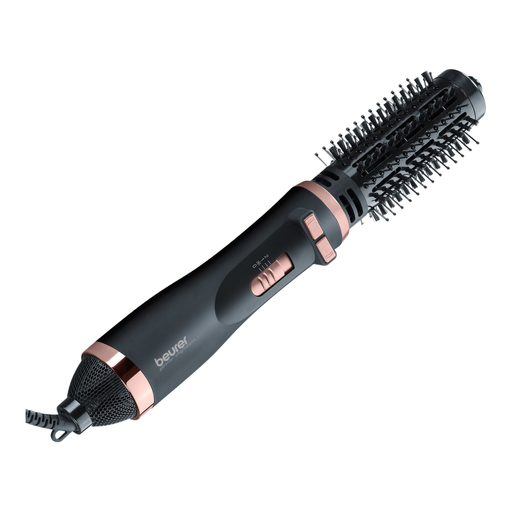
Why it suits this profile: This model focuses on the essentials: the warm air and brush let you style damp or dry hair. That makes it a straightforward choice for anyone using a hot air brush for the first time.
The product information explains how to use it step by step and clearly states that hot surfaces become hot. No unnecessary styling functions have been added.
Hot-air function for damp or dry hair; suitable for creating volume and a range of styles.
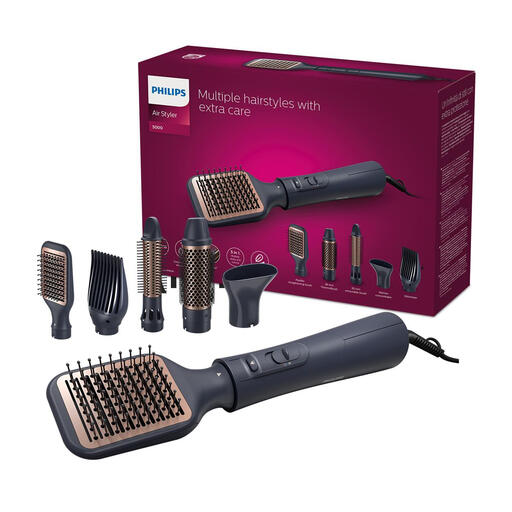
Why it suits this profile: If you regularly switch between smooth hair, volume and waves, five attachments give you more styling options in a single device.
The functions are linked to specific accessories. This means you can check in advance whether the set matches your preferred styling, rather than relying solely on a marketing name.
1000 W power; five attachments; three heat settings and a cool shot; Care setting according to the product description.

Why it suits this profile: This model is designed for users who want to combine several techniques: drying, curling, adding volume and smoothing, particularly on medium-length to long hair.
The set clearly states which four attachments are included and offers two heat and speed settings, plus a cool shot.
800 W; two rotation directions; 30 mm curling tong and 40 mm rotating brush; storage case and swivel cord.
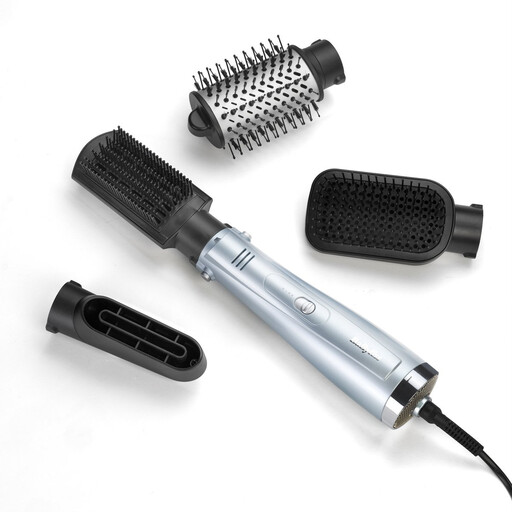
Why it suits this profile: The four attachments make this model appealing if you want to dry, smooth, create volume and experiment with different shapes.
The ceramic heating, minimum temperature of 70 °C and separate cool shot are listed as product specifications. This allows you to adapt the controls to your routine.
1000 W; four attachments; ceramic heating; ionic technology and cool shot according to the product information.
We have put together a complete, up-to-date list of products that fully meet these strict selection criteria and the applicable European safety regulations.
Never use a hot air brush near water. Check the cord regularly and do not use the device if the plug, cable or casing is damaged. You can clean a removable filter according to the instructions to remove accumulated dust and hair.
Most models are designed for towel-dried or dry hair, not soaking-wet hair. Always check the instructions for use. A drying nozzle can help remove excess moisture first.
It can be, particularly if the device has a small round brush or curling attachment. A larger diameter is often more practical for loose waves. Work with small sections and allow the hair to cool briefly before releasing it.
Consumption depends on the power rating and how long you use the device. A 1000 W model running for half an hour theoretically uses around 0.5 kWh. In practice, consumption may be lower if you do not work continuously on the highest setting. So consider both the wattage and the time needed for styling.
