What should you look for when choosing?
First, map out the connection between your home and garden office. Then work out how many cluster ports you need, what network management is required and whether you need PoE power.
| What to consider |
What should you check? |
Who is this important for? |
| Ports and uplink |
Count the connections for your servers and NAS, the uplink to your home and any extra capacity you want for future expansion. Check whether copper or SFP+ is suitable at both ends. |
If I’m connecting several cluster devices, I want to know whether enough suitable ports will remain for the connection to my home. Around 29% of consumers prioritise port layout and uplink. |
| VLANs and management |
Check VLAN support on the exact model and decide how it will connect to the rest of your network. |
If you want to logically separate lab devices from other network devices, you’ll need management features that suit your preferred VLAN configuration. For around 23% of consumers, VLAN management is the top priority. |
| Connection between buildings |
Plan the cable route and connections at both ends. Check whether the cable will run through a duct or be buried directly. |
If I still need to install the connection between my home and garden office, I first want to know which cable type and connections are suitable for the route. Around 18% of consumers prioritise the connection between buildings. |
| PoE for peripheral devices |
Compare each device’s PoE requirements with the appropriate port standard, power per port and total power budget. |
If you want to power a suitable access point or camera over the network cable, check that both the standard and available power are sufficient. Around 18% of consumers say power over network ports is their top priority. |
| Noise, heat and power consumption |
Check the cooling design and the conditions attached to any stated power figures. Also check the permitted temperature and humidity for the exact model. |
If the switch is going near my workspace, I want to take fan noise and conditions in the garden office into account. For around 12% of consumers, noise and power consumption come first. |
Joybuy product selection
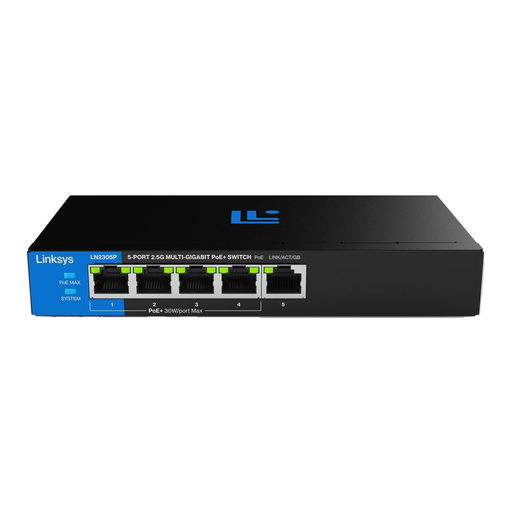
This selection features an unmanaged 2.5GbE switch for a simple homelab setup. Check whether five ports are enough and whether you can manage without VLANs or an SFP+ uplink.
 No image available
Linksys 2.5 GB PoE unmanaged switch, 5-port
Suitable for a simple cluster setup without VLAN management, if five connections are enough.
The product description lists five 2.5GbE ports, four of which support PoE+, and a total PoE budget of 60 W. This is an unmanaged model, so check the total power requirements of your connected devices.
View at Joybuy
Frequently asked questions
Does the switch itself need to be installed outdoors?
Not just because it’s connected to a garden office: compare the specified operating temperature and non-condensing humidity with the conditions where you plan to put the switch. Installing the cable between buildings is a separate consideration; Belden points out that cable rated for outdoor use isn’t automatically suitable for direct burial.
Can I use an SFP+ port for fibre without checking anything else?
No. Check that the modules, fibre type, connectors and equipment at both ends are compatible. An SFP+ port gives you a connection option, but doesn’t by itself confirm that your chosen components will work together. Fibre doesn’t carry PoE power.
How do I maintain a managed switch?
Keep a record of your VLAN and port settings, and follow the documentation for your exact model and hardware version when applying updates. QNAP lists firmware management for the QSW-M2108-2S; MikroTik describes RouterOS software for specific models.
Does a two-year manufacturer’s warranty mean my rights end afterwards?
No. ACM ConsuWijzer distinguishes between a manufacturer’s or seller’s warranty and your statutory consumer rights. What you can reasonably expect from a product after the warranty expires depends on the product and how it’s used. The seller is your point of contact if a product is faulty.
What product rules apply to selling an electrical switch in the Netherlands?
According to Ondernemersplein, electrical or electronic equipment placed on the market must comply with the applicable European rules. The manufacturer is responsible for the required CE marking and EU Declaration of Conformity. The Netherlands Enterprise Agency explains that CE is a conformity mark, not an independent safety guarantee. Check the specific version being offered, not just a model with the same name.


