
Writer with sources alongside their proposal
You often switch between your draft and reference documents, and want to see how much screen space will fit on your desk.


If you usually write in a single document and have a compact desk, an adjustable monitor of around 24 inches could be a good fit. If you want to view a proposal and your sources side by side, consider a 27-inch QHD screen. Only pay extra for a USB-C hub or 4K if your laptop supports the required features and you’ll use those connections or resolution. Also check that you can position the monitor comfortably in your workspace.
You often switch between your draft and reference documents, and want to see how much screen space will fit on your desk.
You spend long stretches reading and editing, and want text that’s comfortable to read on a screen you can position to suit you.
You regularly connect your laptop and want to check whether a single cable can provide video, connect peripherals and supply enough power to charge it.
Choose this if: you mainly write in a single document and have limited desk space. Dell Netherlands specifies that the P2425 has a 24.07-inch screen with 1920 × 1200 pixels and a 16:10 aspect ratio.
The trade-off: it offers less horizontal space than the 27-inch QHD models reviewed. The P2425’s USB-C downstream port is for data and delivers up to 15 W.
Choose this if: you often want to place documents side by side and have enough room on your desk. According to Dell Netherlands and BenQ Netherlands, the Dell P2725DE and BenQ GW2790QT reviewed here both have 2560 × 1440 pixels.
The trade-off: check your desk depth and whether the charging power suits your laptop. Dell specifies 90 W Power Delivery for the P2725DE, while BenQ specifies 65 W for the GW2790QT.
Choose this if: you assess detailed material as well as text, and your laptop supports the desired resolution through the connection you plan to use. LG Netherlands specifies 3840 × 2160 pixels for the 27UP850K-W.
The trade-off: 4K isn’t essential for a project proposal. Make sure text remains comfortable to read at your preferred size.
| Point to consider | What to look for when buying | Which consumers should pay particular attention? |
|---|---|---|
| Room for proposals and sources | Measure the available space and compare the aspect ratio and resolution. Dell Netherlands specifies 1920 × 1200 pixels for the P2425 and 2560 × 1440 for the P2725DE; BenQ Netherlands specifies 2560 × 1440 for the GW2790QT. | If I want to see my proposal and references at the same time, I need enough horizontal space without losing sight of how much room I have on my desk. Around 33% of consumers say comparing documents is their main buying priority. |
| Readability and posture | Assess the text size at your usual viewing distance, any reflections, and the height and tilt adjustment on the exact model. | During long writing sessions, I want to read text easily and position the screen comfortably in front of me. Around 27% of consumers give readability and posture top priority. |
| Connecting and charging a laptop | Check whether your laptop supports video over USB-C, how much charging power it needs and which features the specific monitor port offers. | If I regularly connect my laptop, I want to know whether the connection provides the features I need. Around 20% of consumers say connecting a laptop is their main buying priority. |
| Suitability for a small desk | Measure the space available for the screen and stand, and consider which resolution and connections you actually need. | On a small desk, I don’t want to choose screen space or features that don’t suit my writing needs. Around 20% of consumers prioritise limited space and avoiding extra features they won’t use. |
USB-C features vary between models. For example, the USB-C downstream port on the Dell P2425 is a data port with a maximum output of 15 W. It’s not the same as a port that provides video and power to a laptop.
Before buying, compare the port features on your exact laptop and monitor. If the connections don’t match, allow for a separate video cable or a suitable hub.
The 24-inch 16:10, 27-inch QHD and 27-inch 4K models reviewed here combine different screen sizes and resolutions. 4K isn’t automatically necessary for working with text.
Think about which documents you want to view at the same time, and check that the text remains comfortable to read at your preferred size.
Arboportaal also highlights screen position, reflections, lighting, and varying your work and posture when using a screen. A monitor alone won’t prevent discomfort.
Check that the stand suits your desk and sitting position, and make sure the rest of your workspace is set up appropriately too.
ACM ConsuWijzer distinguishes between a stated manufacturer’s warranty and your statutory rights when a product doesn’t meet the standard you’re entitled to expect.
Keep your proof of purchase and contact the retailer if you think your product may be faulty.
The P2425 reviewed here offers a compact 16:10 option for documents, while the P2725DE is a 27-inch QHD model with a USB-C hub.
The GW2790QT reviewed here is a 27-inch QHD monitor for those looking for adjustability and a USB-C laptop connection.
The 27UP850K-W reviewed here is a 27-inch 4K alternative with a height-adjustable stand.
The 27E1N5600HE/00 reviewed here is a QHD option for anyone considering a built-in webcam as well as a monitor for writing.
This selection includes 27-inch 4K monitors, a 27-inch QHD monitor and a compact 24-inch Full HD monitor for writing and working with documents at home.
 Image unavailable
A 27-inch 4K option for those who want a higher resolution for documents and detailed work; 4K isn’t essential for text alone.
3840 × 2160 pixels; IPS; 60 Hz; 4 ms; HDMI and DisplayPort; height-adjustable stand.
 Image unavailable
A 27-inch QHD option for viewing a proposal and sources on a larger screen; check that it will fit on your desk before you buy.
2560 × 1440 pixels; 130 mm height adjustment; tilt, swivel and pivot adjustment.
 Image unavailable
A 27-inch 4K screen for those who want to combine document work at a higher resolution with a USB-C connection. Check that your laptop supports the video mode and charging power.
3840 × 2160 pixels; USB-C with DisplayPort Alt Mode and up to 98 W Power Delivery; height, tilt and swivel adjustment.
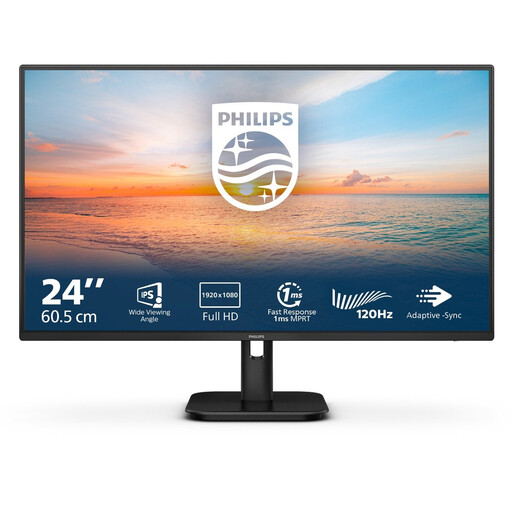 Image unavailable
A more compact option for everyday document work when you have less desk space.
24 inches; 1920 × 1080 pixels; IPS; 100 Hz; built-in speakers; VESA mounting.
 Image unavailable
A 27-inch 4K option for those looking for a large workspace for documents and considering USB-C laptop charging; check that 65 W is suitable for your laptop.
3840 × 2160 pixels; USB-C with 65 W Power Delivery; height and tilt adjustment; built-in speakers.
Place the screen directly in front of you, with the top just below eye level. Arboportaal recommends tilting the screen so you’re looking straight at it. Remember to vary your posture too.
No. Also check whether your laptop supports video over USB-C and how much charging power it needs. BenQ specifies DisplayPort Alt Mode and 65 W Power Delivery for the GW2790QT; Dell specifies 90 W for the P2725DE. The USB-C downstream port on the Dell P2425 is for data only and delivers up to 15 W.
The Dutch government explains that employers assess what equipment each employee needs to work from home safely and effectively. This doesn’t mean that everyone is entitled to a particular monitor model. Discuss your setup and any possible reimbursement with your employer.
Arboportaal says that for employees who do screen-based work for more than two hours a day, the screen and keyboard must not be attached to each other. When working on a laptop, it must therefore be possible to use a separate screen or keyboard. This is a conditional workplace rule, not a general requirement for everyone buying a monitor for personal use.
According to the Dutch government, online consumer purchases often come with a 14-day cooling-off period. This is separate from your statutory guarantee: ACM ConsuWijzer explains that in the Netherlands there’s no fixed statutory period, and it depends on what you could reasonably expect from the product under normal use. The retailer is responsible if the product doesn’t meet those expectations.