
Cluster builder with a NAS
You want enough fast wired connections for cluster nodes and storage, with room for the uplink. TP-Link and Zyxel describe port options suited to this setup.


Choose based on the number of wired devices, their connections and how they connect to your NAS or router. An unmanaged 2.5GbE switch is a good fit for a simple cluster; choose a managed model if you want to set up VLANs. Also check whether you need 10G SFP+ ports, PoE or a fanless design on the exact model: listed features don’t measure the performance or noise levels you’ll experience in your workspace.
You want enough fast wired connections for cluster nodes and storage, with room for the uplink. TP-Link and Zyxel describe port options suited to this setup.
You want to separate lab traffic using configurable switch features and are happy to put in some extra time to set them up. TP-Link and MikroTik describe models with management features.
You may want to place the switch close to your desk, so you’ll want to consider its fan design as well as the number of connections you need. Zyxel and Linksys offer fanless models.
First, count your devices and the connection to your router or existing network. Then decide whether you need VLAN management, PoE or a dedicated 10G uplink.
The percentages represent consumers choosing one top purchase priority for this home lab scenario.
| What to consider | What should you check? | Who should pay particular attention? |
|---|---|---|
| Ports and speed | Count your nodes, NAS and uplink; compare their connections with the RJ45 ports and any SFP+ ports. | If I want to connect several devices and storage over Ethernet, I need to know how many ports will be left after the uplink and which speeds my devices support. Around 36% of consumers prioritise ports and speed. |
| VLANs and management | Check whether the exact model supports VLANs and which other network devices need to support your configuration. | If I want to separate lab traffic on the switch, I need management features and should allow time for setup. Around 29% of consumers put management first. |
| Noise at your desk | Check whether the exact model is fanless and consider where you’ll place the switch and power supply. | If my switch is right next to my workspace, I’ll factor its listed fan design into my choice. Around 21% of consumers prioritise a quiet workspace. |
| PoE for additional devices | Compare the PoE standard and power per port with your devices’ requirements; check the total power budget too. | If I want to power compatible access points or other network devices over Ethernet, I’ll check PoE compatibility and the available power. Around 14% of consumers consider PoE their top priority. |
The connection to your router or another switch will usually use one of the ports.
Map out your current connections and planned expansion before choosing the number of ports.
If you need more connections later, you may need to add another switch or replace it with a model that has more ports.
An unmanaged model doesn’t offer switch management for VLAN configuration.
Before you buy, decide whether you need to set up VLANs on this switch.
You may need to change models later if you find you need management features after all.
SFP+ slots and RJ45 ports are different connection types; check what your server or other switch uses.
Before you buy, check which compatible connection and any modules or cables you’ll need at both ends.
You may need to buy additional equipment to make the connection.
Zyxel doesn’t list PoE for the XMG1915-10E, while other models in the range do have PoE specifications.
Compare the full model number and check the power per port and total power budget.
A model without PoE won’t be able to power the intended device through the switch.
These brands and product ranges provide a starting point for comparing features and models; their inclusion doesn’t indicate that a specific model is available.
The product ranges include both unmanaged and managed 2.5GbE models, including versions with PoE+ and SFP+ slots.
The XMG1915 range includes smart-managed models for anyone looking for 2.5GbE connections and SFP+ links.
According to MikroTik, the CRS310-8G+2S+IN combines 2.5GbE ports with 10G SFP+ ports and RouterOS management.
The MS305 is a compact, unmanaged option if five multi-gigabit ports are enough.
The LN2308 is an unmanaged 2.5GbE switch with eight ports.
This selection focuses on a straightforward, unmanaged 2.5GbE connection; the Linksys model shown also offers PoE+ for compatible devices.
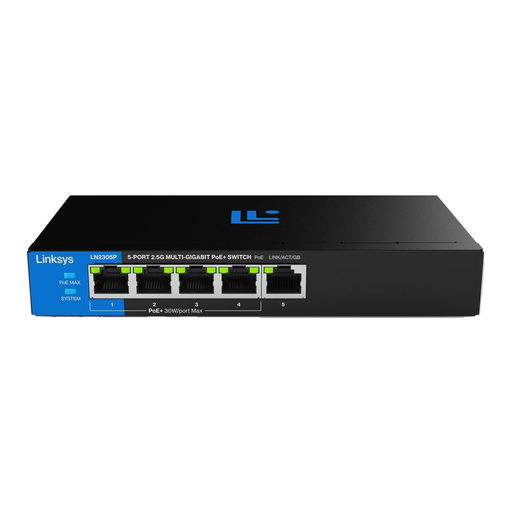 Image unavailable
For a straightforward wired cluster that doesn’t need VLAN settings on the switch.
All five RJ45 ports support 2.5GbE; four support PoE+ and the total PoE budget is 60 W. The uplink also uses a port, leaving a maximum of four ports for devices once connected.
The product description mentions a fanless metal casing. Check that the PoE budget is sufficient for the devices you want to connect.
Connect the switch to your router or existing network infrastructure, then connect your other wired devices. Include the connection to the rest of your network when working out how many ports you need. You’ll also need to configure a managed switch to use the features you want.
No. The Zyxel and MikroTik models mentioned list 2.5GbE RJ45 ports separately from 10G SFP+ ports. Before you buy, check the connections and any additional equipment you’ll need at both ends.
Only if you want to power compatible devices through their network cables. Check the PoE standard, power per port and total power budget. TP-Link specifies eight PoE+ ports and a total power budget of 160 W for the SG2210XMP-M2.
No. Check the full model number and the specifications for the exact model. For example, Zyxel doesn’t list PoE for the XMG1915-10E, while other models in the same range do have PoE specifications.
Check which product regulations apply to the device being offered and whether the information covers that specific model. The Dutch government lists CE marking as a requirement for electronic devices; the European Commission also describes electromagnetic compatibility requirements for equipment covered by those rules. A brand name alone doesn’t confirm that an individual product on offer complies with the applicable regulations.