
Vandaag of morgen in huis

Kwaliteit gegarandeerd

Welkomstaanbiedingen ontgrendelen: GRATIS bezorging | Tot 80% korting | Gratis 30 dagen JoyPlus-proefperiode
Download de app
A home gym sounds simple until a treadmill sits unused in the corner, a weight bench wobbles or a set of dumbbells no longer suits your training level after a few weeks. When choosing home fitness equipment, it is not just the price or number of features that matters. Dimensions, weight capacity, adjustability and maintenance all determine whether you will continue using the equipment in the long term.
A piece of equipment with dozens of training programmes or app connections may seem appealing. However, these features are only useful if you actually use them. First, consider which exercises and types of training you need: strength training at home, walking, cycling or a combination.
For example, an adjustable dumbbell can replace several fixed weights. With home cardio equipment, it is particularly important that the speed, running area and storage options fit into your daily routine.
Terms such as “professional”, “quiet” or “extra stable” mean little without concrete specifications. Instead, look at:
According to information provided by the HadMax brand, the walking pad operates at a noise level of 45 dB. This is a product specification from the product description, not a guarantee that you will hear nothing in every home. Noise also depends on the floor, footwear and operating speed.
Do not just measure the place where the equipment will stand. Also allow for room to move, ceiling height, access to a socket and the route to a cupboard or storage area. A power tower can be versatile, but it requires more permanent space than a few pieces of fitness equipment.
For a foldable model, also check the weight. “Foldable” does not automatically mean that it is easy to move every day.
The maximum weight capacity must suit the user and the planned exercises. With a weight bench, you need to consider not only body weight but also the weight of dumbbells or a barbell. Check whether the manufacturer clearly distinguishes between user weight and total load.
A wide base, non-slip feet and a clearly visible locking mechanism are practical features. Always place home fitness equipment on a firm, level surface.
For beginners, a fixed set of 4 or 5 kg may be sufficient. If you want to gradually train with heavier weights, consider adjustable dumbbells. Pay attention to the adjustment mechanism: the weight must be fully locked before every repetition.
A fitness bench with flat, incline and decline positions supports more exercises than a flat-only model. However, check that the positions are easy to secure and that the bench does not move during exercise.
When measuring a treadmill or walking pad, measure the running surface, not just the external dimensions. A more compact surface may be sufficient for gentle walking; for jogging, greater length and width are generally more practical. Also check that the European mains voltage of 220–240 V is supported.
For metal equipment, regular cleaning, checking bolts and inspecting hinges are important. A treadmill or walking pad may also require belt checks and lubrication as described in the manual. Before buying, check whether the manual and customer service are easy to access.
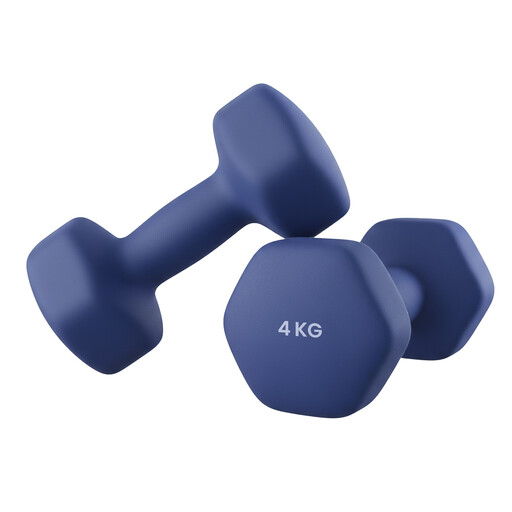
Why this suits the profile: This set of 2 x 4 kg is easy to use for basic exercises and takes up little storage space in a flat or home office.
According to the product description, the hexagonal shape stops the dumbbells from rolling away when put down. The fixed weight avoids a complicated adjustment mechanism.
Neoprene-coated handles, cast-iron core and a compact pair weighing 4 kg.
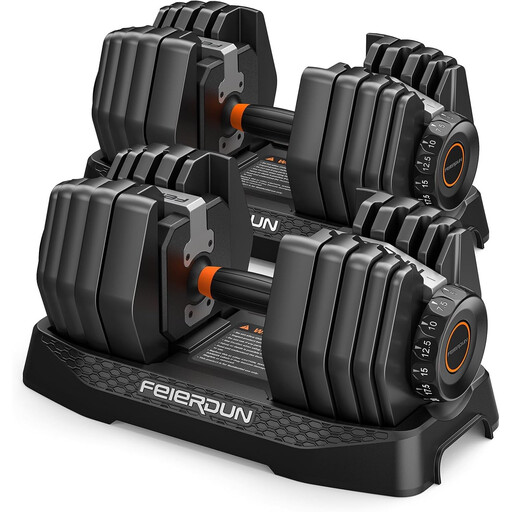
Why this suits the profile: If you are building a consistent home strength-training routine, one pair gives you several weight options for different exercises.
The product description states that a click mechanism allows you to select weights quickly. Before every set, check that the mechanism clicks audibly and is fully locked.
2 x 24 kg, cast iron, non-slip grip and compact storage according to the product information.

Why this suits the profile: Suitable for anyone who wants to walk regularly or jog lightly but has limited floor space available.
The product details mention transport wheels, a foldable handle and a size that can be stored under a bed or sofa. Measure this in advance.
Speed of 0.6–3.8 mph, a manual incline of 10%, LED display and maximum user weight of 300 lb according to the product description.

Why this suits the profile: The various positions are practical for users who want to perform dumbbell exercises, presses and other full-body exercises with a single fitness bench.
The flat, incline and decline positions are clearly specified. Always position the bench securely and check the locking mechanism before using weights.
Steel frame, three basic positions and a stated maximum load of 1500 lb.
We have put together a complete, up-to-date list of products that fully meet these strict selection criteria and the applicable European safety regulations.
Start with one product that suits your available space and training goals. For strength training, a pair of dumbbells and a fitness bench make a practical combination. For cardiovascular training, you can choose between an exercise bike, walking pad or treadmill. A power tower is particularly useful if you want to do pull-ups, dips and bodyweight exercises.
Measure the equipment’s external dimensions and add space for movement. With a fitness bench, you need room beside and above the bench. For a treadmill or walking pad, you also need to allow space for getting on and off safely. With foldable equipment, check the dimensions both when in use and when stored.
The running costs mainly consist of the purchase price, electricity and maintenance. An exercise bike and dumbbells use little or no electricity during training. A treadmill requires more power, depending on the motor, speed and workout duration. So do not compare just the price; also consider the warranty, spare parts, maintenance instructions and returns policy.
