
Vandaag of morgen in huis

Kwaliteit gegarandeerd

Welkomstaanbiedingen ontgrendelen: GRATIS bezorging | Tot 80% korting | Gratis 30 dagen JoyPlus-proefperiode
Download de app
Buying fitness equipment for your home seems straightforward, until you discover how much products can differ in resistance, dimensions, noise levels and ease of storage. A machine that looks compact in photos can still take up a lot of space in a small living room. Claims about quiet operation or a full-body workout can also hide important details.
So focus on product specifications you can check. That way, you’re less likely to buy a machine that ends up unused in the shed after a few weeks.
More resistance levels don’t automatically mean a machine is better suited to you. What matters more is whether the resistance can be adjusted to suit your fitness level and whether the movement stays smooth. Beginners often need different settings from people who train several times a week.
For a rowing machine, the rail system, seat and maximum user height are also relevant. With a cross trainer, stride length and pedal stability matter too.
Magnetic resistance generally makes less mechanical noise than systems that rely on direct friction, but the machine won’t be completely silent. Footsteps, the rails moving and vibrations on a hard floor can also be audible.
Check whether the manufacturer specifies a noise level, and look at the type of resistance. A quiet cross trainer can be a good choice for flats or early-morning workouts, but it’s still important to place it on a level surface.
A foldable rowing machine or cross trainer takes up less floor space when folded, but you’ll still need to consider its weight, height and transport wheels. Measure the space where you plan to use it, as well as where you intend to store it after your workout.
Also consider assembly. A compact machine that’s difficult to put together may be less practical than a slightly larger model that arrives mostly assembled.
For rowing and cross training, magnetic resistance and a clearly stated number of adjustable levels are practical features. A magnetic rowing machine generally uses a flywheel or magnet system, with the intensity adjusted manually. The product information should clearly state how many levels are available.
A rowing machine supports a full-body workout at home, bringing your legs, core and arms into action. A cross trainer is a good option if you’re looking for a continuous elliptical movement. If you’re mainly interested in controlled exercises for your core, arms and legs, consider a Pilates reformer board or a Pilates board with resistance bands.
At a minimum, check:
The maximum weight capacity isn’t a limit you should exceed. Use the machine on a flat, stable surface and follow the manufacturer’s assembly and safety instructions.
A comfortable seat, non-slip pedals and a stable frame make regular use easier. Check whether the display shows the information you need, such as time, distance, speed or stroke count.
For maintenance, wiping the machine with a soft cloth and regularly checking the bolts and connections is often enough. Keep magnetic systems dry and store foldable equipment indoors.
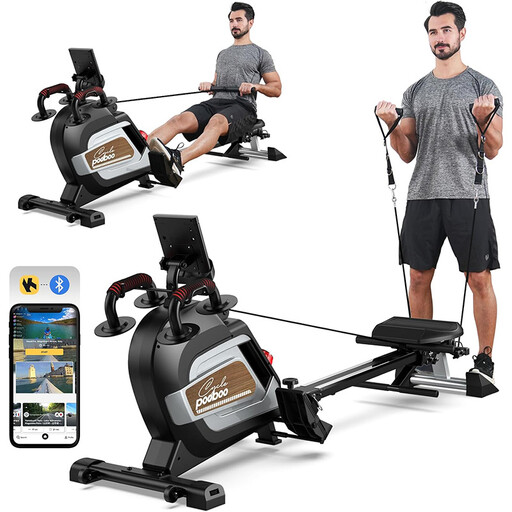
Why it suits this profile: This rowing machine has 14 adjustable resistance levels and a foldable design. It’s a good fit if you want to ease into working out at home and put the machine away after use.
The resistance isn’t limited to a single fixed intensity. The dimensions, weight of 62 lb and maximum weight capacity of 360 lb are listed in the product specifications.
Magnetic resistance, LCD monitor, tablet holder, comfortable seat and foldable frame.
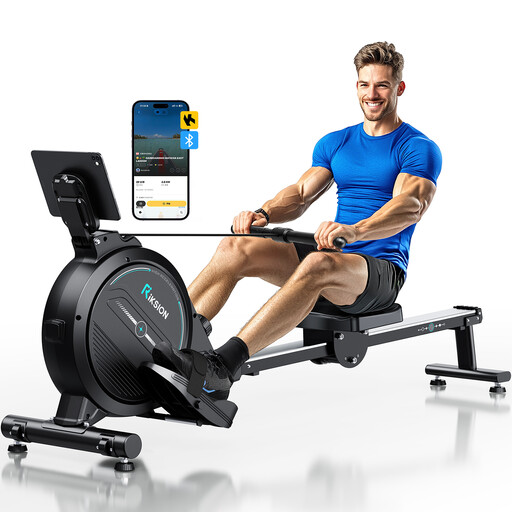
Why it suits this profile: This model combines 16 resistance levels with vertical storage and transport wheels. The stated user height range is 145 to 195 cm.
The storage method and maximum user weight of 160 kg are clearly specified. According to the product information, the machine arrives 70% assembled.
16 resistance levels, LED display, smooth rails, vertical storage and a weight capacity of 160 kg.
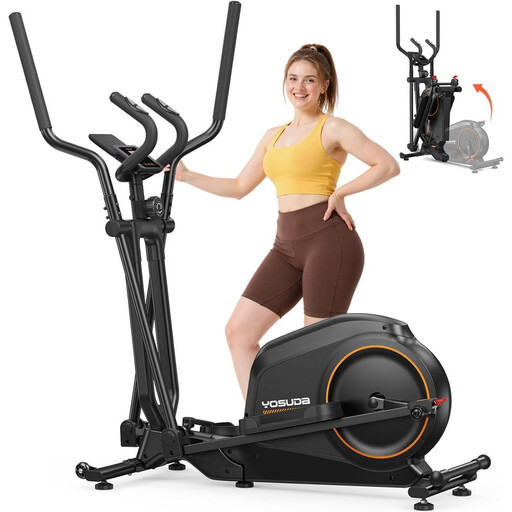
Why it suits this profile: This foldable cross trainer has transport wheels and a stated folded footprint of around 0.2 m². That’s handy if you work out in a flat.
The manufacturer states a noise level below 20 decibels. This is a product claim, not a guarantee that the machine will be completely silent in every home.
16 resistance levels, large non-slip pedals, LCD display, 38 cm stride length and three-step folding.
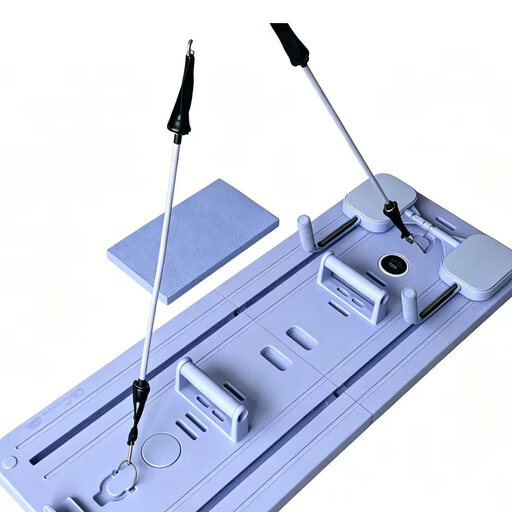
Why it suits this profile: This Pilates board is 42 inches long and 16 inches wide, and combines a board with resistance bands. It’s suited to people looking for variety without bringing a large cardio machine into their home.
The dimensions and adjustable resistance system are listed. Before you buy, check that you have enough clear floor space for the exercises and bands.
Foldable design, adjustable resistance, resistance bands, tablet holder and timer, according to the product information.
We’ve put together a complete, up-to-date list of products that meet these strict selection criteria and current European safety regulations.
Choose a machine with clearly stated storage dimensions, transport wheels or vertical storage. A foldable cross trainer or rowing machine can be practical, but always measure the space it takes up when folded. A Pilates board generally takes up less permanent space than a large cardio machine.
Most mechanical fitness machines don’t use much electricity. Displays often run on batteries. Check the power source for each product, and factor in assembly, a protective mat if needed, and periodic maintenance. With magnetic systems, correct use and checking the connections are particularly important.
Its lifespan depends on how often it’s used, the user’s weight, maintenance and storage. Regularly check bolts, rails, pedals and bands. Wipe the frame with a soft cloth, and don’t use the machine if any parts are loose or damaged.
