
Vandaag of morgen in huis

Kwaliteit gegarandeerd

Welkomstaanbiedingen ontgrendelen: GRATIS bezorging | Tot 80% korting | Gratis 30 dagen JoyPlus-proefperiode
Download de app
Working out at home sounds simple, until your equipment does not fit in practice. A treadmill may be too noisy, a workout bench may feel unstable and a yoga and fitness mat may shift during exercises. If you focus only on discounts, motor power or an impressive number of training programmes, you risk spending money on equipment that ends up barely being used.
This guide helps you compare home fitness equipment based on dimensions, stability, ease of use and maintenance. That way, you can find home workout equipment that suits your space and the way you like to exercise.
Higher motor power, more programmes or a high maximum load may sound appealing. However, figures like these do not tell the whole story. Also check the running surface, adjustability, noise level and the equipment’s dimensions when folded.
The same applies to strength training at home. A fixed-weight dumbbell set is not automatically suitable for every exercise. Consider the grip, the shape of the weights and how you can put them down safely.
Equipment that looks compact in a product photo may still take up a lot of room in a Dutch bedroom or home office. So measure not only the space where the equipment will stand, but also the area around it. Sufficient clear space is important when using a fitness trampoline or treadmill at home.
For yoga, Pilates and stretching, a mat measuring 183 × 61 cm is a common size. Thickness affects balance and cushioning. A thicker mat is not more comfortable for every exercise; during balance exercises, a soft surface may actually feel less stable.
Before buying, check whether the components are accessible and whether the product comes with clear maintenance instructions. This may include inspecting elastic bungees, lubricating and aligning a treadmill, or checking the bolts on an adjustable workout bench.
Use equipment on a level surface, do not exceed the stated maximum load and follow the manufacturer’s instructions. Product claims about joint comfort or training results are not a guarantee for every user. According to information provided by the brands themselves, certain designs may help provide cushioning or a quieter workout; individual experiences may vary.
Measure the space in three situations: during use, when folded and when stored away. A compact piece of fitness equipment with transport wheels may be more practical than a larger model with more features that has to remain permanently in the room.
A yoga or fitness mat with a carrying strap is useful if you switch between home, the studio and outdoors. Also consider the weight. A mat weighing around 0.7 kg is easier to carry than a heavy model with similar dimensions.
A stable frame, non-slip material and securely fastened adjustment points are more important than a long list of extra features. With dumbbells, hexagonal ends help prevent them from rolling away. With a workout bench, check that the backrest locks securely in every position.
Treat the maximum load as a technical limit, not a training target. Take your body weight, dumbbells and any additional load into account. Also check whether the stated value refers to the total weight or the user alone.
For cardio equipment, noise is an important practical consideration, especially in flats or when exercising while working from home. With a walking pad, the running surface, shock absorbers and speed are all important. With a fitness trampoline, look at the suspension, handle and the clear space around the frame.
According to the product description, a 6 mm TPE mat may offer a combination of cushioning and contact with the floor. The surface must still be flat and clean. No non-slip texture can replace correct posture or sufficient space.
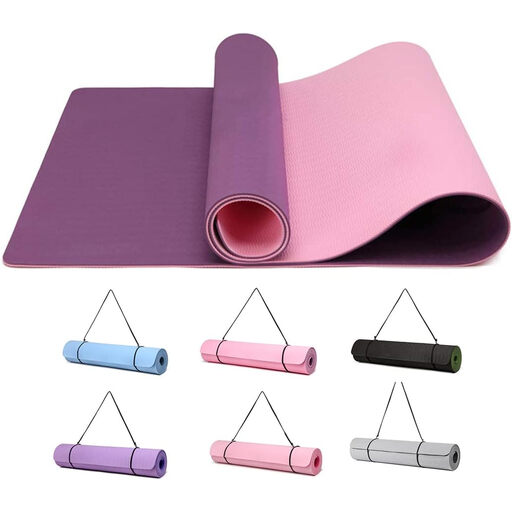
Why it suits this profile: This lightweight mat is suitable for yoga, Pilates, stretching and general home fitness without having to buy a large piece of equipment.
The dimensions, 6 mm thickness and carrying strap are clearly stated. The double texture is designed to provide grip on both sides; however, place the mat on a clean, level floor.
TPE material, 183 × 61 cm, approximately 0.7 kg and suitable for a range of gentle and dynamic exercises.

Why it suits this profile: An option for anyone who wants to walk regularly in a home office, flat or small training space.
The product specifications list a running surface of approximately 90 × 40 cm, a folding handle and transport wheels. Measure beforehand to make sure this size suits your stride length and available space.
Speed range of 0.6–3.8 mph, 10% manual incline, LED display and 12 programmes according to the product information.

Why it suits this profile: This adjustable bench is designed for users who want to perform strength exercises at home in a range of positions.
The bench offers flat, incline and decline positions. After assembly, check all locking mechanisms and treat the stated maximum load as an absolute limit.
Steel frame, multiple backrest positions and dimensions of approximately 148 × 61 × 117 cm according to the product specifications.

Why it suits this profile: A simple pair of dumbbells for arm, shoulder and general strength training without a large piece of equipment.
The neoprene layer and hexagonal shape are clearly described. According to the product information, the weight may vary by approximately 3%; bear this in mind when performing one-sided exercises.
Cast-iron core, neoprene coating and two fixed 5 kg weights; suitable for exercises using both hands.
We have put together a complete, up-to-date list of products that fully meet these strict selection criteria and the applicable European safety regulations.
Start with equipment that supports a range of exercises. A yoga and fitness mat is suitable for mobility work, stretching and bodyweight exercises. Add dumbbells when you want to build up your strength training. Cardio equipment such as a walking pad or fitness trampoline is particularly useful if you can use it regularly and have enough space.
Measure the equipment in full, including the handles and the clear space at the front and rear. Also check whether you can fold it up and move it. A compact model takes up less room, but the running surface must still suit your stride length and pace.
Its lifespan depends on the material, frequency of use, load and maintenance. Clean a mat with a damp cloth, check the bungees on a trampoline, and regularly inspect the belt, cable and lubrication on a walking pad. Store equipment in a dry place and always follow the manufacturer’s maintenance instructions.
