
Vandaag of morgen in huis

Kwaliteit gegarandeerd

Welkomstaanbiedingen ontgrendelen: GRATIS bezorging | Tot 80% korting | Gratis 30 dagen JoyPlus-proefperiode
Download de app
Working out at home sounds simple, until a piece of equipment turns out to be too large, wobbles during use or ends up serving mainly as a clothes horse after a few weeks. If you are looking for home fitness equipment, price and the number of workout programmes are not the only things to consider. The space available, your training goals and the construction all determine whether your purchase remains practical.
A high weight capacity may sound reassuring, but it does not tell you everything about stability. Also check the frame, footrests, adjustable parts and the surface on which the equipment will stand. A power tower or dip station, for example, should be placed on a level floor and properly secured in accordance with the assembly instructions.
Also pay attention to the difference between the user's body weight and the total weight during an exercise. Movements during strength training at home can create additional loads.
A folding treadmill or walking pad takes up little space when stored away. During use, however, you need enough clearance around the equipment. So measure not only the storage area, but also the walking space, ceiling height and distance from furniture.
With a pull-up bar for home use, you should also check whether the door frame is suitable. A door-mounted model that requires no drilling can be convenient for rented homes, but the construction must rest correctly on the frame and must not be used if the installation is unstable.
Terms such as “ultra-quiet”, “gym level” and “joint protection” often come from product marketing. According to a brand's or supplier's own research, such claims have not necessarily been independently verified. It is better to look at measurable details such as noise level, motor power, adjustment range, running surface and materials.
For flats, vibration and structure-borne noise are at least as important as the stated decibel level. A sturdy fitness mat and a level floor can help, but they cannot fully resolve unsuitable positioning.
Before buying, make a note of:
Space-saving fitness equipment is particularly useful if you can move it without too much effort. A cross trainer for home use with transport wheels may, for example, be more practical than a lighter model without a good grip.
For strength training at home, a sturdy frame and parts that lock securely are important. With an adjustable fitness bench, check how many positions are available and whether the backrest can be set flat, at an incline and, if applicable, at a decline. Also look at the maximum load and the assembly space required.
With a pull-up bar or dip station, the handles, footrests, rubber feet and fixing points are all relevant. A product that supports multiple exercises is not automatically suitable for every user: the height and range of movement must suit your body and room.
For home cardio equipment, motor power, maximum speed and running surface are practical selection criteria. A walking pad with a narrow running surface may be suitable for gentle walking, but may feel less spacious when walking faster.
Also check the maintenance requirements. A treadmill or walking pad needs a clean belt, correct alignment, suitable tension and lubrication in accordance with the manual. Keep the power cable free from kinks and stop using the equipment for inspection if you notice unusual noises.
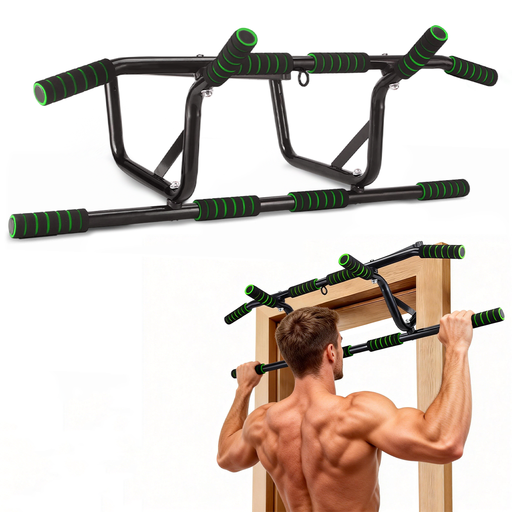
Why it suits this profile: This door-mounted model is aimed at users who want to start upper-body training with limited space. Its drill-free installation may be particularly useful in a rented home.
The product listing states a weight capacity of up to 200 kg and ergonomic, non-slip handles. Before use, however, check that your door frame is suitable and follow the instructions provided.
Drill-free installation according to the product description, several grip positions and resistance bands included.

Why it suits this profile: A practical choice for home workers and flat-dwellers who want to walk during or alongside the working day. The foldable handlebar and transport wheels make storage easier.
The specifications state a running surface of 35,4 × 15,7 inches, a speed of 0,6–3,8 mph and a handlebar with two height settings. Check in advance that these dimensions suit your workspace.
3,0 hp brushless motor according to the product information, 10% manual incline, twelve programmes and a stated 24-month warranty.

Why it suits this profile: This bench is suitable for anyone who wants one foundation for dumbbell training, presses and full-body exercises. Its adjustability allows for a range of training angles.
The product details list flat, incline and decline positions, as well as an alloy steel frame. The bench must be adjusted and stabilised correctly before every exercise.
Three training positions, steel frame and a maximum load of 1500 pound stated by the supplier.
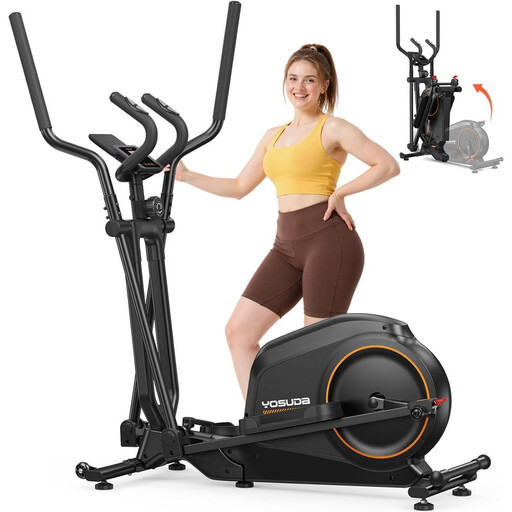
Why it suits this profile: This home cross trainer is designed for users who want to build a consistent cardio routine without having a large piece of equipment permanently on display.
The product description states that it has a foldable design, transport wheels and sixteen resistance levels. Check that the 38 cm stride length and stated user height range are suitable for you.
Sixteen resistance levels, LCD display, foldable construction and a noise level below 20 decibels stated by the supplier.
An alternative for anyone who mainly wants to combine bodyweight exercises is a dip station with a pull-up bar. The Sportsroyals Power Tower lists, among other features, six height settings, resistance bands from 10–40 kg and a maximum load of 204 kg. With this type of equipment, always check the floor, bolted connections and available headroom.
We have put together a complete, up-to-date list of products that fully meet these strict selection criteria and the applicable European safety regulations.
A walking pad, folding cross trainer, door-mounted pull-up bar or adjustable fitness bench takes up relatively little storage space. Always measure the dimensions when in use and consider noise, vibration and the surface on which it will stand.
Its lifespan depends on the materials, frequency of use, assembly and maintenance. Check bolts, cables, hinges and treadmill belt tension regularly. Use equipment within its stated weight capacity and follow the manufacturer's maintenance instructions.
In addition to the purchase price, your main costs are electricity and any replacement maintenance parts. Consumption depends on motor power, workout duration and frequency of use. With an elliptical trainer or walking pad, the stated power rating is a useful point of comparison, but actual consumption varies from one session to the next.
