
Vandaag of morgen in huis

Kwaliteit gegarandeerd

Welkomstaanbiedingen ontgrendelen: GRATIS bezorging | Tot 80% korting | Gratis 30 dagen JoyPlus-proefperiode
Download de app
An EV charger for home can make everyday use of an electric car or plug-in hybrid easier. However, choosing one is not simply a matter of selecting the highest number of kilowatts. A charger needs to suit your consumer unit, car, charging location and driving habits.
Many buyers run into the same pitfalls:
Use the checks below to compare an electric car charger based on practical features rather than marketing claims.
Charging power determines how quickly your car can charge at home, but the lowest limit is what matters: the charger, the electrical installation or the car’s onboard charger.
So first check the maximum AC charging capacity of your Tesla, Volkswagen, BMW, Hyundai, Kia or other Type 2 vehicle. A plug-in hybrid charger with 3.7 kW may already be sufficient in many situations, as a plug-in hybrid’s battery is smaller.
A Type 2 charging cable compliant with IEC 62196-2 is the standard connection for European electric cars and many plug-in hybrids. Check that the cable really has a Type 2 plug on the vehicle side and that its length suits your driveway or garage.
Also consider the following:
For a fixed home charging point, the installation should be assessed by a qualified installer. Consider the available grid capacity, residual-current protection, cable cross-section and circuit layout. A product with a high charging rating does not automatically make an unsuitable consumer unit suitable.
A charger with an adjustable charging current can be useful when you do not always want to charge at maximum power. Some models offer settings such as 8A, 10A, 13A, 16A, 20A, 25A and 32A. This allows you to match the charging power to the connection or time of use.
An EV charger with an app may offer functions such as:
However, check which app is used, whether Wi-Fi is required and whether the charger can also be operated without the app. With a model featuring dynamic load balancing, you should also check whether the required meter or installation components are included.
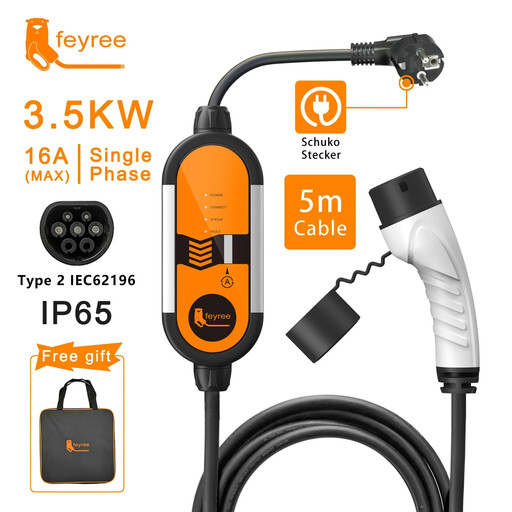
Why it suits this profile: This mobile EV charger uses a Schuko plug and is suitable for users who want to charge slowly at home or at a family member’s house without having a wallbox installed straight away.
The stated maximum output of 3.5 kW makes it clear that this is not an 11 kW or 22 kW solution. The charging current can be adjusted from 8A to 16A.
5-metre cable, OLED indicator, Type 2 compatibility and protection features according to the product description, including overcurrent and overheating protection.
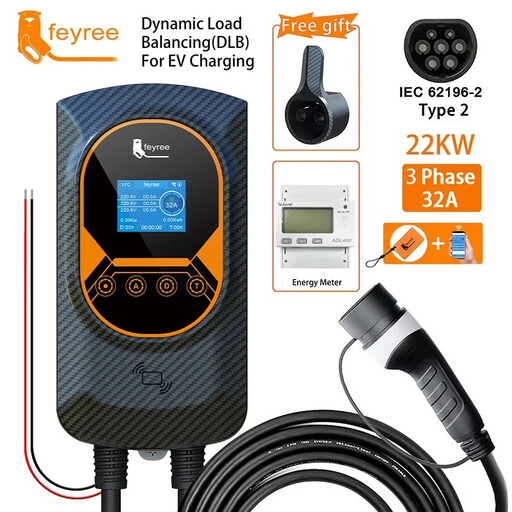
Why it suits this profile: Suitable for households considering a fixed wallbox for electric cars and placing a high value on monitoring, scheduling and power management.
The stated dynamic load balancing is intended to distribute the available power between the car and household appliances. Check in advance that the required installation components are available.
22 kW class, 3-phase connection, 5-metre Type 2 cable, Tuya app, LCD screen and adjustable current up to 32A according to the product information.
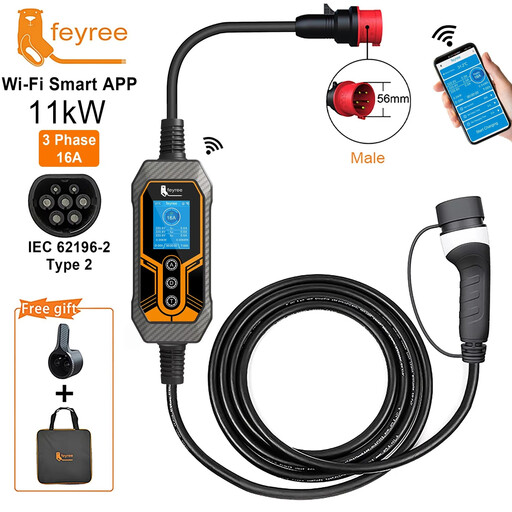
Why it suits this profile: A practical choice for anyone wanting to use a 3-phase EV charger both at home and at a suitable location with a CEE connection.
The charger explicitly states 11 kW, 16A and three phases. This makes the required connection clearer than with products that only claim a general charging speed.
5-metre cable, Wi-Fi and Bluetooth control, charging schedule, LCD screen and adjustable current from 8A to 16A according to the product description.
Position a home charging point so that the cable does not cross a walkway or pull on the plug when taut. For outdoor use, the charging unit’s protection rating and the connector’s seal are important. The IP65 or IP66 rating quoted for some models describes protection against dust and water under certain conditions; always follow the instructions for actual use.
Also consider the total charging costs. The car’s energy consumption does not change solely because of the charging power. However, you may benefit from a lower electricity tariff when you set a charging schedule, if your energy supplier offers different rates. An app function is useful here, but is not essential for every user.
We have compiled a complete, up-to-date list of products that fully meet these strict selection criteria and the applicable European safety regulations.
Not always. A 3-phase connection is required to use an 11 kW or 22 kW EV charger to its full capacity. For a 3.5 kW mobile charger or a 7 kW charging station, a single-phase connection may be sufficient. Have your consumer unit checked before ordering.
Its lifespan depends on how often it is used, how it is installed, moisture, temperature and how the cable is handled. Check the plug and cable regularly for cracks, discolouration, loose contacts or damage. Do not use a damaged charger and follow the manufacturer’s maintenance instructions.
The electricity consumption per kilowatt-hour charged is not automatically lower because of the type of charger. The main differences are the purchase price, installation and charging power. A mobile charger can be convenient without permanent installation, while a wallbox often provides a fixed parking solution and additional features such as charging schedules or load balancing.
