
Vandaag of morgen in huis

Kwaliteit gegarandeerd

Welkomstaanbiedingen ontgrendelen: GRATIS bezorging | Tot 80% korting | Gratis 30 dagen JoyPlus-proefperiode
Download de app
A home EV charger might seem straightforward at first glance: pick a power output, plug in your car and start charging. In reality, the electrical connection in your home, your car’s onboard charging technology and the way you want to charge all determine which wallbox is right for you. This applies to both fully electric cars and a charging station for a PHEV.
Making the wrong choice can lead to unnecessary installation costs, a charger that works slower than expected, or an app you barely use. So pay particular attention to these common pitfalls.
A 22 kW charger won’t automatically charge every car at 22 kW. The car itself partly determines how much AC power it can accept. Many models have an onboard charger that supports a maximum of, say, 7.4 kW or 11 kW. A plug-in hybrid may have an even lower charging capacity.
So check before you buy:
A three-phase EV charger can be appealing if your car supports 11 kW or more. However, your home needs to have a suitable three-phase connection for this. The available grid capacity, residual current protection, cable thickness and circuit breaker also play a role.
Have a qualified electrician assess your electrical installation. Connecting a charger to an existing circuit without checking can cause faults or safety risks. Also ask whether load balancing is needed. This feature distributes the available power when, for example, your heat pump, oven and charger are all running at the same time. Not every wallbox has this, so check the product specifications.
A smart charger with an app can be handy for starting, stopping, scheduling and viewing charging information. However, the exact features vary by model and app. Check whether the app is available for your smartphone, whether Wi-Fi coverage at the installation location is sufficient, and whether features like charging schedules and current adjustment are actually listed.
An RFID charging station can be practical when several drivers use the same charger. An RFID card or tag can control access to the charging function. This is not the same as a payment solution for public charging.
The choice depends on your car and electrical connection:
The charging power is no guarantee of a specific charging time. Battery capacity, state of charge, outside temperature and your car’s onboard charger all affect the result.
A fixed cable can be convenient if you always charge the same car. A longer cable, such as 7 metres, gives you more flexibility if your charging point isn’t right next to your car’s charging port. Do check that you can hang the cable neatly and that it doesn’t create a trip hazard.
With a socket model, you use a separate Type 2 cable. This offers flexibility if you own different cars, but it also means you need to buy the cable separately or remember to take it with you.
Check which protections are explicitly listed in the product information. Think about residual current detection, overcurrent protection, temperature monitoring and moisture protection. An IP rating indicates how well a housing is protected against dust and water; the installation location and correct mounting remain important.
With the feyree wallbox, the product description mentions IP66 water resistance and a built-in Type B AC 30 mA + DC 6 mA leakage protection. These are product specifications from the listing, not a general guarantee that every installation is suitable without additional checks. Ask your electrician to assess what protection is needed in your consumer unit.
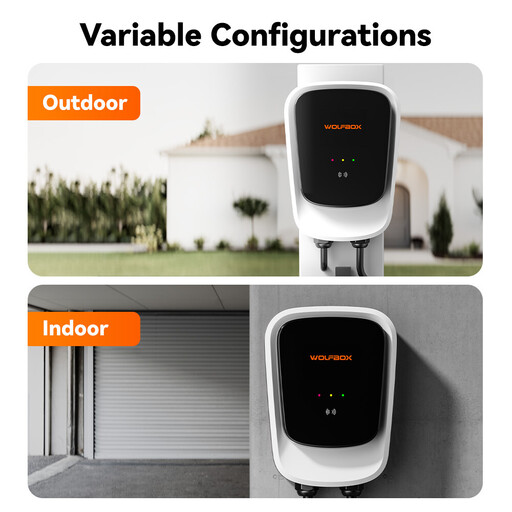
Why this fits the profile: A straightforward choice if you have a single-phase installation and mainly want to charge at home overnight. The combination of app control and RFID suits a household with multiple users.
The rated power, single-phase connection and Type 2 compatibility are clearly stated in the product name. Do check beforehand whether your consumer unit can support 32A.
7 kW, 32A and single-phase; control via app and RFID card according to the product listing.
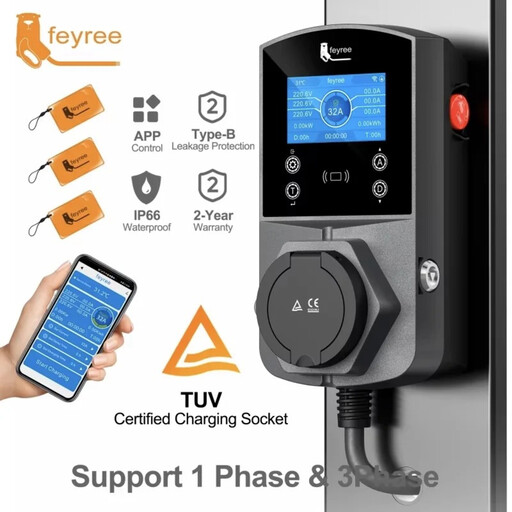
Why this fits the profile: Suitable for users who want a socket wallbox with plenty of adjustment options and who have a suitable single-phase or three-phase installation.
According to the product description, the charging current can be adjusted via the app. This lets you tailor the settings better to your car and installation, but 22 kW is only possible when both support it.
1.4 to 22 kW according to the description; Wi-Fi and Bluetooth app, charging schedules and Type B AC/DC leakage protection are mentioned.
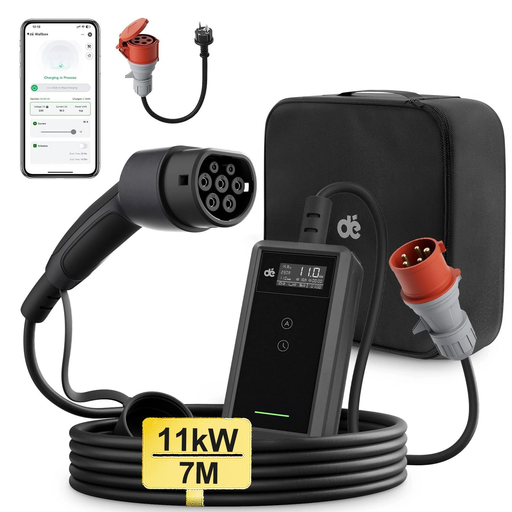
Why this fits the profile: Interesting for drivers of, among others, Tesla Model 3/Y, Volkswagen ID.3/ID.4, Volvo EX30 and other Type 2 cars looking for a three-phase home charger with a long cable.
The product name states 11 kW, three-phase, a 7-metre cable and adjustable current from 6A to 16A. Check before buying whether these values match your consumer unit and car.
11 kW and three-phase; app control, 7-metre cable and Schuko adapter are mentioned in the product name.
We’ve put together a full, up-to-date list of products that fully meet these strict selection criteria and comply with current European safety regulations.
A fixed wallbox should be connected by a qualified electrician. The necessary circuit, residual current protection, cabling and phase distribution must be matched to the charging power. A portable charger with a Schuko adapter may seem simpler, but even then you need to check that the socket and electrical circuit are suitable for prolonged use.
The lifespan depends on installation, weather conditions, charging frequency and maintenance. Choose a model with clear specifications for the housing and protection, protect the cable from kinking and regularly check the plug, socket and cable for visible damage. Follow the manufacturer’s instructions for cleaning and use.
The costs consist of your electricity rate, the number of kilowatt-hours charged and any fixed costs from your energy contract. An app can help you track charging sessions and consumption. Charging during cheaper hours is only beneficial if your contract has different rates and the wallbox supports charging schedules. So check both your energy contract and the features of the charger you choose.
