
Vandaag of morgen in huis

Kwaliteit gegarandeerd

Welkomstaanbiedingen ontgrendelen: GRATIS bezorging | Tot 80% korting | Gratis 30 dagen JoyPlus-proefperiode
Download de app
Charging your electric car at home should be simple and cost-effective. No more hassle searching for an available public charging station or paying variable rates. With your own charging point, you can charge your car whenever it suits you, often at a lower electricity rate. But which charging solution is right for your situation? A fixed wallbox or a flexible mobile charger? And what do terms like 1-phase, 3-phase, and 11kW actually mean?
As a Joybuy Product Recommendation Officer, I'm here to help you make the right choices. In this article, we'll compare the specifications of various charging solutions so you can make an informed decision that fits your car, your electrical panel, and your budget.
Before you make a choice, it's wise to consider a few key points. These will determine which home EV charger is most suitable for you.
Charging speed is perhaps the most important factor. It depends on two things: the connection in your electrical panel and the charging capacity of your car.
Always check your electrical panel and your car's specifications before choosing a charger.
The next choice is between a permanently installed charging station and a portable charger.
A smart charger offers extra functionalities via an app on your smartphone. Think of starting or stopping a charging session remotely, setting charging times to take advantage of off-peak rates, and monitoring power consumption. This gives you more control and can help reduce charging costs.
Based on specifications and features, we have listed some interesting options for you.

Why this model stands out This Feyree charger is a solid and reliable wallbox for home use. The design is functional, with a special socket that keeps dust out and a sturdy 5-meter cable. According to the manufacturer Feyree, the built-in intelligent chip monitors the charging process to protect the charger and the vehicle. The device automatically shuts off when the battery is full.
Key Features
Who is this product for? For the EV driver with a 1-phase connection who is looking for a reliable, fixed charging solution for daily use, without complex smart features.
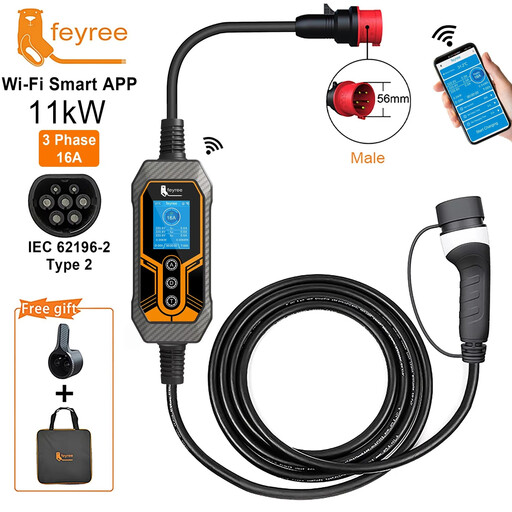
Why this model stands out This mobile charger combines the power of an 11kW charger with the flexibility of a portable device. It is a smart charger that you can control via Wi-Fi and an app. According to Feyree, you can use it to schedule charging times to benefit from off-peak rates and monitor the charging status in real-time. The charging current is adjustable from 8A to 16A.
Key Features
Who is this product for? For the EV owner with a 3-phase connection who wants maximum control and flexibility. Ideal for those who want to save money by charging at night and also want to take the charger on trips.
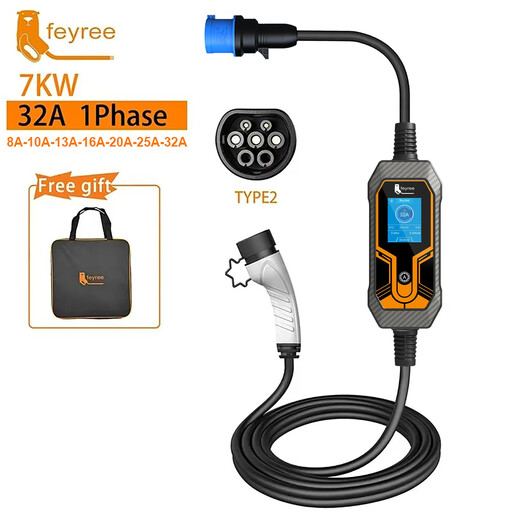
Why this model stands out This mobile car charger offers an excellent combination of power and portability for vehicles and connections on 1-phase. A key feature is the adjustable charging current (8A to 32A), allowing you to adapt the charging speed to the available power supply. All charging data can be read directly from the bright LCD screen.
Key Features
Who is this product for? For EV drivers who cannot or do not want to install a fixed wallbox, or who travel frequently and need a reliable EV charger for on the go. Also suitable as a backup charger for home.
The choice of a charging solution is personal and depends on many factors. If the recommendations above don't quite match your needs, there are plenty of other options available.
View our full range of charging solutions and accessories in the cable connector adapter category.
A 1-phase charger uses a standard power connection and charges with a power of up to about 7.4 kW. A 3-phase charger uses three-phase power and can charge faster, typically at 11 kW or 22 kW. The choice depends on the connection in your electrical panel and what your car can handle. A 3-phase charger can charge a compatible car up to three times faster than a basic 1-phase charger.
No installation is needed for a mobile charger; you just plug it into a suitable socket. However, the installation of a fixed wallbox is a job for a specialist. It requires modifications to the electrical panel and must be done safely and in accordance with current standards. It is strongly recommended to always hire a certified electrician for this.
For many users, yes. A modern mobile charger offers the same charging speeds and safety features as a fixed wallbox. The main difference is the installation and form factor. A wallbox is a neater, permanent solution for the wall. A mobile charger offers flexibility and is ideal if you want to charge at multiple locations or do not want a permanent installation.
