Who is this relevant to?

Hobbyist with shower moisture near the room

Wants to check first whether moisture from the bathroom is reaching the hobby room, and whether better extraction would remove the need for an appliance. Milieu Centraal, GGD Leefomgeving and Consumentenbond all emphasise ventilation and tackling the source of the moisture.

Someone using a cool hobby room

Still has a damp, minimally heated room after tackling the source of the moisture and wants to weigh up adsorption and condensation at the room’s temperature. Consumentenbond discusses how these technologies depend on temperature.

Looking after moisture-sensitive hobby items

Wants to protect books, wood or musical instruments, so pays attention to humidity readings, controls and persistent sources of moisture. Consumentenbond recommends finding the cause and measuring humidity.

What should you look for when choosing?

Ventilate and tackle the source of the moisture

Choose this step if: humidity rises mainly after showering; check the extraction and then measure humidity in the hobby room.

Bear in mind: dehumidifying does not replace ventilation or fix a leak.

Adsorption dehumidifier

Compare this option if: the hobby room stays cold or unheated after you’ve tackled the source of the moisture, particularly at temperatures below 15 °C.

Bear in mind: adsorption releases warm air and, according to Consumentenbond, generally uses more electricity than condensation; Consumentenbond has not independently tested this type.

Compressor dehumidifier

Compare this option if: the hobby room generally stays above 15 °C and you still need to dehumidify after ventilating.

Bear in mind: performance depends on temperature; a stated daily capacity does not guarantee the same output in a colder room.

What to consider What should you check? Who is this important for?
Extracting shower moisture Check the bathroom extraction while and after showering, then measure whether the hobby room stays damp for an extended period. If I suspect humidity spikes after showering, I want to find out first whether better extraction is enough. Around 36% of consumers give tackling the source the highest priority.
Performance at room temperature Measure the temperature when dehumidifying is needed and compare it with the stated operating range and the conditions used to measure capacity. In a cool or unheated hobby room, I want a technology suited to the actual temperature. Around 29% of consumers prioritise performance in a cold room.
Protecting hobby items Look at humidity controls, the tank or a suitable drainage option, and how humidity changes around your belongings. If I keep books, wood or musical instruments in the room, I want to monitor damp over time. Around 21% of consumers give protecting hobby items the highest priority.
Energy use, noise and emptying Compare the power rating under the stated conditions, any noise figures, and the tank capacity or drainage options. If the appliance runs frequently or is on while I’m working on my hobby, energy use, noise and maintenance all matter. Around 14% of consumers prioritise these practical considerations.

Avoiding common buying mistakes

  • Buying a dehumidifier before checking the source of the moisture

    An appliance doesn’t replace ventilation or fix a leak or poor drainage. The moisture problem may therefore persist.

    Check the extraction and other possible sources of moisture. Then measure humidity in the hobby room again before deciding whether you need an appliance.

    An unnecessary purchase can also mean ongoing electricity costs.

  • Assuming the stated capacity is what you’ll get in your own room

    Temperature, humidity and testing conditions all affect actual output. Capacity figures for different models are not necessarily directly comparable.

    Measure the temperature in the hobby room and compare capacity figures only alongside the conditions used to measure them.

  • Assuming adsorption is always the right or most energy-efficient choice

    Adsorption is particularly relevant at low temperatures, but according to Consumentenbond it generally uses more electricity than condensation. The Wood’s WDD80 manual also specifies that the appliance must be kept away from water sources.

    For a warmer room, compare compressor models too, and follow the positioning instructions for the exact model.

Brands to compare

Qlima

Qlima describes the DD 808 as an adsorption model for cold rooms. The D 620 is a separate compressor model, not a variant of the DD 808.

  • According to Qlima, the DD 808 has a hygrometer, timer and stated capacity of 8 l/24 uur.
  • These are manufacturer specifications, not independent measurements in a hobby room. Features of the D 620 do not automatically apply to the DD 808.

Wood’s

The WDD80 is an adsorption model with a collection tank and a connection for a drainage hose.

  • The manual states a capacity of 8 litres at 20 °C and 60% relative humidity, a 2-litre tank, 650 W under those test conditions, and a noise level of 36–50 dB.
  • The manual gives an operating range starting at +1 °C, while the product page states 0 °C. Until this is clarified, don’t assume that 0 °C is a guaranteed lower limit. Keep the appliance away from water sources as instructed in the manual.

Trotec

Trotec describes the TTR 57 E as an adsorption dehumidifier for rooms up to 20 m² or 50 m³.

  • Trotec states a capacity of 9 l/24 uur and a 5-litre tank.
  • Without matching test conditions, the stated daily capacity cannot be directly compared with that of other models. The manufacturer’s specifications are not an independent performance test.

Joybuy products

These Joybuy products are dehumidifiers for dealing with moisture that remains in the hobby room after you’ve tackled the source in the bathroom. Check the dehumidifying technology and temperature range for each model; the product details do not identify these models as adsorption dehumidifiers.

Comfee' MDDO-10DEN7, 10 l/day, 2.5-litre tank

Comfee' MDDO-10DEN7, 10 l/day, 2.5-litre tank

A dehumidifier for anyone who wants to control humidity in their hobby room.

Stated capacity: 10 l/day; tank: 2.5 l. The product description mentions an adjustable humidity target of 35–85% and an automatic mode of 45–55%.

View at Joybuy
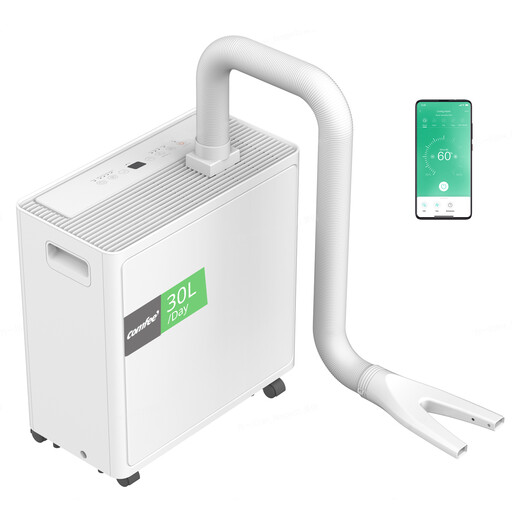
Comfee' MDDA-30DEN7-SD, 30 l/day, 3.2-litre tank

Comfee' MDDA-30DEN7-SD, 30 l/day, 3.2-litre tank

An option to compare if the room still feels damp after ventilation.

Stated capacity: 30 l/day; tank: 3.2 l. The product description mentions app control, a 24-hour timer and continuous drainage as an option.

View at Joybuy
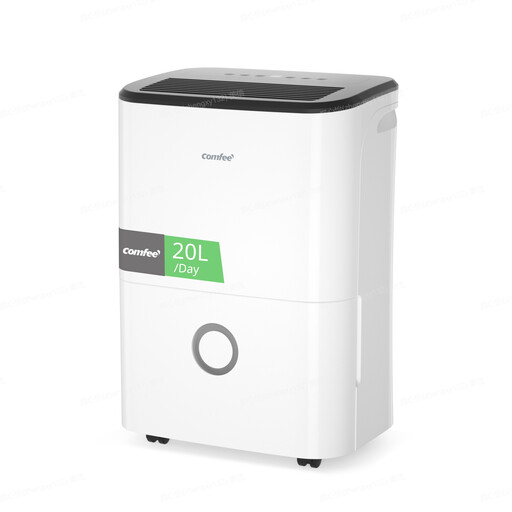
Comfee' MDDF-20DEN7, 20 l/24 hours, 3-litre tank

Comfee' MDDF-20DEN7, 20 l/24 hours, 3-litre tank

For anyone looking to compare an adjustable humidity mode and the choice between tank and hose drainage.

Stated capacity: 20 l/24 hours; tank: 3 l. The product description mentions a Smart mode for 45–55% and drainage via the tank or hose. The hose for continuous drainage is not included.

View at Joybuy

ELECCI 12L/D, 3.8-litre tank, with drainage hose

ELECCI 12L/D, 3.8-litre tank

An option to compare if you also want to consider how often the tank needs emptying.

Stated capacity: 12 l/day; tank: 3.8 l. The product title mentions a 24-hour timer and continuous drainage using a hose.

View at Joybuy
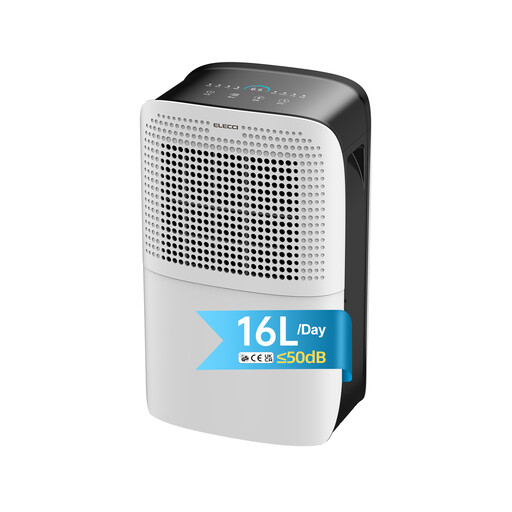
ELECCI 16L/D, 3.1-litre tank

ELECCI 16L/D, 3.1-litre tank

For anyone who wants to include a humidity sensor and automatic control in their comparison.

Stated capacity: 16 l/day; tank: 3.1 l. The product description mentions an automatic humidity sensor and an adjustable range of 40–80% RH.

View at Joybuy

Frequently asked questions

Should a dehumidifier replace ventilation after showering?

No. Ventilation removes humid air and other pollutants. Turn up the mechanical extraction while showering, or use a suitable ventilation option. Then check whether the hobby room is still too damp. Milieu Centraal and GGD Leefomgeving recommend extra ventilation when showering.

Can I put a portable adsorption dehumidifier next to the shower?

Don’t assume you can based on the technology alone. The Wood’s WDD80 manual says to keep it away from water sources. For another model, follow the instructions for that exact version. If you’re unsure about the electrical installation, have the positioning assessed; there is no general permission or fixed safe distance in metres that applies here.

How can I estimate a dehumidifier’s energy use?

For a single operating mode under comparable conditions, divide the power rating in W by 1,000 and multiply it by the number of operating hours to get consumption in kWh. The Wood’s WDD80 manual states 650 W at 20 °C and 60% relative humidity. Without knowing the mode used, operating hours and your electricity tariff, this doesn’t give you a reliable cost estimate.

What can I do if a dehumidifier I bought online isn’t suitable?

For a standard online consumer purchase, you generally have a legal cooling-off period of up to 14 days after delivery, subject to applicable exceptions. The seller is also responsible for the statutory guarantee if a product doesn’t meet what you can reasonably expect from normal use. ACM ConsuWijzer explains the cooling-off period; the Netherlands Authority for Consumers and Markets describes the seller’s responsibility for the guarantee.

Is a CE mark required, and does it mean the appliance is suitable for bathroom use?

Electrical consumer products must carry a CE mark. The Netherlands Food and Consumer Product Safety Authority explains this requirement. A CE mark is not general permission to use a portable dehumidifier near shower water. Follow the restrictions for the exact appliance, and get any concerns about the electrical installation assessed.
