
Vandaag of morgen in huis

Kwaliteit gegarandeerd

Welkomstaanbiedingen ontgrendelen: GRATIS bezorging | Tot 80% korting | Gratis 30 dagen JoyPlus-proefperiode
Download de app
Buying a highlighter set seems straightforward. Yet many shoppers end up with a set that dries out quickly, bleeds through the paper or contains colours that are barely distinguishable in practice. Whether you need them for school, work, a planner or creative projects, the type of pen makes a real difference.
So don’t just look at the number of colours or the packaging. The ink type, nib shape and suitability for the surface determine whether a highlighter set is comfortable and effective to use.
A set with 24 colours may look appealing, but more colours do not automatically mean more ways to use them. For studying, four to eight distinct colours are often enough. For drawing or hand lettering, colour variety and different nib shapes are more important.
Also check whether the set really contains different colours or mainly lots of shades that are very similar.
Neon highlighters are designed to make text stand out quickly. Pastel highlighters create a softer result and are often more comfortable for planners, diaries and notes where you don’t want harsh blocks of colour.
Brush pens, acrylic markers and fineliners serve different purposes. A brush pen is suitable for varying line widths, an acrylic marker for surfaces such as wood or glass, and a fineliner for thin lines. None of these pens is automatically a replacement for a classic highlighter.
Some brands state that a highlighter can be left uncapped for a certain amount of time without drying out. This is a product specification under specific conditions, not a guarantee for every situation. Temperature, sunlight, frequency of use and the condition of the cap all play a part.
So always recap a pen properly after use. This is important for coloured highlighters as well as brush pens and acrylic markers.
For school, the office and everyday highlighting, water-based ink is a practical choice. This type of ink is widely used in highlighters and fineliners and is generally suitable for standard paper.
Alcohol markers dry quickly and are intended for illustrations and sketches. However, they can bleed through thin paper. Use marker paper or place a protective sheet underneath your work.
Water-based acrylic ink is designed for use on multiple surfaces. The Faber-Castell Acrylic Marker sets state that they can be used on, among other things, paper, metal, ceramics, plastic, glass, textiles, stone, canvas and wood. Always test the marker on an inconspicuous area first, especially on porous materials.
A chisel nib usually offers two line widths. This allows you to highlight text with the broad side and underline with the narrow side. In the STABILO models featured in this overview, the narrow line is 1 or 2 mm and the broader line is 4 or 5 mm, depending on the model.
A brush nib allows you to create varying line widths by adjusting the pressure you apply to the pen. This is ideal for hand lettering, drawing and decorative headings.
A 0.4 mm fineliner tip is suitable for details, diagrams, outlines and writing with a ruler or stencil.
For children, age recommendations, small parts and ventilated caps are important points to check. Products with EN 71 or CE marking provide information about the stated conformity, but you should always read the safety warnings on the product page as well.
With washable pens, “washable” is not an absolute guarantee for every material. According to Jar Melo’s product information, the ink is approximately 90% washable from skin and most fabrics. Nevertheless, test the pen first and protect clothing, furniture and floors.
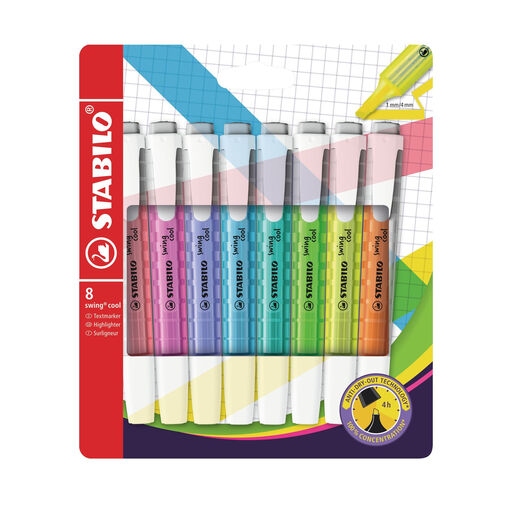
Why this suits the profile: The compact set of eight neon colours fits in a pencil case and is suitable for school, studying and everyday use.
The chisel nib has two line widths of 1 and 4 mm. This means you don’t need a separate pen for underlining and broad highlighting.
Water-based ink, a clip on the barrel, a matt grip area and, according to the product information, up to four hours without the cap without drying out.
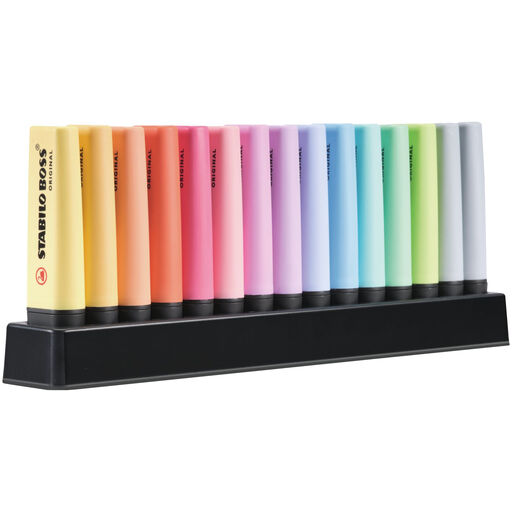
Why this suits the profile: The combination of pastel colours and multiple line widths is ideal for planners, detailed summaries, hand lettering and creative office work.
The colour selection goes beyond fluorescent yellow. However, check beforehand that the soft shades provide enough contrast on your paper.
Chisel nib with 2 and 5 mm line widths, water-based ink and a set with 14 pastel colours according to the product description.
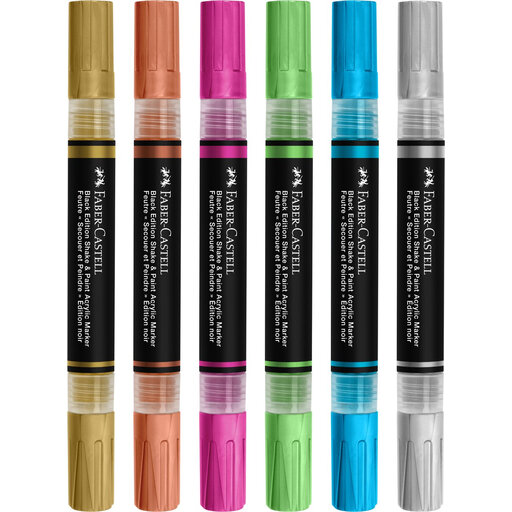
Why this suits the profile: For creative users who want to mark more than just paper and also create projects on surfaces such as wood, glass, ceramics or canvas.
The set is clearly an acrylic marker set rather than an ordinary text highlighter. The activation process of shaking and pumping makes the way it is used clear from the outset.
Six metallic colours, two nib sizes of 1 and 3 mm and, according to the product information, suitable for multiple surfaces.
We’ve put together a complete, up-to-date list of products that fully meet these strict selection criteria and the applicable European safety regulations.
For school, water-based highlighters with a chisel nib are practical. With a narrow and broad side, you can both underline and highlight text. A compact set with a clip will also fit in most pencil cases.
Replace the cap immediately after use and check that it closes securely. Store the pens away from direct sunlight and extreme heat. For sets with multiple nibs, it’s a good idea to keep the markers in their box or pencil case so that the caps don’t get lost.
Not always. Pastel shades produce a softer colour result and may offer less contrast on cream-coloured or thin paper. Test the colour on the same paper you intend to write on. For clear study highlights, neon highlighters are often more visible.
