
Vandaag of morgen in huis

Kwaliteit gegarandeerd

Welkomstaanbiedingen ontgrendelen: GRATIS bezorging | Tot 80% korting | Gratis 30 dagen JoyPlus-proefperiode
Download de app
A highlighter pen set might seem like a straightforward purchase, but the differences become clear with daily use. A tip that's too hard makes broad marks uneven, pale ink gets lost in text, and a cap that doesn't seal properly can dry the pen out. For school pupils, university students, teachers, professionals and bullet-journal enthusiasts, the number of colours, the tip shape and the type of ink are the key factors.
A set with twelve or more colours looks appealing, but not everyone will use them all. For summaries, four clear colours are often enough: for example, yellow for definitions, green for examples, blue for main points and pink for actions. Pastel highlighters are gentler on the page, while neon highlighters offer more contrast.
So don't just look at the number of pens. Check whether the colours suit your needs and whether they are clearly different from one another.
According to product descriptions, certain water-based inks may be developed to limit bleed-through or smudging. That doesn't mean every highlighter will perform the same on every paper. Thin school paper, Bible paper and paper from cheap notebooks react differently to sturdy printer paper.
If in doubt, test first on an inconspicuous page. Let the ink dry briefly before writing over the highlight with a pen.
A click mechanism is practical in a full bag. However, you need to check that the tip is fully retracted after use. With a classic model, the cap remains important: put it back straight away to limit drying out. A chisel tip highlighter is also not automatically suitable for small text; for that, you need the narrow side of the tip.
A chisel tip is versatile. You can use the broad side to highlight a line of text and the narrow side to underline. According to the product information, the STABILO BOSS ORIGINAL comes with a chisel tip for lines of approximately 2 to 5 mm. This makes this type suitable for planners, diaries and school textbooks.
A soft, flexible tip can be pleasant for journaling, but feels different from a firm classic chisel tip. If you need to write very precisely, you might be better off also choosing rollerball pens or fine ballpoint pens.
Water-based ink is common in highlighters. Check whether the product description gives information about drying time, scent, colour intensity and use on different paper types. A claim such as "smudge-proof" or "quick-drying" should be seen as a product specification or brand claim, not a guaranteed result under all conditions.
Left-handed writers often benefit from ink that the product description says dries quickly. Even then, writing speed, paper type and pressure on the paper still have an effect.
A ribbed or shaped barrel can offer more grip. A click model prevents a loose cap, while a traditional model is often simpler. With refillable ballpoint pens, check whether suitable refills are available. This can work out cheaper in the long run than buying a new pen each time.
Also pay attention to the contents of the pack. A set might contain four highlighters, for example, while another stationery set also adds pens or mechanical pencils. Compare the actual number of usable writing instruments, not just the packaging.
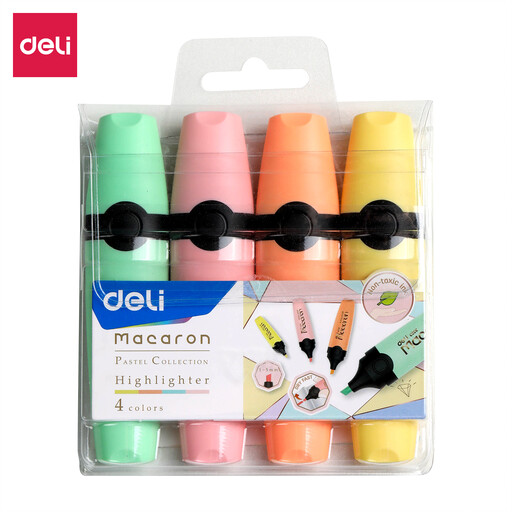
Why this suits the profile: A straightforward set of four pastel colours is suitable for first-year students, school pupils and anyone who wants to start colour-coding without too much choice.
The limited number of colours stops you paying for shades that would go unused. The chisel tip offers a broad and a narrower writing side.
Four pastel colours and a chisel tip according to the product name and description; suitable for highlighting, planning and notes.
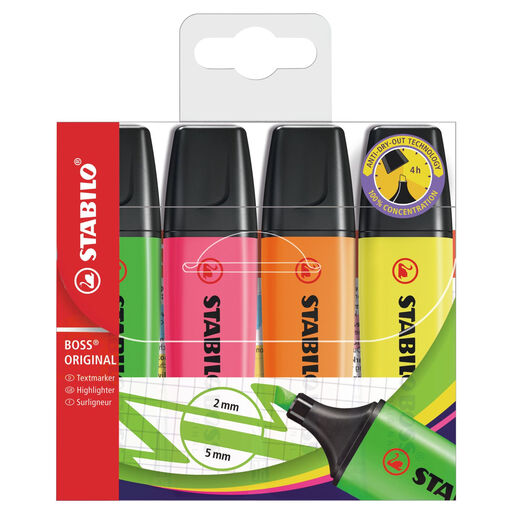
Why this suits the profile: Suitable for users looking for a recognisable classic model with four fluorescent colours and a versatile tip.
The product description mentions a water-based ink and a tip range of 2 to 5 mm. Still close the cap carefully after use.
Four colours, chisel tip and line width of approximately 2–5 mm according to the product information.
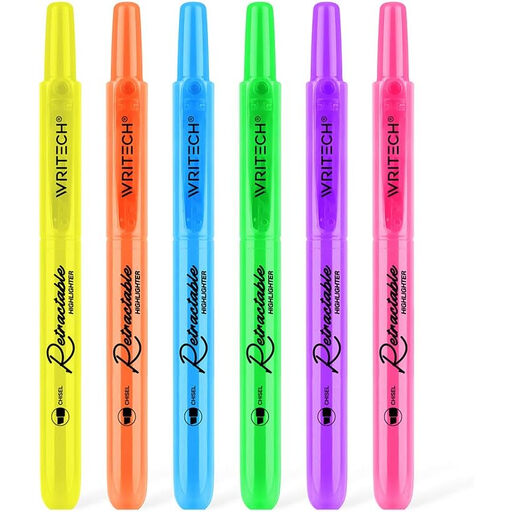
Why this suits the profile: Handy for heavy use in planners, study books and bullet journals, especially when you want to highlight with one hand.
The retractable design reduces the chance of a lost cap. The product description mentions a line width of 1–4 mm and a chisel tip.
Twelve pens with neon and pastel shades; click mechanism and a stated line width of 1–4 mm.
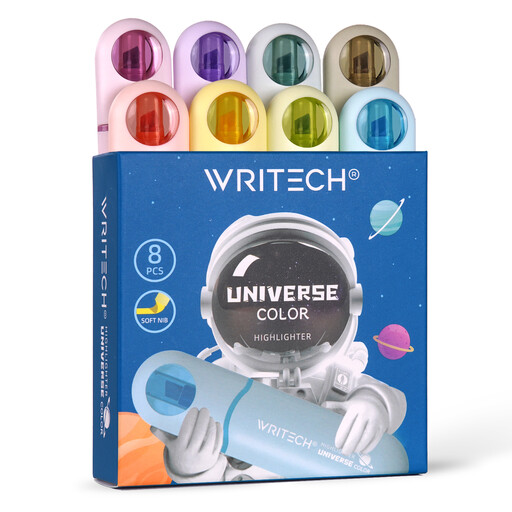
Why this suits the profile: The combination of eight colours and a soft, flexible tip suits bullet journals, page decoration and colour-coding.
The soft chisel tip is designed for broad and thin lines. According to the product description, the ink is water-based and designed to limit bleed-through and smudging.
Eight assorted colours, flexible chisel tip and a shaped barrel according to the product details.
We've put together a full, up-to-date list of products that fully meet these strict selection criteria and current European safety regulations.
A highlighter pen set often works better when combined with other writing materials. For daily notes, refillable ballpoint pens are practical if you want to replace the whole pen less often. A pen set for school and office can be handy for families or shared workspaces.
For a fine line, the WRITECH rollerball pens with a 0.5 mm tip are described in the product information as suitable for notes, drawing and journaling. If you prefer working with a pencil, consider a set of mechanical pencils with 0.7 mm HB lead. With each product, check whether refills and spare parts are available.
Choose a model whose product information refers to water-based ink or limiting bleed-through, but always test on your paper first. Use less pressure and let the highlight dry before writing over the text again.
Close a cap model immediately after use. With a click model, retract the tip fully. Don't store the pens for long periods in direct sunlight or extreme heat. The product description of some models mentions extra protection against drying out, but closing them properly is still wise.
Not necessarily. Compare the price per usable pen and think about how many colours you will actually use. Four colours can be enough for school and office; eight to twelve colours offer more possibilities for planners and creative projects, but also take up more space.
