
Fans of a sweet, crunchy breakfast
Fibre is likely to be your main priority. The stated amount per 100 g helps you compare different options; then check what you’ll get in your own portion.


When choosing granola for a sweet breakfast, start by comparing the fibre per 100 g, then check total and added sugars. Also check the ingredients, allergens and nutritional values for the portion you plan to eat: a fibre claim or the words ‘0% added sugar’ don’t tell you the whole story.
Fibre is likely to be your main priority. The stated amount per 100 g helps you compare different options; then check what you’ll get in your own portion.
You’re looking for a sweet taste without added sugar as your main criterion. Also compare total sugars and fibre: these are separate from any claim on the front of the pack.
If you need to eat gluten-free or avoid certain allergens, check the labelling and allergen information for the exact product before letting fibre content or flavour sway your decision.
First compare granola per 100 g, then check the nutritional values for the portion you’ll actually eat. If you have a dietary requirement, start by checking whether the exact product is suitable for you.
| What to consider | What to check when buying | Who is this important for? |
|---|---|---|
| Fibre | Compare fibre per 100 g and work out how much you’ll get in your own portion. | If fibre is my main breakfast priority, I want to know how much I’ll get in my usual portion. Around 45% of consumers put their fibre needs first. |
| Sugars | Check both total and added sugars per 100 g, and read the ingredients list. | I want a sweet taste, but I’m especially mindful of added sugar. For around 33% of consumers, this is the most important consideration. |
| Gluten and allergens | If needed, check the gluten-free labelling and read the allergen and ‘may contain’ information for the exact product. | If I need to avoid certain ingredients, my granola has to suit my dietary requirements. This is the main priority for around 22% of consumers. |
A fibre claim alone doesn’t tell you anything about the granola’s total sugars, energy content or allergens.
Compare the nutritional values per 100 g, and also check the ingredients and the portion you plan to eat.
Granola with no added sugar may still contain sugars. For example, Jumbo lists 6.3 g of total sugars per 100 g for Jumbo's Granola Rood Fruit, alongside the claim ‘0% added sugar’.
Check the total sugars figure separately, and look at the nutritional values for your portion.
The products reviewed contain or mention, among other things, cereals containing gluten, nuts, peanuts and soya. A high fibre content doesn’t automatically make a product suitable for someone with an allergy.
Check the allergen statement again if you choose a different flavour or pack.
Albert Heijn lists 19 g of fibre in AH Glutenvrij Granola, but also 11 g of added sugars and 537 kcal per 100 g. So a gluten-free label answers a different question from the nutrition table.
If you need a gluten-free option, start with a product labelled as such, then compare the nutritional values of suitable options.
The differences below apply to the granola varieties mentioned, not to a brand’s entire range.
Classic Crunchy is an organic granola for anyone who wants to compare fibre and added sugar side by side.
Two AH varieties cater to different needs: no added sugar or a gluten-free label.
The product information for Granola Rood Fruit combines a fibre figure with a claim about added sugar.
Low Carb Granola is a distinct option for anyone comparing protein and carbohydrates per 100 g as well as fibre.
Quaker Cruesli Granola Original is a sweet, crunchy option with portion information that lets you compare it if fibre is a priority.
These products offer a range of flavours and varieties for a sweet breakfast. Quaker Cruesli products are crunchy muesli, so don’t treat them as the same product category as granola. Check the latest nutritional information and allergens on each product’s packaging.
 Image unavailable
A chocolate and nut granola for anyone looking for a sweet breakfast option and wanting to compare fibre and sugars per 100 g.
According to the product information, this variety contains soya, oats, hazelnuts and almonds. Check the packaging for information about possible traces too.
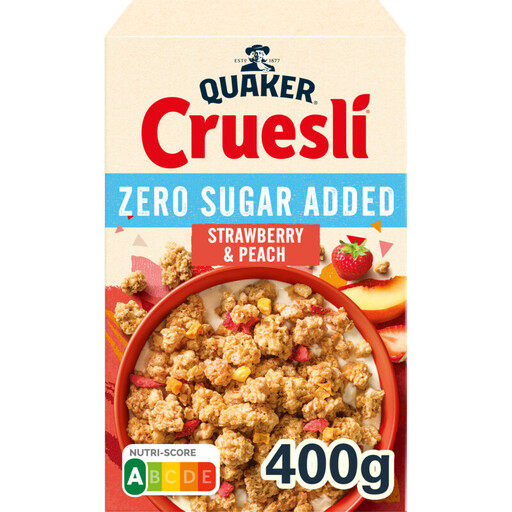 Image unavailable
A crunchy muesli with strawberry and peach for anyone who wants to check added and total sugars separately as part of a sweet breakfast.
According to the product information, this variety contains wheat and oats, and may contain milk and nuts. Check the latest allergen statement.
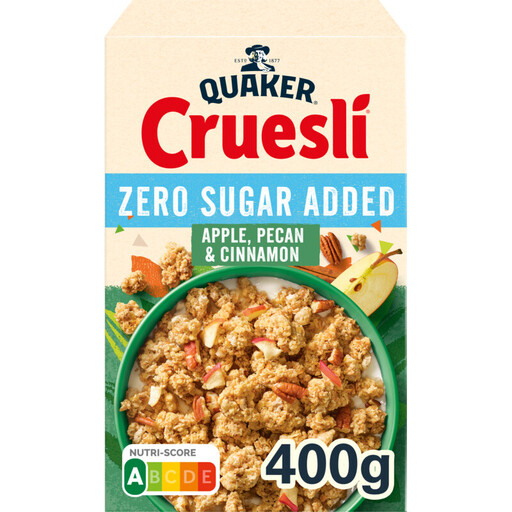 Image unavailable
A crunchy muesli with apple, pecan and cinnamon for anyone looking for this flavour and wanting to compare the sugar claim with the nutrition table.
According to the product information, this variety contains wheat, oats and pecans, and may contain milk and other nuts.
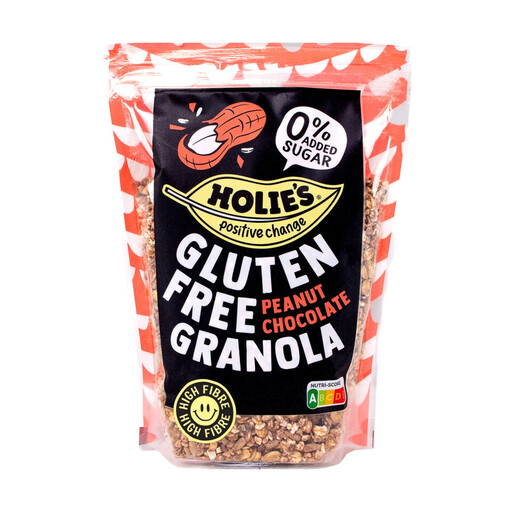 Image unavailable
A peanut and chocolate granola to consider if you’re looking for an option explicitly labelled gluten-free; check the label on the current packaging.
According to the product information, this variety contains peanuts and oats, and may contain various nuts and soya. It isn’t suitable if you need to avoid peanuts.
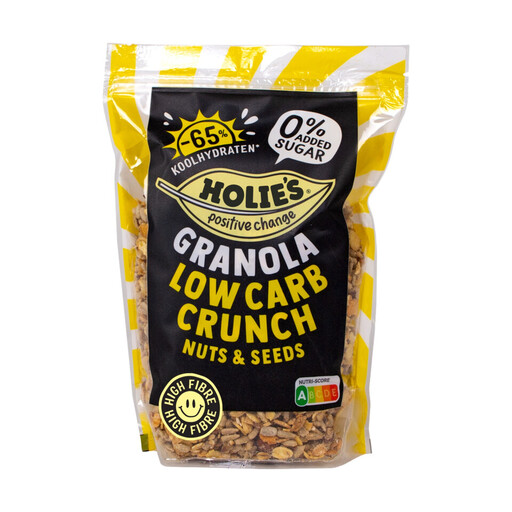 Image unavailable
A granola for anyone who wants to compare protein and carbohydrates as well as fibre; check the nutritional values per 100 g and for your portion.
According to the product information, this variety contains soya, almonds, peanuts and cereals containing gluten, among other ingredients. If you have allergies, check the full allergen statement.
Compare the stated fibre per 100 g, then check how much your own portion contains. A claim such as ‘high fibre’ doesn’t replace the nutrition table; check sugars and ingredients at the same time.
No, total sugars may still be listed in the nutrition table. For example, Jumbo lists 6.3 g of total sugars per 100 g for Jumbo's Granola Rood Fruit, alongside ‘0% added sugar’, so check both figures.
Use the portion you actually eat to assess the nutritional value of your breakfast. Figures per 100 g make products easier to compare, but they don’t automatically tell you how much fibre, sugar or energy is in your bowl.
Check the labelling and allergen information on the exact pack. If you need a gluten-free option, choose a product explicitly labelled as gluten-free, then check which other ingredients, such as peanuts, nuts or soya, may be present.