
If fibre is your priority
You want to know how much fibre the cereal adds to your breakfast. To compare, look not only at the amount per 100 g, but also at how much you put in your bowl.


For Sunday breakfast, start by choosing between crunchy muesli and a warm bowl, or look at a bran cereal if fibre content is your main priority. Then compare fibre and sugars on the same nutritional basis, and consider how much you actually eat per serving. A claim on the front of the pack doesn’t, on its own, tell you what your whole breakfast contains.
You want to know how much fibre the cereal adds to your breakfast. To compare, look not only at the amount per 100 g, but also at how much you put in your bowl.
You’re looking for crunchy muesli and want to assess its sugars and ingredients as well as its fibre. A claim such as ‘no added sugars’ doesn’t replace the nutrition table.
You’d rather have porridge, another warm cereal breakfast or a drinkable option. When comparing, take into account what’s in your serving once it’s prepared.
A bran cereal, crunchy muesli and a warm cereal breakfast don’t quite meet the same needs. Decide which suits you first, then compare the nutritional information on a like-for-like basis.
When to choose it: If fibre from your cereal is your priority, Kellogg's All-Bran Fibre Plus is a useful point of comparison: Albert Heijn lists 26 g of fibre per 100 g.
What to consider: Check the sugars and ingredients too. The variant reviewed lists 15 g of sugars per 100 g and contains wheat and barley.
When to choose it: If you’re mainly after a crunchy texture, you could try a Quaker Zero Sugar Added variant, for example.
What to consider: Albert Heijn states that the Strawberry & Peach variant contains naturally occurring sugars. Don’t compare the nutritional value of a prepared serving directly with that of 100 g of dry product.
When to choose it: If you fancy a warm bowl, Brinta Volkoren graanontbijt is a wheat-based option to consider; Albert Heijn describes it as 100% wholegrain wheat.
What to consider: A breakfast drink is a different type of product. Assess its nutritional value per prepared serving separately, rather than treating it as equivalent to dry cereal.
| What to consider | What should you check? | Who is this most relevant to? |
|---|---|---|
| Fibre in your serving | Check the fibre per 100 g and see how many grams of cereal you actually use. | I want the cereal in my bowl to make a meaningful contribution to my fibre intake, not just have an appealing claim on the pack. For around 42% of consumers, fibre content is the top priority. |
| Sugars in crunchy muesli | Check the sugars in the nutrition table and read what the pack says about added sugars. | I want crunchy muesli, but I also want to be able to assess how much sugar my choice contains. This is the top priority for around 33% of consumers. |
| Preparation and serving size | Check how to prepare the cereal and whether the nutritional information is for the dry product or the prepared serving. | A warm bowl or a quick-to-prepare breakfast suits my Sunday morning better; I want to know what that preparation method means for my serving. Around 25% of consumers prioritise this convenience. |
The claim on the front doesn’t tell you how much fibre is in your own serving. It also says nothing about the amount of sugars or any allergens.
Read the nutrition table per 100 g, check your serving size, then look at the ingredients and allergens.
Adding milk or yoghurt changes what’s in the bowl. Nutritional information for a prepared serving is therefore based on something different from information per 100 g of dry cereal.
Compare the cereals on the same basis first, then assess your own prepared serving.
Allergens vary by product and variant. Even if you already know a cereal, the information on the pack still matters.
When you buy it, check the current ingredients and allergen information for the specific variant you’ve chosen.
The examples below relate to specific product ranges, not every cereal from each brand.
All-Bran Fibre Plus is an example to compare if you’re looking for a cereal with wheat bran.
Brinta Volkoren graanontbijt is an option to consider if you want to make a bowl using wholegrain wheat.
The Zero Sugar Added variants reviewed are examples of crunchy muesli where the claim about added sugars is worth considering.
The range includes wholegrain porridge oats, wholegrain muesli and bran flakes, among other options: different types of product to assess individually.
These products let you choose between crunchy muesli and cereal for a warm bowl. Compare variants individually: a name or product type doesn’t tell you what’s in each serving.
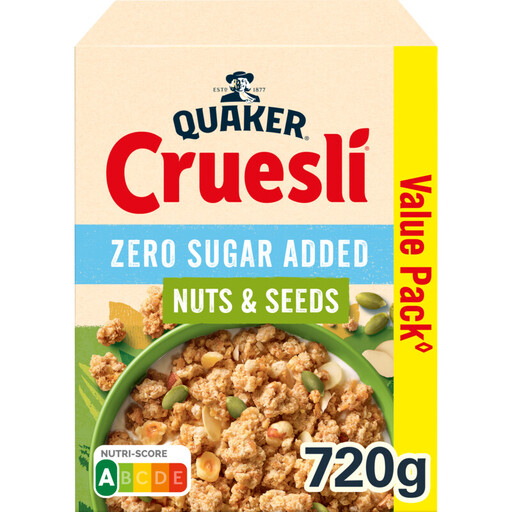 Image unavailable
Crunchy muesli for anyone who also wants to check the nutritional information about sugars at Sunday breakfast.
Pack size: 720 g. Check the pack for the fibre in the serving you use and the latest allergen information.
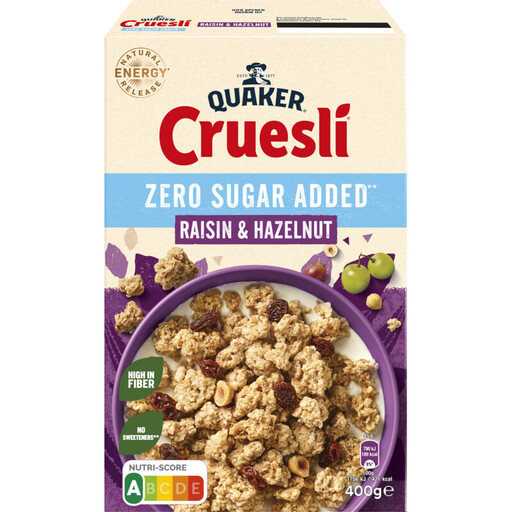 Image unavailable
Crunchy muesli with raisins and hazelnuts for anyone who likes that combination in their bowl.
Pack size: 400 g. Check sugars and fibre on the same nutritional basis as other muesli, and look at the allergen information.
 Image unavailable
An oat option if you’d rather prepare a bowl of cereal than eat crunchy muesli.
Pack size: 450 g. Check the preparation instructions and assess the nutritional value for your prepared serving; check the allergens too.
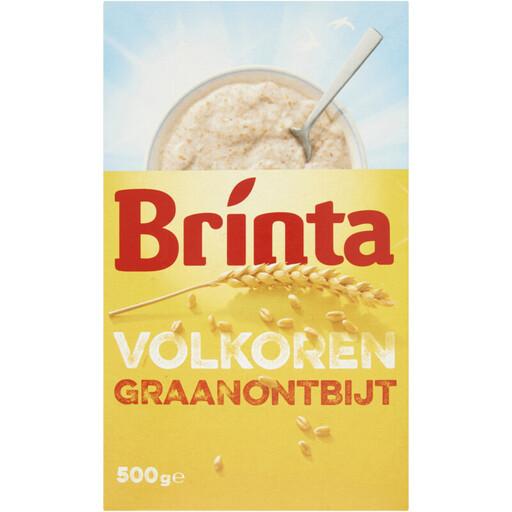 Image unavailable
A wheat-based cereal for anyone who wants to make a warm bowl.
Pack size: 500 g. Check the preparation instructions and fibre content for the amount you use. Look for the wheat and gluten information on the pack.
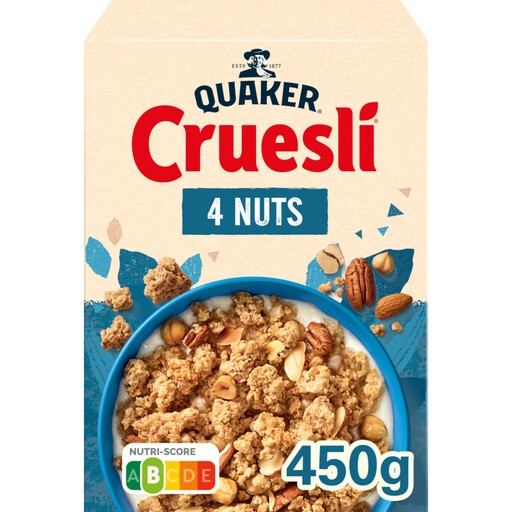 Image unavailable
Crunchy muesli with nuts for anyone who’s mainly looking for this type of cereal.
Pack size: 450 g. Compare the sugars and fibre with other crunchy muesli, and read the latest allergen information.
The claim doesn’t tell you how much fibre you’ll get from your own serving. So check the fibre per 100 g, see how much cereal you use, and consider the sugars and ingredients too.
Start with the nutritional information per 100 g, then check how much you actually put in your bowl. According to the Voedingscentrum, a 45 g serving in the ‘other breakfast cereals’ category contains 9.5 g of fibre; that figure doesn’t automatically apply to the product or serving you choose.
No, it may contain naturally occurring sugars. Albert Heijn states this explicitly for Quaker Zero Sugar Added Strawberry & Peach. Check the sugars in the nutrition table for the variant you’re buying.
Check the allergen information for the specific cereal. The All-Bran and Brinta wheat products discussed here, as well as the Quaker variant reviewed, contain ingredients that make information about gluten-containing cereals relevant. Don’t rely on the brand name or the general term ‘breakfast cereals’.