What should you look for when buying?
First compare the protein in a typical portion, then work out how much you’ll need for the week, and finally check the ingredients and allergen information.
| What to consider |
What should you check? |
Who is this important for? |
| Protein per portion |
Compare the same portion size. As general reference values, the Netherlands Nutrition Centre gives 6.3 g per 25 g of unsalted peanuts and 5.4 g per 25 g of unsalted almonds; for a branded product, use its own nutrition table. |
If you want to know what your post-workout snack contributes, look at the portion you actually eat. Around 45% of consumers in this breakdown prioritise protein per portion. |
| Pack size |
Match the pack size to the number of people eating, the occasions you have planned and your chosen portion. Jumbo lists a 500 g pack as one example, while PLUS and ALDI list 250 g packs. |
When shopping for several people or occasions, you’ll want to plan enough stock without treating the pack size as a recommended portion. Around 36% of consumers prioritise the amount they plan to use during the week. |
| Ingredients and variety |
Check the ingredients, salt content and preparation method separately. If you have an allergy, also check the allergen information on the exact pack. |
If you want to vary your choices or are looking for a particular combination, the ingredients will help you see what’s actually in the pack. Around 19% of consumers look at this first. |
The term ‘high protein’ in a search query doesn’t, by itself, tell you whether a specific pack meets the requirements for a nutrition claim. The European Commission states that nutrition claims may only be used if they are included in EU rules. So compare the specific product information, and don’t treat a claim as a substitute for the nutrition table.
Nuts and nut mixes at Joybuy
A selection of Joybuy products featuring almonds, peanuts and nut mixes, with product details and protein values as listed for each individual pack.
 Image unavailable
Jia Zhou Yuan Ye Original almond kernels 160 g
An option if you want to portion out almonds and are looking for a 160 g pack.
The ingredients list states 100% almond kernels. The nutrition table lists 21.5 g of protein per 100 g.
Contains almonds.
View at Joybuy
 Image unavailable
g’woon unsalted peanuts 250 g
An option if you’re looking for unsalted peanuts and want to work out the protein per portion.
The nutrition table lists 27 g of protein per 100 g. The ingredients list states 99% peanuts and sunflower oil; the pack contains 250 g.
Contains peanuts and may contain cashew nuts.
View at Joybuy
 Image unavailable
g’woon raw, unsalted almonds 200 g
An option if you’re looking for raw, unsalted almonds and want to plan how much you’ll need for the week.
The nutrition table lists 24 g of protein per 100 g. The pack contains 200 g.
The ingredients information lists almonds, but the allergen information also states that none of the 14 main EU allergens are present. Check the current packaging before buying, especially if you have an allergy.
View at Joybuy
 Image unavailable
Anatolia Badem Natural almonds 500 g
An option if you want to match a larger pack of almonds to the portions you have planned.
The product information lists 100% almonds, no added salt and 21.0 g of protein per 100 g. The pack contains 500 g.
Contains almonds.
View at Joybuy
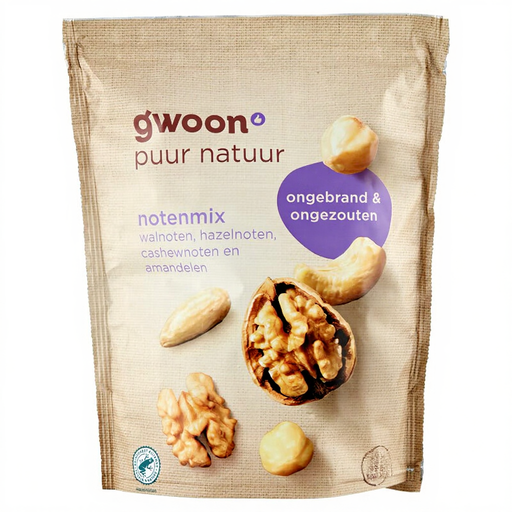 Image unavailable
g’woon unroasted mixed nuts 500 g
An option if you want to combine different types of nuts in an unsalted mix.
The product information lists hazelnuts, walnuts, almonds and cashew nuts. The nutrition table lists 16.9 g of protein per 100 g; the pack contains 500 g.
May contain traces of peanuts and other nuts.
View at Joybuy


