What should you look for when choosing?
Start with the nutritional information for the dry product and the serving size you actually use. Then read the ingredients and preparation instructions, so a claim on the front of the pack isn’t the only thing guiding your choice.
| What to consider |
What to check when buying |
Who it matters to |
| Protein per serving |
Compare protein per 100 g and calculate the amount in your usual serving; also check where the added protein comes from. |
If I want to put together a protein-focused breakfast with instant oats, what matters most is how much protein my serving provides. For around 36% of consumers, protein content comes first. |
| Added sugar and sweeteners |
Read the ingredients list alongside the statement about added sugar, and check separately for sweeteners. |
I want a neutral base and avoid both added sugar and sweeteners. This is the main requirement for around 29% of consumers. |
| Total sugars |
Compare ‘of which sugars’ per 100 g and per serving; don’t rely on the claim about added sugar alone. |
With a cup containing fruit or milk ingredients, I want to know how much sugar is in the product, regardless of the claim on the front. Total sugar content matters most to around 21% of consumers. |
| Allergens and preparation |
Check the allergen statement, any gluten-free label and whether you can prepare the variety with what you have available. |
If I need to avoid soya or milk, or need a gluten-free option, the exact ingredients determine my choice. For around 14% of consumers, requirements like these and the preparation method make all the difference. |
Brands to consider
The differences below apply to the products mentioned, not to a brand’s entire range.
Quaker
Albert Heijn describes two separate plain protein varieties: Oats Express Naturel Protein and Protein Naturel in a single-serving cup.
- Oats Express Naturel Protein contains 22 g of protein and 1.2 g of sugars per 100 g. Protein Naturel contains 24 g of protein and 12 g of sugars per 100 g; both are sold with no added sugar.
- Both varieties described contain soya and cereals containing gluten. The Protein Naturel cup also contains milk ingredients.
Elovena
The Natural Instant Oatmeal described here is a plain, gluten-free instant porridge in individual sachets.
- According to Albert Heijn product information, this variety has no added sugar and contains 14 g of protein and 1.2 g of sugars per 100 g.
- If you’re aiming for a particular amount of protein in your whole breakfast, remember to include your serving size and anything you add.
Albert Heijn
Its own-brand Oat & Go Appel Kaneel comes in a cup which, according to the product information, is prepared with hot water.
- The cup contains 17 g of protein and 0 g of added sugar per 100 g.
- At 18 g of total sugars per 100 g, the statement about added sugar is no substitute for checking the nutrition table.
Brinta
According to Albert Heijn’s ingredient information, the Brinta Havermout described here consists of oat flakes.
- You can assess the nutritional value of a breakfast made with these oats based on your chosen serving size and additions.
- The figures shown for oats prepared with semi-skimmed milk aren’t directly comparable with figures per 100 g of dry protein oats.
Instant oats on Joybuy
This selection focuses on an oat base that’s quick to prepare and has no added sugar. Check the current label if protein or total sugars per serving will determine your choice.
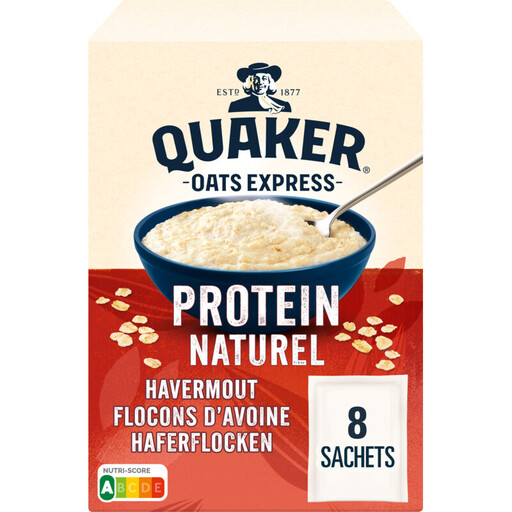 Image unavailable
Quaker Oats Express Protein, 302 g
An option if you want to make porridge quickly with no added sugar; the product description gives a preparation time of 2 minutes.
According to the description, the product contains 85% wholegrain oats and 15% soya protein. It contains soya and cereals containing gluten, and may contain wheat and barley.
Check the current packaging to compare protein and total sugars per 100 g and per serving.
View on Joybuy
Frequently asked questions
Does ‘no added sugar’ mean the same as sugar-free?
No. A product with no added sugar can still contain sugars from ingredients such as fruit or milk powder. For example, according to Albert Heijn, Quaker Protein Naturel has no added sugar but contains 12 g of sugars per 100 g. So check the ‘of which sugars’ figure too.
How do I compare protein and sugars in plain instant oats?
First compare the same amount of dry product, then check your actual serving size. According to Albert Heijn product information, Quaker Oats Express Naturel Protein contains 22 g of protein and 1.2 g of sugars per 100 g; gluten-free Elovena Natural Instant Oatmeal contains 14 g of protein and also 1.2 g of sugars per 100 g. If you need a gluten-free option, that could lead to a different choice than comparing protein alone.
Can I make instant oats with water if I’m watching my protein intake?
Yes. According to the product information, the Quaker Oats Express variety and Elovena Natural Instant Oatmeal described here can be made with water. Water doesn’t add protein, so assess the protein in the serving of oats you use and in any other ingredients separately.
Are protein oats suitable if I need to avoid soya, milk or gluten?
It depends on the variety. The Quaker Oats Express Naturel Protein described here contains soya and cereals containing gluten; Quaker Protein Naturel also contains milk. Elovena Natural Instant Oatmeal is described as gluten-free. Before buying, read the allergen statement on the packaging of the exact product.


