
If fibre is your priority
You want a sweet breakfast, but choose your muesli mainly for its fibre content per 100 g and the grains listed in the ingredients, not just the flavour description.


Choose muesli for a sweet breakfast by first comparing the fibre and total sugar content per 100 g, then checking the portion you eat. Fruit muesli and crunchy varieties may suit your taste, but check their ingredients and allergens too. If you need to avoid gluten, choose a variety explicitly labelled gluten-free. A fibre claim on the label doesn’t prove that a breakfast will provide long-lasting energy.
You want a sweet breakfast, but choose your muesli mainly for its fibre content per 100 g and the grains listed in the ingredients, not just the flavour description.
You’re looking for the texture of crunchy muesli or granola, while still wanting to compare total sugars, ingredients and portion size.
You need a product that’s explicitly labelled gluten-free. A description such as wholegrain or high-fibre doesn’t replace this check; other allergens and warnings on the packaging are important too.
Start with any essential requirements, such as gluten-free. Then compare fibre and sugars on the same basis, and only then choose the flavour and pack size that suit your breakfast.
| What to consider | What to check before buying | Who it matters most to |
|---|---|---|
| Fibre and grains | Compare fibre per 100 g and check which grains are listed as wholegrain in the ingredients. | I want a sweet breakfast, but the stated fibre content determines my choice. For around 40% of consumers, this need comes first. |
| Sugars and flavour | Check ‘of which sugars’ per 100 g and look for ingredients such as dried fruit and syrup. | I like a fruity or crunchy flavour, as long as I can take the total sugars into account. Around 30% of consumers give this the highest priority. |
| Gluten and allergens | Check for an explicit gluten-free label if needed, as well as the latest allergen information and warnings on the packaging. | If I need to avoid gluten or another allergen, whether the specific variety is suitable matters more than its flavour or fibre content. For around 20% of consumers, this is the first thing they consider. |
| Packaging and availability | Check the pack size and whether the variety you’ve chosen is available through your preferred retailer. | I want to be able to buy the same muesli regularly in a pack size that suits how I use it. For around 10% of consumers, this practical consideration matters most. |
Fibre content doesn’t tell you how much sugar a muesli contains. For Muesli Fruit, Jumbo lists both 10.0 g of fibre and 19.4 g of sugars per 100 g.
When comparing products, look at both figures in the nutrition table, then check which ingredients provide the flavour you’re looking for.
A product with no added sugar may still contain sugars, for example from dried fruit. So the claim alone doesn’t tell you how much total sugar it contains.
Also check ‘of which sugars’ per 100 g and the ingredients list for the specific variety.
A description such as wholegrain or high-fibre says nothing about whether a product is gluten-free. The regular muesli varieties from Albert Heijn and Jumbo described here contain gluten-containing grains.
If you need to avoid gluten, choose a product explicitly labelled gluten-free and check the allergen information on the packaging.
The differences below apply to the specific product ranges and varieties mentioned, not necessarily to every muesli from each brand.
Albert Heijn offers, among other options, a plain wholegrain muesli and a separate gluten-free muesli.
The range includes fruit muesli and plain muesli, including 1 kg packs.
Quaker offers crunchy Cruesli and granola varieties, including products called Zero Sugar Added.
ALDI lists wholegrain muesli under the Golden Bridge brand, including varieties with ingredients such as nuts or fruit, seeds and kernels.
Lidl’s Crownfield range includes crunchy and fruity muesli.
These crunchy Cruesli and granola varieties are for anyone who wants to consider texture and flavour when choosing a sweet breakfast. Check the exact pack for fibre, total sugars and allergens; granola is a different product category from regular muesli.
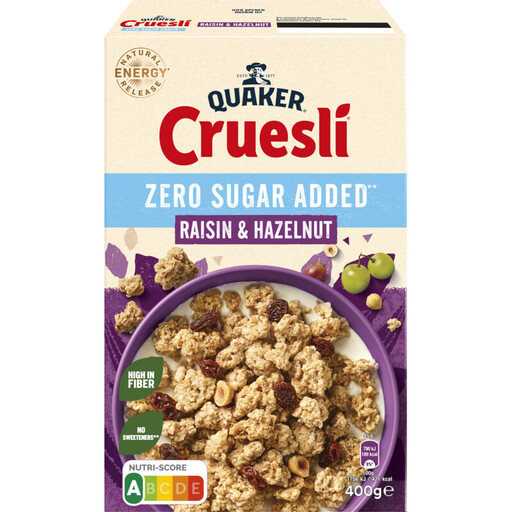 Image unavailable
A good fit if you prefer crunchy muesli with raisins and hazelnuts.
Pack size: 400 g. Compare fibre and total sugars on the packaging, and check the allergen information if you need to avoid nuts or certain grains.
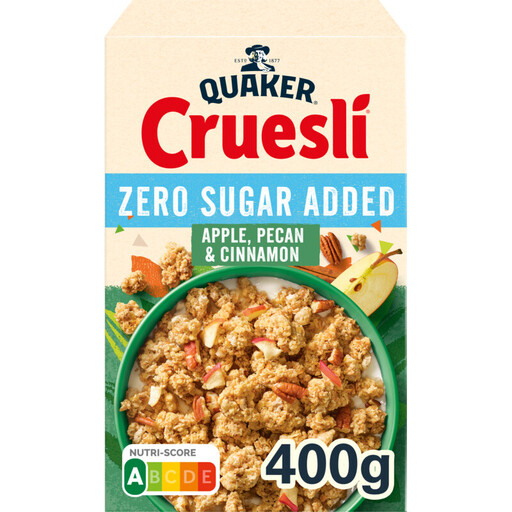 Image unavailable
The combination of apple, pecans and cinnamon is for anyone looking for a fruity, crunchy flavour.
Pack size: 400 g. Alongside the product name, check the total sugars per 100 g and the allergen information if you have a nut allergy.
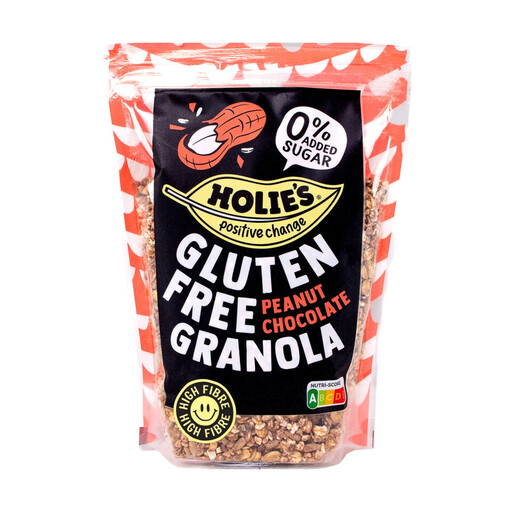 Image unavailable
This granola suits anyone who prefers chocolate and peanut flavour to fruity crunchy muesli.
Pack size: 330 g. If gluten-free is essential for you, check the label on the current packaging. Also read the allergen information, including details about peanuts.
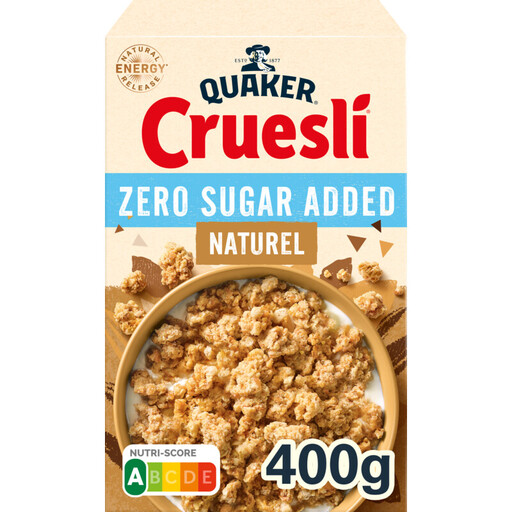 Image unavailable
Plain crunchy muesli is a good choice if you want to decide what flavour to add to your breakfast yourself, for example with fruit.
Pack size: 400 g. Compare fibre and total sugars per 100 g, and read the allergen information for this plain variety.
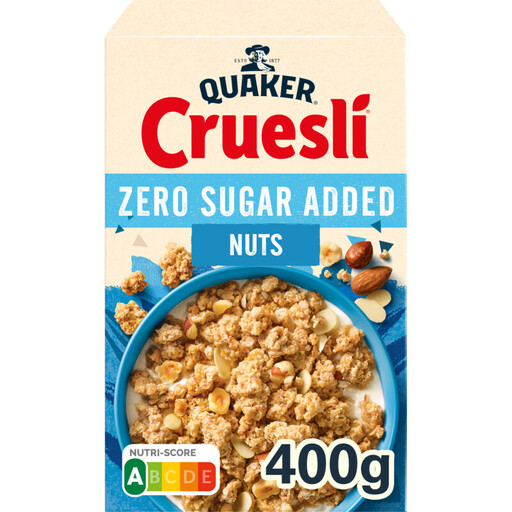 Image unavailable
A good fit if you’re looking for crunchy muesli with a nutty flavour.
Pack size: 400 g. The product name is no substitute for checking ‘of which sugars’ on the label; if you have a nut allergy, check the full allergen information too.
Compare the fibre content per 100 g in the nutrition table, then check which grains appear in the ingredients list. The Netherlands Nutrition Centre identifies wholegrain cereal products as a relevant source of fibre; when comparing muesli, also take the sugars and your usual portion size into account.
No. The claim doesn’t tell you how much total sugar the product contains. Sugars may come from dried fruit, for example. So check ‘of which sugars’ per 100 g and read the ingredients for the specific variety.
If you need to avoid gluten, don’t choose regular wholegrain muesli based on its wholegrain or fibre claim. Look for a product explicitly labelled gluten-free and also check the current packaging for other allergens and any warnings.
Online nutritional information is useful for comparing varieties in advance, but check the packaging before using the product. Ingredients, nutritional values and allergen information can vary between varieties or change if the recipe is updated.