Choose plain wholegrain porridge oats if you’re mainly looking for fibre and a neutral base; compare the fibre content per 100 g and per serving. Sachets save you weighing out a portion, while a protein or gluten-free option is mainly worth considering if you need that specific feature. Enjoy the porridge at a separate mealtime around your Indonesian rijsttafel, rather than as a substitute for the rice dishes.
Which oat option is right for you?
If you want to prepare a portion quickly
If you want to spend as little time as possible on a separate mealtime before or after your rijsttafel, plain portion sachets are worth considering. You won’t need to weigh out the oats, but do check that the fixed portion size suits you.
If you want to choose the flavour yourself
Loose wholegrain oat flakes provide a neutral base that you can combine with other ingredients. You weigh out your own portion and choose a preparation method that suits the flakes.
If you need to be strict about allergens
Check the ingredients and warnings on the packaging before you buy. If you follow a strict gluten-free diet, a standard pack of oats is not the same as a product explicitly labelled gluten-free.
What should you consider when choosing?
If you’re considering quick-cook oats as a separate mealtime around an Indonesian rijsttafel, fibre content, preparation, flavour and any dietary requirements are all factors that may influence your choice.
| What to consider | What to check before buying | Who it matters to |
|---|
| Fibre and wholegrain oats |
Compare fibre per 100 g and calculate how much you’ll get in your portion; also check the ingredients list. |
If I’m mainly looking for fibre from wholegrain oats, I want to know how much my own portion contains. This is estimated to be the main reason for buying for 40% of these consumers. |
| Preparation and portion size |
Check the preparation time, the equipment needed and the amount in each sachet. |
When I’m busy, I want to be able to make something without weighing out the oats. Around 30% of these consumers are expected to prioritise this convenience. |
| Neutral flavour |
Check the ingredients and nutritional information if you want to decide for yourself what to add. |
I want to eat my oats separately from the spicy meal and choose the flavour myself. This freedom is estimated to be the most important factor for around 20% of these consumers. |
| Allergens and gluten-free options |
Read the latest allergen information; if you follow a strict gluten-free diet, check whether the product is explicitly labelled gluten-free. |
If I need to avoid an ingredient, the label determines which oat options are suitable. This check is estimated to come first for 10% of these consumers. |
What should you look out for?
-
Looking at the fibre claim alone
According to Jumbo’s product information, Quaker Oats Express Naturel contains 9 g of fibre per 100 g. Albert Heijn lists 10 g per 100 g for AH fine wholegrain flakes. The amount you actually eat also determines how much fibre you get from a portion.
Compare products on the same 100 g basis, then check the fibre per portion.
-
Assuming every pack of oats is gluten-free
Standard oats may carry warnings about other cereals containing gluten. The Dutch Coeliac Association therefore highlights the importance of choosing oats that are clearly labelled gluten-free.
If you follow a strict gluten-free diet, check the latest gluten-free label and allergen information.
-
Confusing protein with a higher fibre content
Albert Heijn lists 7.2 g of fibre and 22 g of protein per 100 g for Quaker Oats Express Protein. That’s less fibre than the 9 g per 100 g Jumbo lists for Quaker Oats Express Naturel.
Compare fibre and protein separately, and check the allergen information on protein versions too.
-
Presenting porridge as a rijsttafel dish
Plain porridge can make a separate breakfast or snack around the meal. That doesn’t make it a traditional part of the meal or a substitute for the rice dishes.
Choose plain oats if you want to decide for yourself how to flavour this separate meal.
Brands compared
Always compare the specific version from each brand: plain porridge, a protein version and gluten-free oats may have different ingredients and nutritional values.
Quaker
Oats Express includes plain sachets and a Protein version for quick preparation.
- Jumbo lists 9 g of fibre per 100 g for Oats Express Naturel; Albert Heijn lists 7.2 g of fibre and 22 g of protein per 100 g for the Protein version.
- The Protein version contains soya. Check the latest allergen warnings for both versions.
Brinta
Brinta Havermout is an option if you’re looking for extra-fine oat flakes.
- Albert Heijn’s product information lists 100% oat flakes as the ingredient.
- The warning that the product may contain traces of wheat and rye means the standard version is not interchangeable with oats explicitly labelled gluten-free.
Albert Heijn
The AH range includes fine wholegrain flakes, a protein version and a wholegrain version explicitly labelled gluten-free.
- Albert Heijn lists 10 g of fibre per 100 g for the fine wholegrain flakes and 11 g per 100 g for the gluten-free wholegrain version.
- The AH Protein version contains soya; check the gluten-free label and other allergens on each pack.
Jumbo
Jumbo Grove Vlokken Volkoren is a loose oat option if you want to weigh out your own portions.
- Jumbo lists 10 g of fibre per 100 g for its coarse wholegrain flakes.
- Check the preparation instructions and allergens on the packaging of the version you choose.
Lidl
Lidl offers coarse oat flakes as a supermarket option.
- Lidl lists a 500 g pack and suggests having the flakes with milk, yoghurt or quark.
- Check the packaging for fibre per 100 g, ingredients and allergens.
Aldi
Aldi lists Golden Bridge fine or coarse wholegrain porridge oats.
- Aldi lists a 1 kg pack of these porridge oats.
- Read the nutritional information and allergen details for the fine or coarse version you choose before comparing it with other porridge oats.
Instant porridge oats on Joybuy
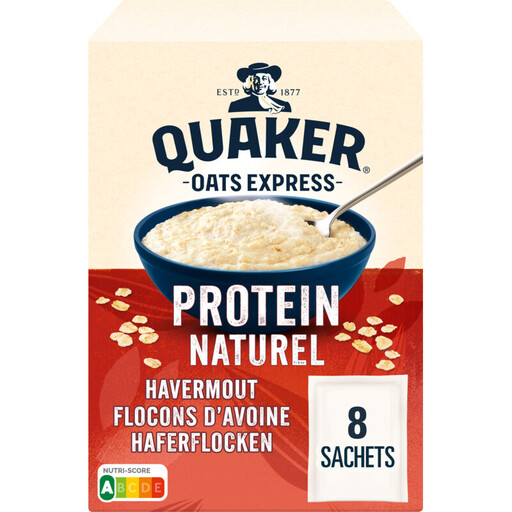
This protein version could suit you if you’re looking for quick-cook oats and want to compare protein as well as fibre content. Check the allergens if soya or cereals containing gluten matter to your choice.
 No image available
Quaker Oats Express Protein 302 g
An option if you want to prepare porridge quickly and take protein content into account too.
The product information lists a preparation time of two minutes, 7.2 g of fibre and 22 g of protein per 100 g.
Contains soya and may contain wheat and barley; check the current label if you have allergies or follow a strict gluten-free diet.
View on Joybuy
Frequently asked questions
How do I compare the fibre content of porridge oats?
First compare the nutritional information per 100 g, then check how much fibre is in the portion you plan to eat. Jumbo lists 9 g of fibre per 100 g for Quaker Oats Express Naturel; Albert Heijn lists 10 g per 100 g for AH fine wholegrain flakes. A sachet and a portion you weigh out yourself may not be the same size.
Are standard porridge oats suitable for a strict gluten-free diet?
If you follow a strict gluten-free diet, don’t rely on the word ‘oats’ alone. Standard oats may carry warnings about other cereals containing gluten, so check that the pack you choose is explicitly labelled gluten-free. The Dutch Coeliac Association also advises looking for the Crossed Grain symbol on gluten-free oats.
What should I look for on the label of plain or protein porridge oats?
Read the ingredients, allergen information and nutritional details for the exact version you’re buying. A protein version may contain soya, for example, and warnings about wheat or barley may also be relevant. A ‘plain’ label doesn’t replace these checks.


