
Families comparing fibre content
For households that want to check the amount of fibre per 100 g and take the sugar content per 100 g into account too.


When choosing granola for a large family, start by comparing the fibre content per 100 g, then check the sugars, allergens and pack size. EU Regulation 1924/2006 sets the requirements for the ‘high fibre’ claim: at least 6 g of fibre per 100 g or 3 g per 100 kcal. A larger bag is practical if the nutritional information and ingredients also suit your household’s needs.
For households that want to check the amount of fibre per 100 g and take the sugar content per 100 g into account too.
For families comparing pack sizes and stated serving numbers to make sure they have enough granola for several breakfasts.
For families where someone needs to check the ingredients and any cross-contamination warnings before buying. The fibre content alone does not tell you whether a product is suitable.
First compare the nutritional information on the same basis, then check that the pack size and ingredients suit your household.
| What to consider | What to check before buying | Who it matters to |
|---|---|---|
| Fibre and sugars | Check the fibre and sugar content per 100 g. Make sure any ‘high fibre’ claim meets the requirements of EU Regulation 1924/2006. | If I choose granola specifically for its fibre content, I want to be able to compare it with the sugars on the label. This comparison is the top priority for an estimated 45% of consumers. |
| Pack size | Compare the weight in grams and, if stated, the number of servings. | When planning several family breakfasts, I want to know how long one pack will last. Around 36% of consumers prioritise this practical need to stock up. |
| Allergens | Read the current ingredients list and any ‘may contain’ warnings on the pack. | If a family member needs to avoid an allergen, the label determines which granola is suitable. This check is the top priority for an estimated 19% of consumers. |
The ingredient name does not tell you how much fibre the finished product contains. For a ‘high fibre’ claim, EU Regulation 1924/2006 specifies at least 6 g of fibre per 100 g or 3 g per 100 kcal.
Check the fibre content in the nutritional information before using that claim to choose products.
The nutritional information published by Quaker for Cruesli Granola Zero Sugar Added Naturel states that it contains 3.2 g of sugars per 100 g. So the product name alone does not give you the full sugar content.
For the variant you choose, compare the ‘of which sugars’ figure per 100 g on the current packaging.
The variants reviewed differ in the allergens they contain and their ‘may contain’ warnings. A different flavour or updated packaging means you need to check again.
Read the current label every time you buy, even if you have bought the same granola before.
Quaker Cruesli Granola Zero Sugar Added Naturel is one option to compare for fibre and sugars.
Published nutritional values for Granola Classic Crunchy make it possible to compare the product per 100 g.
AH Granola noten is a supermarket own-brand option, sold in a 500 g bag.
Jumbo offers Granola Noten, Pitten en Zaden and Granola Haver, Pitten en Bessen, both in 500 g bags.
Lidl lists Super Berry and Super Nutty as granola variants available in store only.
ALDI lists Golden Bridge Granola in a 500 g pack.
These variants and multipacks offer different quantities of granola for family breakfasts. For every option, check the current label, especially if fibre content or allergens are a deciding factor.
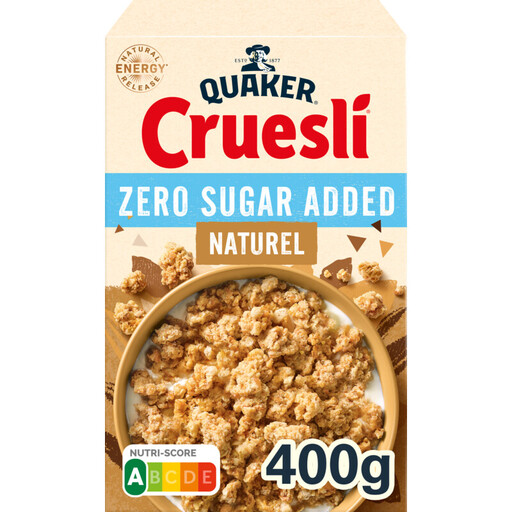 Image unavailable
A 400 g pack for anyone who prefers to buy a smaller quantity at a time. Check the fibre and sugar content on the current packaging, as published values for related Quaker product names vary. If you have allergies, also read the ingredients list and any ‘may contain’ warnings.
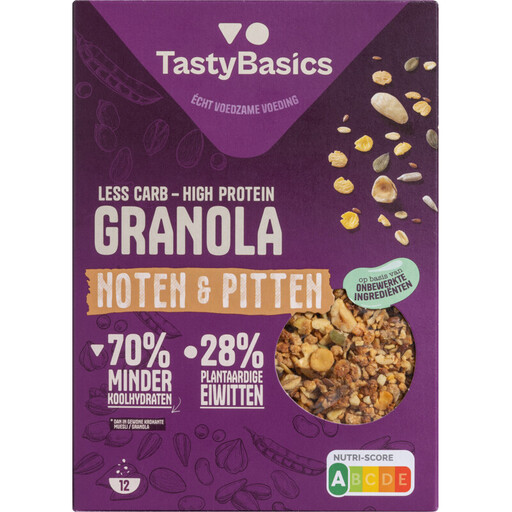 Image unavailable
The 350 g bag is a good option if you prefer to buy smaller quantities. If you’re specifically looking for granola with nuts and seeds, also check the full ingredients list and allergen information on the packaging.
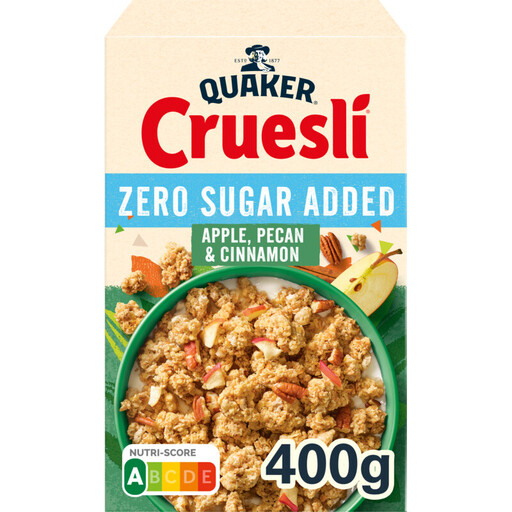 Image unavailable
A different flavour in a 400 g pack. Alongside the product name, check the sugar and fibre content on the current packaging. Also check the allergen information, as this variant contains pecans.
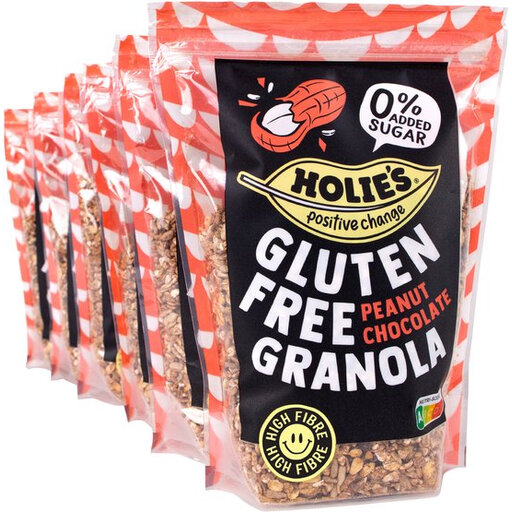 Image unavailable
Six 330 g bags make it easy to spread your supply across several breakfasts. If you need gluten-free granola, don’t rely on the product name alone: check the current packaging and look out for the peanut information too.
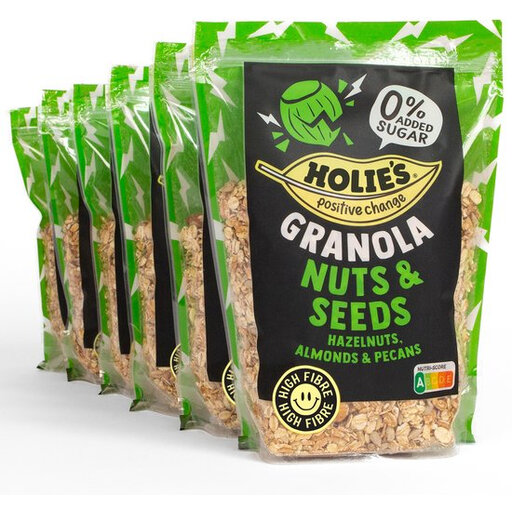 Image unavailable
With six 350 g bags, this multipack is ideal for households that like to keep granola in stock. Check the fibre and sugar content per 100 g, and before buying, check which nuts and grains are listed on the current label.
For a ‘high fibre’ claim, EU Regulation 1924/2006 requires at least 6 g of fibre per 100 g or 3 g of fibre per 100 kcal. Check the nutritional information for your chosen granola to confirm the amount.
You can’t tell from the ‘high fibre’ claim alone. The amount of fibre per serving depends on the serving size, and other foods also contribute fibre throughout the day.
Yes. If a family member needs to avoid an allergen, check the current label for the specific variant you’re choosing. The Netherlands Food and Consumer Product Safety Authority explains how allergens are listed in the ingredients; also check for any ‘may contain’ warnings.
Seal the packaging tightly after use and follow the product’s storage instructions. Albert Heijn advises sealing the packaging tightly for AH Granola noten.