
If fibre per serving is your priority
Compare the fibre content of a measured serving, and check the ingredients and allergens if you’re considering a bran product.


For your Easter brunch, first decide how you want to serve your cereal: choose a bran option if fibre per serving is your priority, porridge oats or cereal porridge for a warm bowl, and muesli or granola for a cold one. Then compare fibre, total sugars, salt and allergens on the label. A high fibre content alone doesn’t tell you about these other factors.
Compare the fibre content of a measured serving, and check the ingredients and allergens if you’re considering a bran product.
You want to customise porridge oats, cereal porridge or muesli with toppings such as fruit or yoghurt, and compare the total and added sugars.
You want to offer both hot and cold options, and check the allergens listed on the packaging in advance.
First decide what role the cereal will play on your table. Then compare the nutritional information per 100 g and for the serving you plan to offer.
| What to consider | What to check when buying | Who it matters to |
|---|---|---|
| Fibre per serving | Compare the fibre per 100 g with the amount in the serving you’ve chosen. | If fibre is my main reason for serving cereal, I want to know how much there is in a typical bowl. Around 36% of consumers prioritise fibre content. |
| Wholegrain and sugars | Read the ingredients list and distinguish between total and added sugars. | For a bowl I can top with fruit, I’m mainly looking for a wholegrain base and want to be able to compare the sugar content. Around 29% of consumers prioritise this. |
| Preparation and serving style | Check whether the product is ready to serve cold or needs to be prepared first. | For a buffet, I want to know whether I can set out bowls straight away or need to prepare a hot option. Serving style is the deciding factor for around 21% of consumers. |
| Allergens | Check the exact label and avoid cross-contact where necessary. | If guests have allergies, I need to identify a suitable option before comparing fibre content. For around 14% of consumers, allergen suitability is their first concern. |
A product can be high in fibre while also containing sugars or salt that you may want to take into account. Kellogg's lists 27 g of fibre and 18 g of sugars per 100 g for All-Bran Fibre Plus.
Read the nutritional information per 100 g, then compare it with the serving you’ll actually offer.
Albert Heijn lists 0 g of added sugar but 7.8 g of total sugars per 100 g for AH Volkoren muesli naturel; the product contains ingredients including raisins.
Check both the total sugars line and the ingredients list.
Quaker states that Havermout Original may contain barley and wheat. Other allergens or possible traces may also be relevant in muesli.
Ask which allergens you need to look out for, read the current packaging and, if necessary, use separate serving spoons and bowls.
The All-Bran range is worth considering if you’re looking at cereals made with wheat bran.
Quaker offers both porridge oats for a warm bowl and Cruesli for a cold one.
Brinta Volkoren graanontbijt is an option if you want to serve warm porridge.
AH Volkoren muesli naturel is a cold muesli that you can serve with yoghurt or milk, for example.
These products offer a choice of Cruesli for a cold bowl or porridge oats or cereal porridge for a warm one. Choose the serving style that suits your brunch, and check the nutritional information and allergens on the specific pack.
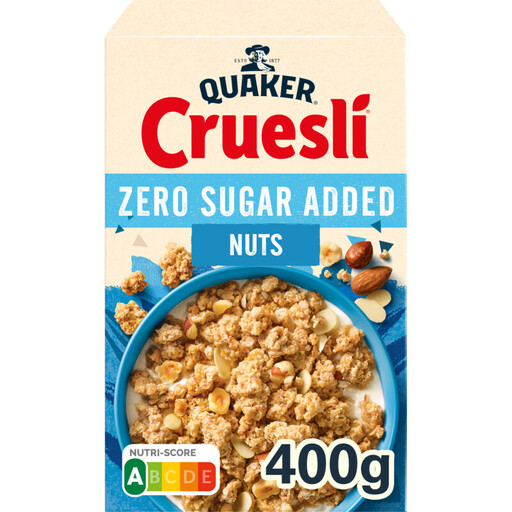 No image available
For a cold brunch bowl when you’re looking for nutty Cruesli. Read the nutritional information on the pack and check the allergens, including any mention of milk.
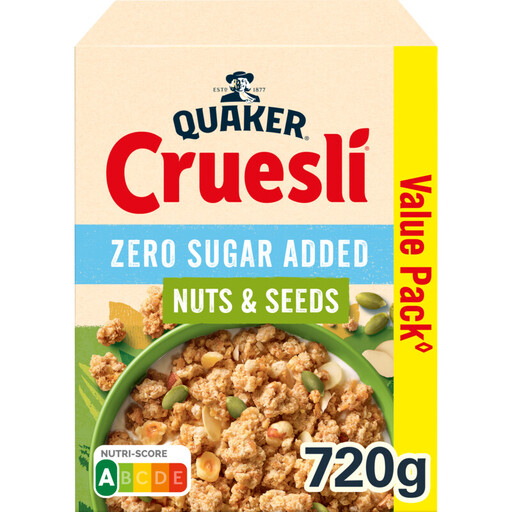 No image available
Cruesli for serving a cold bowl with nuts and seeds at your Easter brunch. Compare the fibre per 100 g; check the value per serving on the pack and read the allergen information.
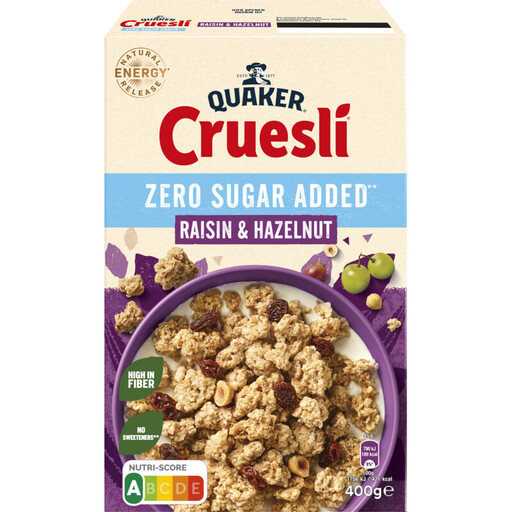 No image available
For a cold bowl if raisins and hazelnuts suit your brunch. Compare the total sugars, even if the pack says there are no added sugars, and check for any mention of milk if you have an allergy.
 No image available
For a warm bowl of porridge when you have time to prepare something during brunch. Check the preparation instructions and allergen information on the packaging.
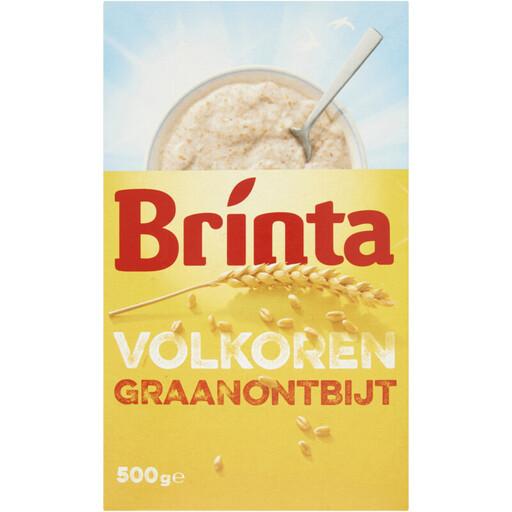 No image available
For warm cereal porridge when you have time to prepare bowls. Bear in mind that it contains wheat when choosing what to serve your guests, and check the current packaging.
European Regulation (EC) No 1924/2006 sets at least 6 g of fibre per 100 g as one of the conditions for using the ‘high fibre’ nutrition claim. Also compare the nutritional information for sugars and salt, and check how much you’ll serve per portion.
No. Albert Heijn lists 0 g of added sugar but 7.8 g of total sugars per 100 g for AH Volkoren muesli naturel; the product contains ingredients including raisins. So be sure to check the total sugars line too.
Don’t assume they’re suitable without checking. Quaker states that Havermout Original may contain barley and wheat; check the exact packaging and dietary suitability for your guest.
Set out muesli or Cruesli for cold bowls, and choose porridge oats or cereal porridge if you’d like to serve something warm too. Keep toppings separate so guests can make their own bowls, and check the allergens in each product.
Check the current packaging of the product you’re going to serve. Albert Heijn notes that ingredients, nutritional values and allergen information can change. If you’re serving a buffet, also watch out for cross-contact through spoons and bowls.