
People with coeliac disease who want to compare fibre
For you, the gluten-free claim on the current packaging comes before the fibre content or a familiar brand name. Also read the ingredients and any warnings about cereals containing gluten.


If you have coeliac disease, choose breakfast cereals whose current packaging explicitly says ‘gluten-free’; a fibre claim on its own isn’t enough. Then compare fibre per 100 g and per serving, as well as sugars and allergens. Take extra care with products containing oats: according to the Dutch Coeliac Society, oats can come into contact with cereals containing gluten, and not everyone with coeliac disease tolerates pure oats.
For you, the gluten-free claim on the current packaging comes before the fibre content or a familiar brand name. Also read the ingredients and any warnings about cereals containing gluten.
You’re looking for flakes, pops or muesli that you can serve without cooking. Once you’ve checked the gluten-free claim, you can compare fibre per 100 g and per serving.
You’d like to keep considering porridge oats or a product containing oats. The Dutch Coeliac Society highlights both the risk of contact with cereals containing gluten and the fact that people vary in how well they tolerate pure oats.
Start by checking the gluten-free claim on the exact product. Only then compare the nutritional information and choose the type of breakfast cereal you enjoy eating.
| What to look for | What to check when buying | Who it matters to |
|---|---|---|
| Gluten-free claim | Look for ‘gluten-free’ on the current packaging and check for warnings about cereals containing gluten. | If I have coeliac disease, I don’t want to assume a product is suitable based only on the type of grain or its fibre content. For around 50% of these consumers, the gluten-free claim comes first. |
| Fibre content | Compare fibre per 100 g and per serving; also check the sugars in the nutritional information. | For a high-fibre breakfast, I want to know how much fibre my usual serving contains without skipping the gluten-free check. Around 30% of consumers give this fibre comparison their highest priority. |
| Preparation and ingredients | Choose between flakes, pops and muesli based on the texture you prefer, and check for any other relevant allergens. | For a quick breakfast, I want a texture I enjoy and ingredients that suit my other dietary restrictions. For around 20% of consumers, everyday convenience matters most. |
According to the Dutch Coeliac Society, oats can come into contact with cereals containing gluten during growing and processing. Not everyone with coeliac disease tolerates pure oats either.
If you choose oats, look for a product with a current gluten-free claim and read the ingredients and warnings on the packaging too.
A warning about possible cross-contamination is not the same as a gluten-free claim, even if the breakfast cereal is described as high in fibre.
Take such a warning seriously. For a coeliac-friendly purchase, look for a product whose current packaging explicitly says ‘gluten-free’.
Gluten-free muesli can contain sugars and other allergens as well as fibre. Joybuy’s product information for Eat Natural Gluten-Free Buckwheat Muesli lists, among other things, nuts, peanuts, soya, sesame seeds and milk.
Read the nutritional information per 100 g and the allergen information for the exact product, especially if you have a food allergy as well as coeliac disease.
Albert Heijn says that product ingredients, nutritional values and allergen information can change.
When you buy a new packet, check the gluten-free claim, ingredients and allergens again.
This Albert Heijn range includes gluten-free muesli, oat flakes, high-fibre oat pops and high-fibre bran flakes.
Eat Natural Gluten-Free Buckwheat Muesli is a muesli made with buckwheat and seeds. Joybuy’s product information lists 7,8 g of fibre per 100 g.
Quaker is worth considering if you’re looking at oat products or Cruesli.
Brinta Porridge Oats are a hot oat option, but the information for this specific product needs extra attention if you have coeliac disease.
This curated selection brings together product examples based on their stated gluten-free and high-fibre positioning, as well as the type of breakfast cereal. It isn’t a ranking of nutritional value or an independent product test; compare the current packaging before choosing.
| Position | Product | Features | Why consider it? | Retailer |
|---|---|---|---|---|
| 1 | AH Gluten-Free High-Fibre Bran Flakes | Bran flakes; the product name states gluten-free and high-fibre. | Albert Heijn lists these flakes in the AH Gluten-Free range. Check the nutritional values and allergens on the current packaging. | Albert Heijn |
| 2 | AH Gluten-Free High-Fibre Oat Pops | Oat pops; the product name states gluten-free and high-fibre. | Albert Heijn lists these oat pops in the AH Gluten-Free range. Check the current gluten-free claim, particularly as the product contains oats. | Albert Heijn |
| 3 | Eat Natural Gluten-Free Buckwheat Muesli, 500 g | Buckwheat muesli; according to Joybuy, 7,8 g of fibre per 100 g. | Joybuy also lists 15,3 g of sugars per 100 g and several allergens for this muesli. Compare the current nutritional and allergen information. | Joybuy |
These products are granola in two pack sizes. Compare them as granola, not as flakes or muesli, and check the gluten-free claim and allergens on the current packaging before eating them if you have coeliac disease.
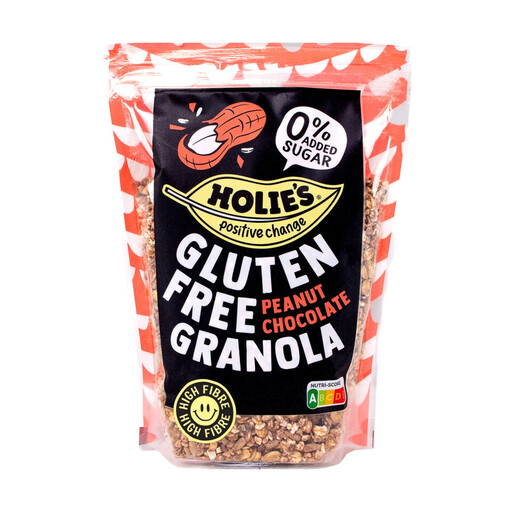 Image unavailable
A single pack of granola for anyone looking to compare this type of breakfast cereal. The product name states Glutenfree and the Peanut Chocolate flavour; check the gluten-free claim, ingredients and allergens on the current packaging.
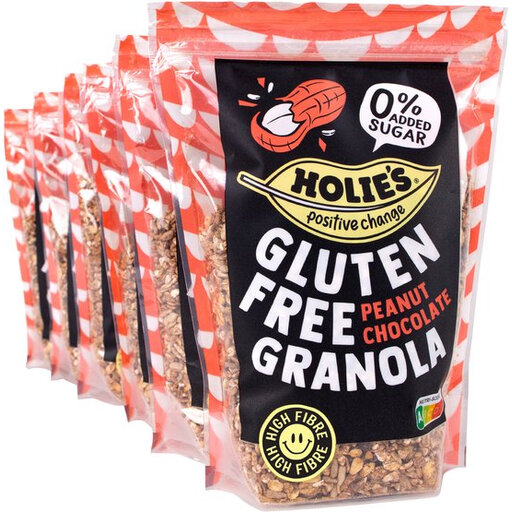 Image unavailable
A six-pack of 330 g packs for anyone looking for the same granola in a multipack. The product name states Glutenfree and the Peanut Chocolate flavour; as with the single pack, check the gluten-free claim, ingredients and allergens on the current packaging.
No. ‘High-fibre’ describes the fibre content, not whether a product is suitable for a gluten-free diet. Check the current packaging separately for the gluten-free claim, ingredients and any warnings about cross-contamination.
Only consider an oat product whose current packaging explicitly says ‘gluten-free’. The Dutch Coeliac Society points out that oats can become contaminated with cereals containing gluten, and that not everyone with coeliac disease tolerates pure oats.
Under Regulation (EC) No 1924/2006, the ‘high-fibre’ claim may be used when a product contains at least 6 g of fibre per 100 g or 3 g of fibre per 100 kcal. If you’re comparing different breakfast cereals, also check the nutritional information per serving.
No, not based on the information for this specific product. Albert Heijn warns that Brinta Porridge Oats may contain traces of wheat and rye; an oat base is no substitute for an explicit gluten-free claim.