What should you look for when choosing?
First decide whether you want heating or can allow more time for drying. Then work out whether a winged airer or a taller tower will best suit your available space and the uniforms you need to dry.
Heated clothes airer
Choose this if: you need to dry uniforms indoors and are short on time.
Bear in mind: it uses electricity, and you’ll need to remove the moist air from the room.
Unheated clothes airer
Choose this if: you have more time and don’t need built-in heating.
Bear in mind: this airer has no electric heating function to help meet a tight drying deadline.
| What to consider |
What to look for when buying |
Who is this important for? |
| Drying time |
Check the heating function and hanging space; don’t assume the wattage guarantees a particular drying time. |
If I need the uniforms dry before packing, I prioritise time. Around 33% of consumers say drying time is their main concern. |
| Space and storage |
Measure the space with the airer fully open, and check its folded dimensions and the space available for longer garments. |
In a small room, I want to be able to set up the airer and store it away compactly afterwards. Around 27% of consumers prioritise a suitable size and easy storage. |
| Electricity use |
Check the wattage and how long you’ll use it; you need both to calculate energy consumption. |
If I have more time, I want to know whether heating is necessary for my needs. Around 20% of consumers say electricity use is their main consideration. |
| Clothing and ventilation |
Read the care label on each garment and check the ventilation instructions for the room and the airer. |
When I’m drying uniforms made from different fabrics, I want to follow the care instructions and be able to remove moist air. Around 20% of consumers put fabric care and ventilation first. |
Clothes airers at Joybuy
This selection includes a heated winged airer and foldable unheated airers, including a drying tower. Focus on how much time you have for drying, how much space the airer takes up when in use and how you’ll store it afterwards.
 No image available
Foldable electric clothes airer with 2 side wings, 230 W
The heated drying area and side wings are useful if you want to spread out uniforms indoors and fold the airer away after use.
Power: 230 W; stated temperature range: 45–55 °C; dimensions when open: 144 × 53 × 91 cm; recommended maximum load: 10 kg.
The product description calls for a stable, level surface, good ventilation and a clearance of at least 31 cm from walls. Use an earthed socket and switch the airer off after use.
Joybuy
 No image available
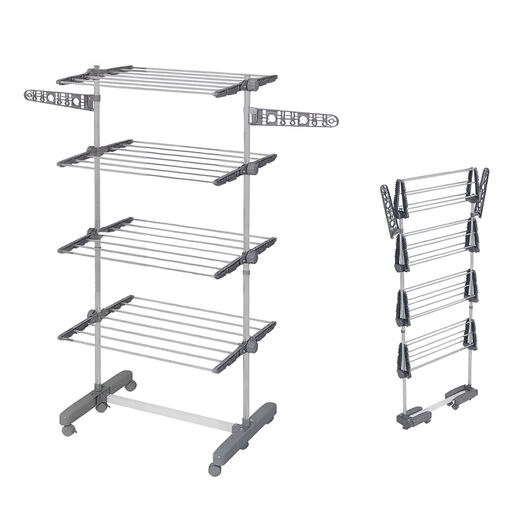
Foldable clothes airer with 4 adjustable tiers
This unheated airer is an option if you want to hang several garments and store it away compactly after use.
The description lists four adjustable tiers, six wheels (two of which lock) and a folded depth of 13 cm. There’s room for clothes hangers on the side wings.
Joybuy
 No image available
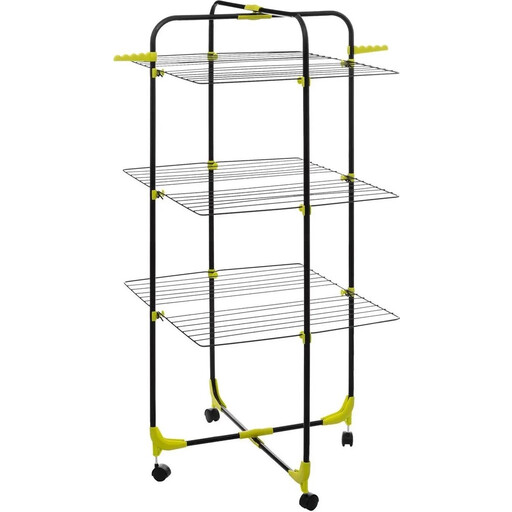
5five Mojave clothes airer, 30 m
The tower design may suit you if you want to make use of vertical drying space and be able to move or fold the airer away.
Stated drying space: 30 m; dimensions: 65 × 70 × 137 cm. The airer is foldable and has wheels; self-assembly is required.
Joybuy
 No image available
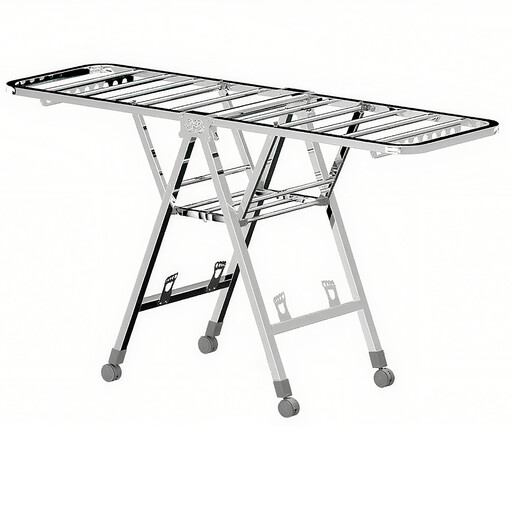
SNSP foldable floor airer with wings
This foldable, unheated floor airer may suit you if you want to hang clothes indoors and put the airer away after use.
The product information lists a stainless steel frame, adjustable angles and several hanging rails.
Joybuy
Frequently asked questions
How do you use a heated clothes airer for school uniforms?
First, check the care label on each garment and follow the instructions for your chosen airer. Space out the laundry, ventilate the room while drying clothes indoors, and only use a cover if it’s intended for that model and the manual allows it.
How do you calculate a clothes airer’s electricity use?
Multiply the power in kilowatts by the number of hours the airer is switched on to calculate consumption in kWh. To work out the cost, multiply that consumption by your own price per kWh. Without the running time and your tariff, the wattage alone won’t tell you the cost of each drying session.
What can you do if an electric airer develops a fault?
When you buy as a consumer in the Netherlands, a product must be of satisfactory quality. If it isn’t, the retailer is your point of contact. The Dutch government states that there is no fixed statutory guarantee period for all products in the Netherlands; an additional guarantee does not replace your statutory rights.
What rules apply to electric clothes airers sold in the Netherlands?
Businesses that place electrical appliances on the Dutch market must comply with the relevant European product safety rules. The Dutch government’s Ondernemersplein explains these requirements. Also check the product information and instructions for the specific airer.


