
Renter with limited floor space
Wants to dry bath towels without a wide airer taking up a walkway for long periods. Compare the space the airer takes up in use with the space available for storing it.


For bath towels in a compact rented home, a slim heated towel rail is a good fit if you have a small, fixed spot for it. A foldable heated airer makes more sense if you can keep a wider area clear while your laundry dries and want to put it away afterwards. Measure both the dimensions in use and when stored, make sure moisture can escape, and check the instructions, installation requirements and documentation for the exact model before buying.
Wants to dry bath towels without a wide airer taking up a walkway for long periods. Compare the space the airer takes up in use with the space available for storing it.
Needs a practical way to get rid of moisture. Milieu Centraal recommends extra ventilation when drying laundry indoors; heat is no substitute for ventilation.
Needs enough room to spread towels out and should consider whether a foldable airer can be put away after use without its wider setup getting in the way while drying.
Start with the space you can keep clear while your laundry dries. Then check ventilation, room for your towels and power consumption.
Suitable if: you mainly want to hang one or a few towels and have a narrow, permanent spot available. DOMO lists model DO7117DR as suitable for freestanding or wall-mounted use, with dimensions of 52,50 × 36,50 × 90,00 cm.
Consider: check whether the towel can hang sufficiently open across the available width and whether the chosen spot is suitable for the installation type.
Suitable if: you can free up extra floor space while your laundry dries and want to put the airer away afterwards. Adler lists the AD 7821 as measuring 148 × 52,5 × 90 cm when open and 113 × 52,5 × 8 cm when folded.
Consider: the width when open could block a walkway in a compact home. The stated power rating of 220 W does not, on its own, tell you how long drying will take.
Suitable if: you would rather not use electric heating and can air-dry your towels with enough ventilation.
Consider: even with an unheated airer, damp air needs to be removed; the airer itself does not add heat.
| What to consider | What to look for | Who it matters most to |
|---|---|---|
| Space in use and storage | Measure the width and depth when open, the clear walkway and the storage dimensions of the exact model. | If I have limited floor space, I want to know whether the airer and a bath towel hanging on it will fit in the space available. Around 31% of consumers say available floor space is their main concern. |
| Moisture removal | Check where fresh air can enter and damp air can escape; don’t choose based on heating power alone. | When I dry laundry indoors, I want to know in advance how damp air can leave the room. Around 25% of consumers say moisture removal is their main concern. |
| Room to spread out towels | Compare the size of your towels with the arrangement of the rails and check how much space remains while the airer is in use. | If I’m hanging several bath towels, I want to be able to spread them out properly rather than relying on the number of rails alone. Around 25% of consumers prioritise space for spreading laundry out. |
| Power consumption | Compare the stated power rating with the expected usage time; the power rating alone doesn’t tell you how much electricity one drying session will use. | If I want to know how much electricity heating uses, I compare the power rating with how long the airer is switched on. Around 19% of consumers say running costs are their main concern. |
An airer may take up very little space when stored but still block a passageway when in use. Adler lists the AD 7821 as 148 cm wide when open and 8 cm deep when folded.
Measure the space with the airer fully open and allow for the room taken up by a hanging bath towel.
A blocked walkway could mean you can’t use the drying area freely while the airer is in use.
A heated airer doesn’t remove evaporated water from your home. Milieu Centraal recommends extra ventilation when drying laundry indoors.
Before buying, work out where fresh air can enter and where damp air can leave the room.
The stated IP rating applies to a specific model and does not, by itself, mean that every spot next to a shower or bath is suitable. DOMO lists IPX4 for the DO7117DR; Adler lists IP22 for the AD 7821.
Check the instructions for the exact model, where it can be installed and how it should be connected. Do not use a damaged cable.
DOMO describes the DO7117DR as an electric towel rail that can be used freestanding or wall-mounted.
The Adler AD 7821 is a foldable heated airer for anyone who wants to hang other laundry as well as towels.
The range includes the foldable Warmmat clothes airer and the Towarck towel rail for floor or wall use; designs vary by model.
These Joybuy products range from a wall-mounted towel rail to foldable clothes airers. Check that the installation type, space needed in use and any heating suit your needs for the exact model.
 No image available
A good fit if you want to install a heated towel rail on the wall; you’ll need a suitable place to mount it.
The product description mentions a top shelf and dimensions of 58,5 × 55 cm.
 No image available
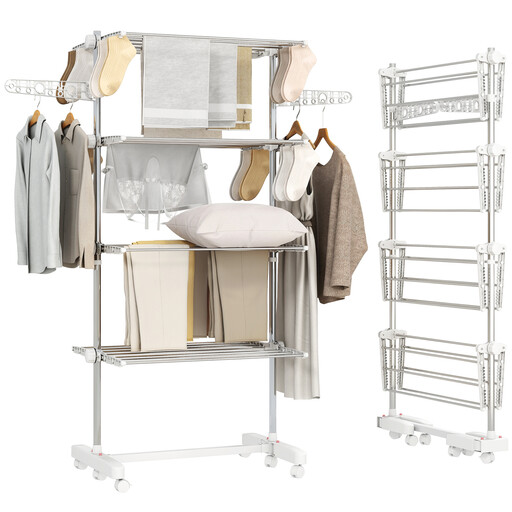
A good fit if you’re looking for multiple hanging surfaces and a foldable design.
The description lists four shelves, side arms and wheels. The airer measures 172 × 142 × 55 cm when open and 172 × 80 × 13 cm when folded.
 No image available
A good fit if you’re looking for a heated airer with side wings and have room for a wider setup while your laundry dries.
The stated dimensions in use are 144 × 53 × 91 cm. The product description says it must be used indoors on a flat surface, with sufficient ventilation and at least 31 cm of clearance from walls.
No. Milieu Centraal recommends extra ventilation when drying laundry indoors. Check that the chosen spot has effective airflow in and out; heat alone won’t remove moisture from the room.
No. Don’t assume a product is suitable for bathroom use just because of its category. DOMO gives the DO7117DR an IPX4 rating, while Adler gives the AD 7821 an IP22 rating. For the exact model, check the instructions, its position in relation to water and how it should be connected safely.
According to the Dutch government, minor changes that can be undone without significant cost are generally possible without the landlord’s permission. More extensive work, such as renovating a bathroom, requires permission. So consider the scope of the installation and the terms of your tenancy.
Multiply the power rating in kilowatts by the number of hours in use to calculate consumption in kWh. Multiply that figure by your electricity tariff if you want to estimate the cost. Without comparable drying times and your own tariff, it’s not possible to say reliably which option costs least per dry towel.
The NVWA outlines safety requirements for electrical equipment within the applicable voltage range; the Low Voltage Directive applies to equipment with a rated AC voltage of 50–1.000 V. The Dutch government states that electronic devices placed on the market in the EU must have a CE mark. Check which requirements apply to the exact model and what product documentation should accompany it.