
Anyone who washes pillowcases
You regularly wash pillowcases separately and want their size and drying instructions to suit the way you dry them.


A heated airer is worth considering if you often dry pillowcases indoors and would find the extra warmth useful. Make sure you choose an airer that lets you lay or hang the cases without overlapping them, in line with their care labels. A standard airer uses no electricity, whereas with a heated model you’ll also need to consider how long you use it for and how much space you have. For an electric model, also check that the product information for the specific item confirms the applicable conformity requirements.
You regularly wash pillowcases separately and want their size and drying instructions to suit the way you dry them.
You often use an airer for a small amount of laundry and weigh up storage space and electricity use against the convenience of heat.
You have limited room for an airer and need to consider ventilation when drying laundry indoors.
A good fit if: you want to spread your pillowcases out side by side and put the airer away after use.
Bear in mind: the space the airer takes up when unfolded and the electricity it uses while heating.
A good fit if: your pillowcases fit on the available drying area and a compact set-up is important to you.
Bear in mind: a narrow airer may not have enough space to spread out a larger pillowcase.
A good fit if: your pillowcases can dry in time without extra heat and you want to avoid using electricity.
Bear in mind: drying may take longer, and you’ll still need ventilation when drying indoors.
First, measure your pillowcase and the space for the airer. Then you can decide whether heating would make a difference to your drying routine.
| What to consider | What should you look for? | Who should pay particular attention? |
|---|---|---|
| Suitable drying area | Compare the pillowcase with the usable sections of the airer and read the care label. Don’t assume it’s suitable for heated bars just because the label says not to tumble dry. | If I want to dry my pillowcases without folding them, I check both their size and the fabric care instructions. Fit and fabric care are the main concerns for around 36% of consumers. |
| Electricity use | Check the stated power rating and controls, and take the length of use into account. An unheated airer uses no electricity, according to Milieu Centraal. | If I do small loads regularly, I want to know whether the extra heat is worth the additional electricity use. Around 29% of consumers are mainly concerned with running costs. |
| Space and storage | Measure the available floor or wall space and compare it with the airer’s dimensions when in use. Also consider where you’ll store it afterwards. | If the airer mustn’t get in the way every day, it needs to fit both the drying area and the space where I’ll store it. Space is the main concern for around 21% of consumers. |
| Moisture and placement | Check whether you can ventilate the room and follow the instructions for connecting and positioning the specific model. | When drying indoors, I want a suitable place for the airer and a way to clear moisture from the room. Around 14% of consumers prioritise moisture control and placement. |
A timer, temperature control or stated power rating won’t, on its own, tell you how long your pillowcases will take to dry. So don’t compare models by drying time or cost per load unless the conditions of use are the same.
An airer that’s suitable for towels may not have enough usable space to spread out a pillowcase.
Measure your pillowcase and compare it with the airer’s layout and dimensions when unfolded.
Without knowing how long it’s used for and how well it dries, the stated power rating won’t tell you how much electricity a full drying session uses.
Compare power ratings and usage times on a like-for-like basis. Consider an unheated airer if you don’t need the extra warmth.
With regular use, electricity consumption is an ongoing cost.
Moisture from your laundry still gets into the air indoors when you use a heated airer.
Choose a spot where you can ventilate the room as needed, whether or not the airer is heated.
The Warmmat is an example of a folding heated winged airer for indoor use. InnovaGoods lists 20 heated bars, 230 W, a timer and adjustable temperature.
DOMO describes the DO7117DR as a compact heated airer that can be freestanding or wall-mounted.
The HangOn airer is an unheated alternative for comparison. Brabantia lists adjustable wings and a shelf for delicates.
This selection includes compact heated airers, an unheated airer and a heated winged airer. Before buying an electric model, check the applicable product information and make sure the dimensions and instructions suit your pillowcase and drying space.
 Image unavailable
A heated wall-mounted airer for anyone looking to free up floor space; it’s designed to be fixed to the wall.
Dimensions: 58,5 × 55 cm. The title mentions touch controls and a digital temperature display.
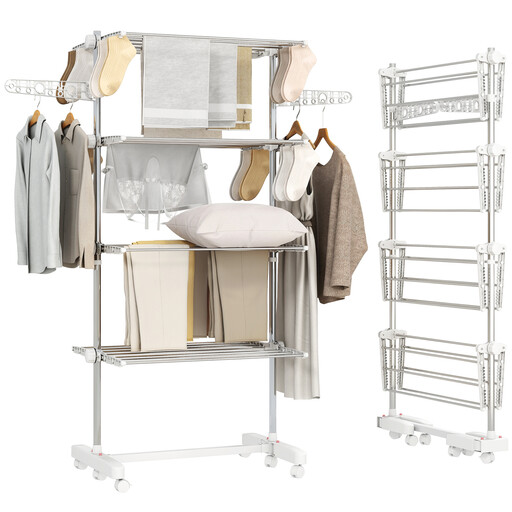 Image unavailable
An unheated airer to consider if you don’t need extra warmth and want a foldable design.
The product description lists four shelves, two side arms and wheels. Spread laundry evenly, lock the wheels during use and don’t exceed 6 kg per shelf.
 Image unavailable
A heated winged airer to consider if you want to spread your pillowcases out side by side and fold the airer away after use.
Dimensions: 144 × 53 × 91 cm. The description mentions two fold-out side wings. Use the airer indoors on a stable, level surface with ventilation, and keep it at least 31 cm away from walls.
No, that doesn’t automatically follow from the care label. Check the full drying instructions for your pillowcase and see whether the airer’s manual allows direct contact with heated parts.
Yes. Moisture from your laundry gets into the room even when you use a heated airer. Milieu Centraal recommends ventilating when you dry laundry indoors.
It can be, if your pillowcases dry in time without extra warmth. An unheated airer uses no electricity; you’ll still need to consider ventilation when drying indoors.
Check the information for the specific model and offer, including the applicable product conformity details. Electrical equipment covered by European low-voltage rules must meet requirements such as CE marking and an EU declaration of conformity. For more information, consult Business.gov.nl and the European Commission.