
People with delicate summer dresses
They want to match the drying method to the care label: some garments need to be hung up, while others should be dried flat or in the shade. GINETEX’s care symbols show which method to use.


First, check the drying method specified on your dress’s care label, and see whether it should be hung up or dried flat. A heated airer may suit small loads dried indoors, but ordinary line or airer drying uses no electricity for heat; Milieu Centraal recommends drying clothes outdoors or in an unheated room where possible. If you’re considering an electric model, check the available space, ventilation and rating plate too, and review the product information before you buy.
They want to match the drying method to the care label: some garments need to be hung up, while others should be dried flat or in the shade. GINETEX’s care symbols show which method to use.
They need a drying spot that’s usually available, without having to unfold a large airer every time, and need to weigh up heating against air-drying. Milieu Centraal recommends drying clothes outdoors or in an unheated room where possible.
They need room for the airer when it’s open, as well as ventilation, and should check whether a long dress can hang freely.
Choose this when: the care label allows the drying method you’ve chosen and you have space outdoors or in an unheated room.
Bear in mind: drying time depends on the conditions; if you have a long dress, check the available hanging height.
Choose this when: you regularly dry small loads indoors and the care label and instructions allow this drying method.
Bear in mind: the rails use electricity; a claim that clothes dry faster isn’t a measured drying time for your dress.
Choose this when: you want to make use of floor space with multiple levels and your dress can hang freely between them.
Bear in mind: multiple levels don’t guarantee enough hanging height for a long dress; check the specifications of the specific model too.
GINETEX distinguishes between different ways of naturally drying clothes. So a ban on tumble-drying doesn’t automatically mean a dress is suitable for direct contact with heated rails.
| What to consider | What to look for | Most important for |
|---|---|---|
| Fabric and drying method | Follow the care label for hanging, flat or shade drying; check that the dress won’t come into unwanted contact with warm rails. | I want to match the drying method to each dress’s care label, not just rely on a ban on tumble-drying; around 33% of consumers make fabric care their top priority. |
| Convenience for small loads | Compare how the airer is set up, used and stored; check whether its drying space suits a small load. | If I often hang up a small load, I want an airer that’s practical to use and store between washes; around 27% of consumers prioritise convenience for frequent use. |
| Hanging space and floor space | Measure the footprint when open, as well as the available height for the dress; drying length alone doesn’t tell you how much room a long dress will have. | I have limited floor space and also want to make sure the hem doesn’t rest on the floor or a lower level; around 20% of consumers prioritise space and clear hanging height. |
| Electricity and ventilation | Calculate energy use using the wattage of the exact model and how long you actually use it; make sure the room is ventilated when drying clothes indoors. | If I regularly dry clothes indoors, I want to be able to weigh up electricity use and let damp air escape; around 20% of consumers prioritise energy use and indoor air quality. |
The symbol rules out tumble-drying, but it doesn’t automatically tell you whether direct heat from the airer’s rails is suitable.
Follow the dress’s care symbols and check that the airer’s instructions allow the drying method you want to use.
Energy use also depends on how long you use the airer and your electricity tariff. Drying on an unheated airer uses no electricity for heat.
Calculate energy use using the wattage of the exact model and the number of hours you actually use it.
The stated drying length doesn’t tell you how much vertical space there is for a dress.
Measure both the footprint when the airer is open and the clear hanging height your dress needs.
Drying clothes indoors adds moisture to the air; using electrical appliances carelessly can create a fire risk. The Netherlands Fire Service warns about the dangers of careless use.
Ventilate the room, check the cord and plug connection, and follow the instructions for your chosen model.
Offers heated airers with side wings and heated drying towers with a cover.
The Classic 100 Easy is a compact, non-electric option for small loads.
Offers non-electric airers, hanging airers and drying towers as alternatives when you don’t need heat.
Here you’ll find a heated airer with side wings and standard airers for anyone who wants to air-dry small loads.
 No image available
This foldable heated airer has a central drying area and two fold-out side wings for small loads indoors.
Listed dimensions: 144 × 53 × 91 cm. The product description recommends a maximum load of 10 kg.
Check that the rating plate shows compatibility with 230 V and 50 Hz and the required CE marking; ensure there’s ventilation and follow the instructions.
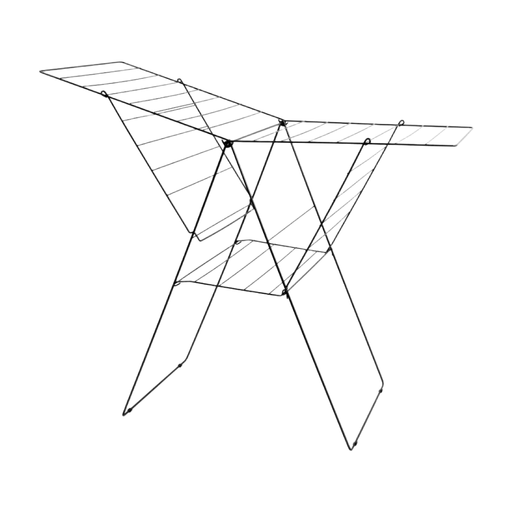 No image available
A foldable standard airer for drying clothes naturally and storing away after use.
Listed dimensions: 95 × 128.5 × 59 cm; folded: 101 × 59 × 4.5 cm. Drying length: 20 m.
If you have a long dress, measure the available hanging height; drying length doesn’t tell you this.
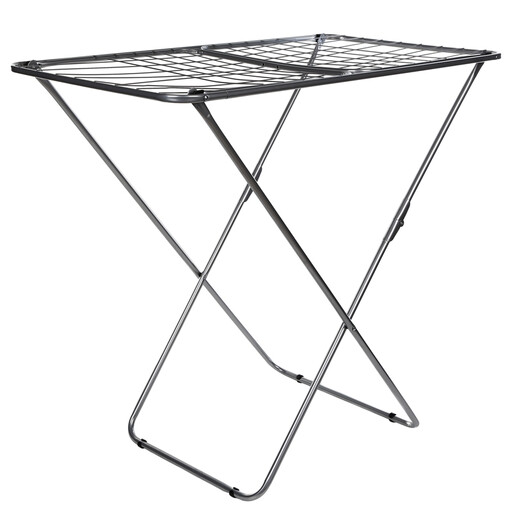 No image available
A clothes airer for natural drying that, according to the product information, can be used indoors and outdoors and is easy to store.
The listed drying length is 18 m. The product information lists metal and plastic as the materials.
Check that the dimensions and layout suit the space you have available and the length of your dress.
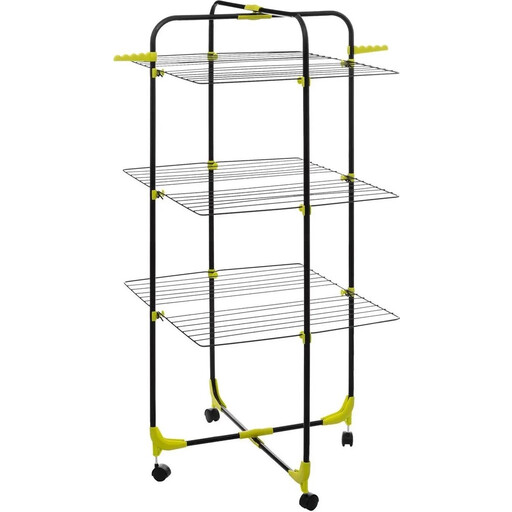 No image available
This standard drying tower is a foldable option for air-drying; the product information suggests it can be used for large and long items of laundry.
Listed height: 137 cm. Drying length: 30 m; self-assembly is required.
Check that a long dress can hang freely between the levels; the height alone doesn’t confirm how much clear hanging space there is.
That symbol rules out tumble-drying, but it doesn’t automatically tell you whether direct heat from the airer’s rails is suitable. Check the natural-drying symbols too, along with the instructions for the garment and the airer.
Ventilate the room so damp air can escape. Milieu Centraal recommends good ventilation; a heated airer isn’t a substitute for it.
To calculate kWh, multiply the wattage divided by 1,000 by the number of hours of use. For example, a 230 W airer left on for 4 hours uses 0.92 kWh; this is a calculation example, not a measured energy use or drying time for a particular load of washing.
In the Netherlands, you’re entitled to a product that works as it should; there’s no single fixed legal guarantee period for all products. The seller must resolve problems with a faulty product. For many distance purchases, you also have a 14-day cooling-off period, subject to exceptions, as explained by the Dutch government.
No. For electrical equipment that must carry the CE marking under the applicable EU rules, the marking is the manufacturer’s declaration. Your Europe explains that there’s no central EU body that issues a general CE certificate for this purpose. Check the rating plate and product information for the specific model too.
Follow the instructions for the exact model. For the airer described, the product information from Joybuy seller Novatech says to switch it off, unplug it before cleaning and let it cool down; don’t immerse it in water.