
People who wear delicate underwear
You want to follow the drying instructions for each garment and check whether contact with heated bars is suitable. GINETEX explains how washing and ironing symbols can provide guidance on drying.


For a few items of underwear, a standard clothes airer is a sensible first option to compare: the airer itself uses no electricity. A heated model may suit you if you regularly dry clothes indoors and want extra warmth. Check the care label, available space and ventilation, though, as heating won’t remove moisture from the room by itself.
You want to follow the drying instructions for each garment and check whether contact with heated bars is suitable. GINETEX explains how washing and ironing symbols can provide guidance on drying.
You regularly dry underwear indoors when the weather is changeable, so you need to consider both the space available while the airer is in use and where you’ll store it. Milieu Centraal also highlights the importance of ventilation at home.
You occasionally dry a small load and want to weigh up whether extra heat suits your needs compared with an airer that uses no electricity itself.
Start with the care label and where you’ll put the airer. Then compare its size and electricity use.
| What to consider | What should you check? | Who is this important to? |
|---|---|---|
| Suitable for your underwear | Read the drying instructions for each garment and follow the guidance for the exact airer. A ban on tumble drying does not, by itself, mean it is safe to place the garment in contact with heated bars. | If I dry different types of underwear, I want to be able to treat each garment according to its care label. Around 33% of consumers prioritise fabric care. |
| Space and storage | Compare the dimensions when the airer is in use and folded away, and consider how many items you want to hang with space between them. | When space is tight, I want to know whether the airer will fit both in use and when stored away. Around 27% of consumers prefer a size that suits their space. |
| Electricity use | Check the stated power rating and estimate how many hours you’ll use the airer. The power rating alone doesn’t tell you how much electricity a drying session will use. | If I only dry a small load now and then, I want to weigh up the electricity use against an airer that uses no electricity itself. Around 20% of consumers focus mainly on electricity use. |
| Ventilation and placement | Choose a spot where you can ventilate, and follow the placement instructions and IP rating for the exact model, especially if you’re putting it near water. | When drying indoors, I want to use a spot where moisture can escape and the appliance can be positioned according to the instructions. Around 20% of consumers prioritise ventilation and safe use. |
A similar shape or size doesn’t prove that products have the same specification, connection requirements or instructions for use.
Check the full model number and read the documentation for the product you want to buy. Don’t automatically assume that an airer that looks similar is the same model.
The AD 7821 is a wide, foldable heated airer for anyone who regularly hangs several items at once.
The DO7117DR is a more compact heated airer which, according to DOMO, can be freestanding or wall-mounted using the included fittings.
An option to consider if you’re looking for a wide, foldable heated airer with room to hang several items at once.
These Joybuy options are designed for drying underwear indoors: an airer with shelves and side arms, and a foldable heated model.
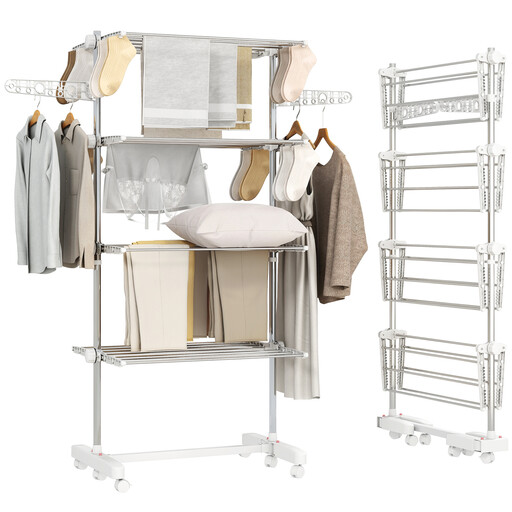 Image unavailable
An option if you want to lay out or hang several different items at once and fold the airer away after use.
Four shelves and side arms with hanger slots. Maximum load: 30 kg, with up to 6 kg per shelf. Folded dimensions: 172 × 80 × 13 cm. Lock the brakes while in use.
 Image unavailable
A heated option if you want to dry underwear and other clothes indoors and fold the airer away after use.
Power rating: 230 W. Dimensions when in use: 144 × 53 × 91 cm. The description gives a recommended maximum load of 10 kg and two fold-out side wings. Use the airer indoors on a stable, level surface, with ventilation and at least 31 cm of clearance from walls. Plug it into an earthed socket that matches the appliance label.
That symbol rules out tumble drying, but it doesn’t give general permission to place the garment in contact with heated bars. Follow the garment’s other drying instructions and the guidance for the exact airer. GINETEX describes washing and ironing symbols as possible guides to drying.
Yes. Ventilation is still important when you dry laundry indoors: heating the airer won’t make the moisture evaporate out of the room by itself. Milieu Centraal highlights the importance of adequate ventilation at home.
No, don’t assume that based on the product category alone. DOMO lists IPX4 for the DO7117DR, but check the IP rating, instructions and intended placement for your exact model.
Follow the instructions for the model you’ve bought and switch it off completely. Brandweer Nederland advises switching electrical appliances off rather than leaving them on standby.
Electric clothes airers covered by the relevant European product rules must meet conformity requirements, including CE marking and an EU declaration of conformity. The Dutch government’s Ondernemersplein and the European Union’s Your Europe explain these product obligations. A CE mark is not a certificate issued by a central EU body for an individual airer.