
Hosts with delicate swimwear to dry
You want to give guests a practical place to dry clothes without assuming that every swimsuit or pair of swim shorts can withstand heat. Compare the care labels with how the airer works and the settings it offers.


Choose a standard, unheated clothes airer if your holiday home has a well-ventilated place to dry clothes. It’s the more cautious option for swimwear whose care label does not allow heat. A heated airer can be practical if drying clothes indoors would otherwise be difficult, but check the care label, settings and placement instructions for the exact model first. For example, Decathlon Netherlands says that a swimsuit must not be tumble-dried. This does not automatically mean that contact with heated bars is suitable or unsuitable.
You want to give guests a practical place to dry clothes without assuming that every swimsuit or pair of swim shorts can withstand heat. Compare the care labels with how the airer works and the settings it offers.
You’re looking for a sturdy airer that guests can use with confidence, with somewhere suitable for the cable and enough space for heat to disperse and air to circulate.
You need to dry wet clothes indoors and want to weigh up the airer’s open dimensions, storage and ventilation against a more compact tower model.
First, work out where you can put the airer and what the care labels allow. Then compare the airers’ design, controls and placement requirements.
| What to consider | What to look for when buying | Who should pay particular attention? |
|---|---|---|
| Heat and fabric care | Check the care label and temperature setting. See whether clothes can dry without touching the heated bars directly. | If I provide swimwear made from different fabrics, I want to know what each care label allows before choosing an airer. Around 33% of consumers prioritise avoiding unsuitable heat for swimwear. |
| Controls and placement | Read the model’s instructions for use, connection and permitted placement; also check the relevant product marking. | With different guests coming and going, I want clear instructions and a suitable, stable place for the airer. Around 27% of consumers prioritise straightforward, careful use by guests. |
| Ventilation | Check where damp air can escape and whether you can hang clothes with space between them. | When drying wet clothes indoors, I want to be able to let damp air out and avoid hanging items too close together. Around 20% of consumers put a well-ventilated drying space first. |
| Space and electricity use | Measure the space available for setting up and storing the airer; compare its power rating in W with how long you expect to use it. | In a small holiday home, I want to be able to set up and store the airer without it getting in the way. Around 20% of consumers prioritise suitable dimensions and knowing how much electricity it uses. |
A care label and a heated airer involve different drying conditions. A warning against tumble-drying does not mean that contact with heat is allowed.
Start with the garment’s label. If in doubt, choose an unheated, well-ventilated place to dry it.
Moisture from wet clothes enters the indoor air; heating or using a cover does not remove that moisture from your home by itself.
First, choose a place for the airer with enough ventilation and space between garments.
The stated power rating alone does not tell you how much electricity a full drying session uses; the length of time matters too.
Compare the power rating and expected running time on the same basis. Then calculate the energy used in kWh, using your own electricity tariff.
Worth considering if you’re comparing a heated winged airer with a horizontal layout against a heated tower airer.
Worth considering if you’re comparing a foldable electric airer with different control options.
The DD6003 model is worth considering if you’re weighing up a foldable airer with heated bars against models with adjustable controls.
This selection includes an unheated, foldable clothes airer and an electric heated airer with side wings. For the heated model, the care label determines whether it’s suitable for swimwear.
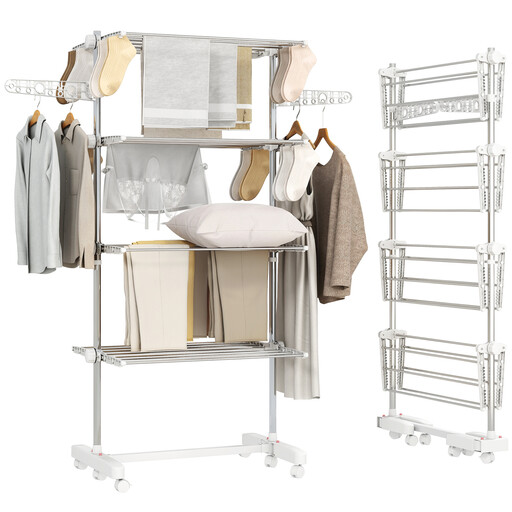 Image unavailable
An unheated option if you want to spread clothes out or dry them on hangers.
Four tiers and side arms with hanger slots. Folded dimensions: 172 × 80 × 13 cm.
Spread the washing evenly, do not exceed 6 kg per tier and lock the wheels while in use.
 Image unavailable
A heated option with extra space for spreading clothes out, if the swimwear care labels allow heated drying.
Stated heating range: 45–55 °C. Dimensions: 144 × 53 × 91 cm.
Use indoors on a stable, level surface, with ventilation and at least 31 cm clearance from walls. The product instructions also specify an earthed socket.
It depends on the specific garment and its care label; heated bars are not automatically suitable for all swimwear. Check the airer’s instructions too. Decathlon Netherlands says that a swimsuit should be rinsed and must not be tumble-dried. This is not blanket approval for contact with heated bars.
Set up the airer securely in a place that the instructions say is suitable, leave the required clearance, space wet garments apart and ensure good ventilation. The instructions for the Joybuy winged airer specify at least 31 cm clearance from walls; don’t automatically apply this measurement to other models.
Multiply the power rating in kW by the number of hours it’s used to calculate energy use in kWh. To work out the cost, multiply the result by your own rate per kWh. A stated power rating, such as 230 W for a particular airer, does not tell you how much energy one drying session uses without knowing how long it runs.
If you bought it as a consumer in the Netherlands, you can exercise your statutory rights with the seller. If the product does not perform as you could reasonably expect under normal use, the seller must provide an appropriate remedy free of charge, such as a repair, replacement or refund, according to ACM ConsuWijzer. A commercial manufacturer’s guarantee does not replace these statutory rights.
CE marking is required for electrical equipment covered by the Dutch Commodities Act Decree on Electrical Equipment. The Low Voltage Directive applies at a rated voltage of 50–1000 V AC or 75–1500 V DC. Check the rated voltage and identification of the specific appliance; a CE logo is not, by itself, a practical test.
Don’t automatically apply this information without first establishing how the property is classified. Informatiepunt Leefomgeving lists holiday cottages as examples of accommodation use, while the Dutch government’s general guidance on smoke alarms concerns homes. That information about homes alone does not determine which fire safety measures are required for a specific rental property.