Which clothes airer is right for you?

Drying swimwear with care

You get home with wet swimwear and want to follow the care instructions. If they rule out heat, you’ll need somewhere to dry it without heating. For the swimwear model reviewed, Arena recommends drying it away from heat sources.

Drying clothes in a small home

You have little room for an airer when it’s unfolded, so you might compare a wall-mounted model with a drying tower. When drying clothes indoors, good ventilation is important to remove moist air, according to Milieu Centraal.

Drying the weekend wash too

You want to dry other laundry as well as swimwear, and are considering hanging space, heating and electricity use. Check the care instructions for each item to see whether heat is suitable.

What should you look for when choosing?

What to consider What should you check? Who is this important for?
Heat and care instructions Read the label and check whether heat is allowed. Also make sure the airer gives you space to hang or lay the garment according to the instructions. If I want to dry wet swimwear safely in line with its care label, I choose a drying method that suits the garment. Around 39% of consumers prioritise keeping their swimwear in good condition.
Moisture indoors Consider where moist air can escape, and follow the airer’s placement instructions. If you dry clothes indoors, you’ll want to let moist air out rather than simply add heat to the laundry. Around 23% of consumers put moisture control at the top of their list; Milieu Centraal recommends extra ventilation when drying clothes indoors.
Space and storage Compare the dimensions when the airer is in use and folded away. Check whether a compact airer, winged airer or tower will fit in the space available. If I have limited floor space, I want to know how much room the airer takes up while drying and where I can store it afterwards. Around 23% of consumers put space requirements first.
Electricity use Compare the stated power rating and running time for the same drying task; the power rating alone won’t tell you how much a drying session costs. If you want to limit electricity use, compare heated drying with drying without heat, and take the running time into account. Around 15% of consumers say running costs are their main consideration.

Common mistakes

  • An airer lists swimwear as a suitable use, so all swimwear can be dried on it with heat

    A general recommendation for an airer doesn’t override the care label. DOMO lists swimwear as a suitable use for its heated airer, while Arena recommends drying the swimwear model reviewed away from heat sources.

    Check the care label on each garment before using the heater.

    Heat can damage clothing if the care label says to dry the garment away from heat.

  • Heating means you don’t need to ventilate

    Even when you use a heated airer, you still need to consider the moist air in your home. Milieu Centraal recommends ventilating when you dry clothes indoors.

    Choose a drying spot where moist air can escape, and follow the airer’s placement instructions.

  • A lower wattage always means lower costs per drying session

    Power shows how much electricity is used per unit of time. Without knowing how long the same drying task takes, you can’t use it to compare the cost of each drying session.

    Compare the power in kilowatts multiplied by the actual running time in hours, then calculate the cost using your own electricity tariff.

    Using the heater for longer increases electricity use.

Brands to consider

DOMO

DOMO lists swimwear as a suitable use for its DO7117DR heated clothes airer. Whether it’s suitable for a particular garment depends on its care label.

  • For the DO7117DR, DOMO lists a timer, 150 W, a maximum temperature of 55 °C and IPX4.
  • IPX4 doesn’t confirm that every bathroom location or electrical connection is suitable.

Silvergear

Silvergear offers several heated models, including a winged airer with a cover and a drying tower. Their designs may be worth considering if you’re comparing drying and floor space.

  • For its Premium winged airer, Silvergear lists temperature and timer settings and 230 W. For its Premium tower, the brand lists 300 W and an adjustable temperature of up to 70 °C.
  • The drying benefits listed aren’t based on comparative drying-time tests for swimwear. Follow the garment’s care label, even when using a cover.

Leifheit

The Classic 100 Easy is an unheated, foldable airer for anyone looking for somewhere to dry clothes without heat.

  • Leifheit lists 10 m of drying line and a foldable frame for this model.
  • The airer doesn’t provide heat, and ventilation is still important when drying clothes indoors.

Brabantia

For one HangOn model with 20 m of drying line, Brabantia says delicate garments can be laid flat to dry.

  • A drying platform gives you an alternative to hanging garments on bars.
  • The stated drying line length alone doesn’t tell you how long swimwear will take to dry.

Products at Joybuy

These products offer different ways to dry swimwear and other laundry indoors, including a heated model and airers in different designs. Check the care label for each garment and follow the instructions for the airer you choose.
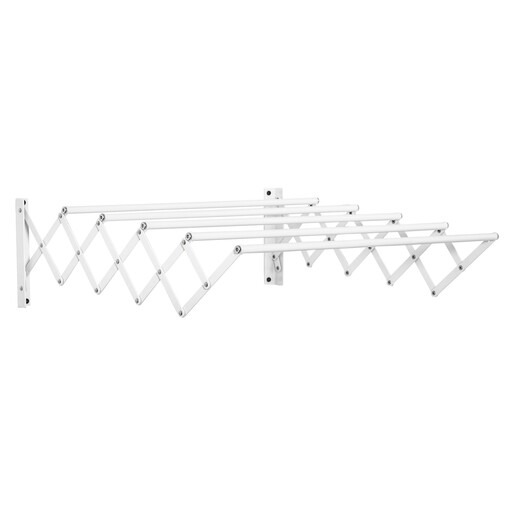
Wall-mounted clothes airer with five rails, 63,5 × 60 × 20 cm

Foldable wall-mounted clothes airer with 5 rails

A wall-mounted model may suit you if you want to keep the floor clear and have a suitable place to fit it.

Five rails; stated dimensions: 63,5 × 60 × 20 cm. The airer must be mounted on the wall.

View at Joybuy

Foldable electric heated clothes airer with two side wings, 230 W

Foldable electric heated clothes airer with 2 side wings

This model offers heat and plenty of hanging space. Use the heat only for garments whose care labels allow it.

Stated power: 230 W; stated temperature range: 45–55 °C. Dimensions when open: 144 × 53 × 91 cm. The product instructions specify indoor use, ventilation, a flat, stable surface, a minimum distance of 31 cm from walls and an earthed socket.

View at Joybuy
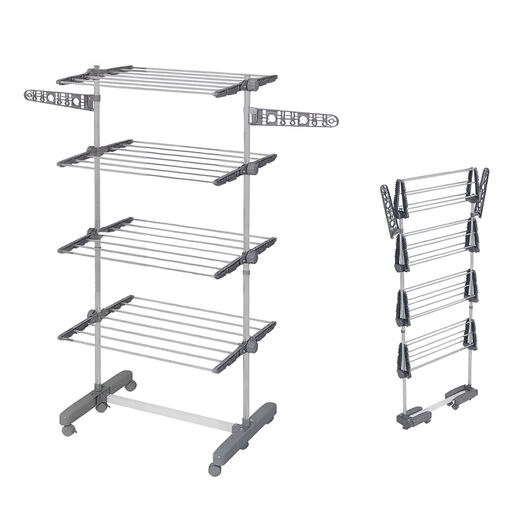
Foldable clothes airer with four adjustable levels and wheels

Foldable clothes airer with 4 adjustable levels

Multiple levels and wheels may come in handy if you want to hang different items of laundry and move the airer around.

Four adjustable levels, side wings and six wheels, two of which lock.

View at Joybuy
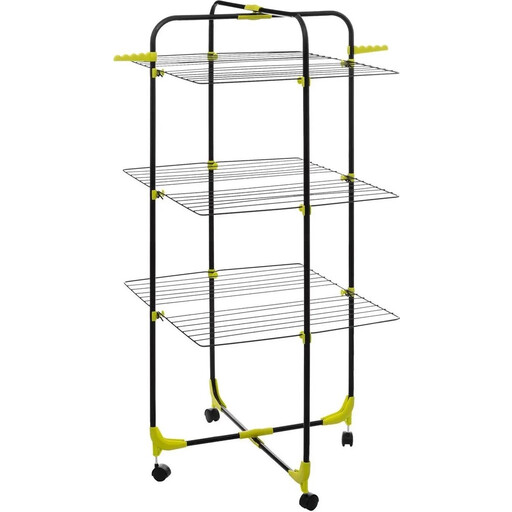
5five Mojave drying tower with 30 m of drying line

5five Mojave drying tower, 30 m

A tower with several drying levels may suit you if you want to hang different items of laundry above one another.

Three drying levels and 30 m of stated drying line; maximum load: 15 kg. Dimensions: 65 × 70 × 137 cm. Self-assembly required.

View at Joybuy

Frequently asked questions

Can I put my swimwear straight onto a heated airer?

Only if the garment’s care instructions allow heat. DOMO lists swimwear as a suitable use for the DO7117DR, but Arena advises drying the swimwear model reviewed away from heat sources. If your care label says the same, follow it and don’t use heat.

How should I dry swimwear after a weekend away?

First, check the care instructions and dry the garment as directed on the label. For the model reviewed, Arena recommends rinsing it straight away in non-chlorinated water, not leaving wet swimwear in a bag for long, and air-drying it away from heat. Make sure the room is ventilated if you’re drying it indoors.

Can I keep an electric clothes airer in the bathroom?

IPX4 alone doesn’t confirm that every spot in a bathroom is suitable. DOMO lists IPX4 for the DO7117DR; check the instructions for the specific model and make sure the location and electrical connection you plan to use are suitable.

How do I compare the electricity use of heated clothes airers?

For the same period of use, multiply the power in kilowatts by the number of hours used; this gives you the consumption in kWh. Multiply this by your own electricity tariff. Comparing wattages alone won’t tell you the drying time or the cost of each drying session.

Which product safety rule applies to an electric clothes airer?

Electrical equipment within the scope of the EU Low Voltage Directive must meet safety requirements and carry a CE marking when placed on the market. This applies to equipment operating at 50–1,000 V AC. Check the details and instructions for the specific model; a CE marking isn’t a test of how the product performs in use.
