
Swimmers with delicate swimwear
You want to dry your swimwear without ignoring its care instructions about heat. The arena swimsuit label cited here says to dry away from heat sources, so always check the label on your own garment.


Start with the care label on your swimwear and the ventilated space available: a heated airer isn’t suitable for garments whose labels say to dry them away from heat. If heat is allowed, compare a flat airer with a tower model based on the space they take up when open, accessibility and where they can be placed. Otherwise, an unheated airer is an alternative. Before buying an electric model, check the product information, instructions and relevant safety details.
You want to dry your swimwear without ignoring its care instructions about heat. The arena swimsuit label cited here says to dry away from heat sources, so always check the label on your own garment.
You’re looking for an airer you can put up and store away without obstructing the walkway or airflow. Milieu Centraal points out that drying laundry indoors adds moisture to the air.
You often dry laundry indoors and are weighing the extra heat against electricity use and the space the airer takes up. Milieu Centraal recommends ventilating more when you dry laundry indoors.
First, check whether the care label on your swimwear allows heat. Then see whether the airer will fit in the shared space, and weigh the potential drying heat against electricity use and the model’s instructions for use.
Choose this when: the garment label rules out heat, or you don’t need extra heat to dry a few swimwear items.
Bear in mind: drying time depends partly on factors such as humidity and ventilation; the size determines how much space the airer takes up.
Consider this when: the label allows heat and you have room for the airer’s full width when open.
Bear in mind: heated rails don’t make a drying method suitable if the garment label rules it out; the temperature alone doesn’t tell you how long drying will take or whether every garment can safely touch the rails.
Consider this when: you want to keep the airer’s floor width to a minimum and the label allows heat.
Bear in mind: check that the levels remain accessible and airflow isn’t obstructed. The stated wattage isn’t the same as measured energy use per drying session.
| What to consider | What to look for | Who might prioritise this |
|---|---|---|
| Swimwear and heat | Read the label on each garment and compare it with the temperature and instructions for the exact airer model. | If I’m drying swimwear with a delicate care label, I want to avoid heat when the label says so. Around 33% of consumers put suitability for the garment’s care label first. |
| Space and ventilation | Measure the space with the airer fully open, and keep walkways and airflow clear. | In a shared utility room, I want to use and store the airer without blocking the way through. Around 27% of consumers prioritise the space available. |
| Electrical set-up | Check the instructions, cable and connection, and allow for the recommended clearance. The Netherlands Food and Consumer Product Safety Authority says CE marking is mandatory for products covered by the Dutch Commodities Act Decree on Electrical Equipment. | With an electric airer, I want to know in advance whether the space and intended use are in line with the product instructions. Around 20% of consumers put electrical safety first. |
| Heating and running costs | Compare the stated wattage and expected hours of use with your own electricity tariff; wattage doesn’t tell you the drying time or cost. | If I only dry a few items now and then, I want to know whether I need heat for my use. Around 20% of consumers prioritise the usefulness of heating and running costs. |
Care instructions vary from one garment to another. The arena swimsuit label cited here says to dry away from heat sources.
Check the label on each garment before putting it on heated rails. If in doubt, follow the garment’s care instructions.
A flat airer and a tower take up space in different ways while in use. An airer that obstructs the walkway or airflow is impractical in a shared utility room.
Measure the space with the airer fully open and decide where you can store it after use. Leave room for airflow, too.
An awkward set-up can take up shared walkway space or obstruct ventilation while in use.
Wattage alone doesn’t tell you how much electricity a drying session uses; how long the airer is switched on also matters.
Calculate consumption using the wattage in kilowatts and the actual hours of use. Don’t treat manufacturers’ claims about savings as the results of an independent test.
Offers heated clothes airers in both flat and tower designs; your choice will depend partly on the floor space available.
Also offers unheated clothes airers as an alternative if you don’t want to use extra drying heat.
Offers unheated clothes airers in a range of designs, including foldable and hanging models.
These product picks include an unheated wall-mounted airer and a foldable heated clothes airer. Choose the heated model only if the garment label allows heat and the product instructions are suitable for the place where you plan to use it.
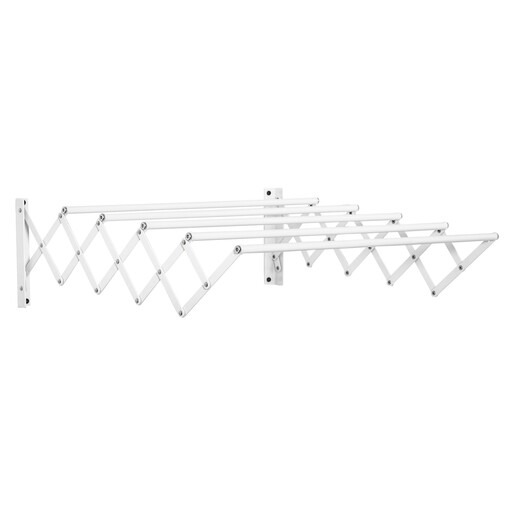 Image unavailable
An unheated option if you want to keep floor space clear and dry clothes without extra heat.
Five rails; total load capacity 10 kg. Folds flat against the wall.
 Image unavailable
Could suit you if you’re looking for a foldable heated model and the garment label allows heat. Before use, check that the product instructions are suitable for the space available.
Stated power 230 W; open dimensions 144 × 53 × 91 cm; recommended maximum load 10 kg. The product description says to use it indoors on a stable, level surface, with ventilation and at least 31 cm clearance from walls. Check the product information and relevant safety details for this item before you buy.
No, don’t assume they’re suitable for every swimsuit. The arena swimsuit label cited here says to air-dry away from heat sources and refers you to the washing instructions on the product label. So check the label on your own swimwear.
Make sure the room can be ventilated and position the airer so it doesn’t block airflow. Milieu Centraal points out that drying laundry indoors adds moisture and recommends extra ventilation when drying clothes indoors.
Multiply the power in kilowatts by the actual time in use in hours to calculate consumption in kWh, then multiply that by your own price per kWh. Silvergear’s stated power of 300 W for the tower reviewed doesn’t, by itself, tell you how long drying will take or what each drying session will cost.
The Government of the Netherlands says the seller must provide a solution if a product is faulty. There’s no fixed statutory guarantee period that applies to all products in the Netherlands; what you’re entitled to expect depends, among other things, on the product and the sales information.
The Netherlands Food and Consumer Product Safety Authority says CE marking is mandatory for products covered by the Dutch Commodities Act Decree on Electrical Equipment. Check the product information and usage restrictions for the specific airer; a CE marking alone doesn’t prove that all safety requirements have been met.