A heated clothes airer is worth considering if an unheated place to hang your washing doesn’t suit your needs and you’ll use the extra warmth regularly. For just a few flannels, an unheated airer may be enough if you can hang them with space between them and ventilate the room. If your laundry varies, a folding airer may be a better choice; if you need a permanent spot for a few towels, consider a compact towel rail. Heat doesn’t replace ventilation: Milieu Centraal recommends extra ventilation when drying laundry indoors.
Which airer is right for you?
Student with limited drying space
You want to dry flannels without leaving a large airer in your room or shared space all the time. Compare its dimensions when open with the space where you can store it afterwards. Brabantia offers folding clothes airers, among other options. A foldable design saves storage space, but still takes up room while your laundry is drying.
Student who often dries small loads
You want to use the same spot to hang flannels and other laundry, and are considering heated rails. Check how many rails you can actually use, and hang your washing so air can circulate around it. Milieu Centraal recommends extra ventilation when drying laundry indoors.
Student with a permanent place for towels
You mainly need space for a few flannels or towels. A compact towel rail could work in a permanent hanging spot; a freestanding model can be moved, while wall mounting requires a suitable wall and fixings.
What should you look for when choosing?
If you want to dry flannels in student accommodation, your choice will mainly come down to space, whether you need extra heat, electricity use and where you plan to put the airer.
| Consideration |
What to look for |
Who it matters to |
| Space |
Compare the dimensions when open and how the airer folds away; check that it will fit in the space you have in mind. |
If I need to put an airer in a shared room and then store it away, I want to know how much space it takes up. Space is the main consideration for around 33% of consumers. |
| Extra heat |
Check how many rails are heated and whether a cover and temperature or timer settings are included with that specific model. |
If an unheated place to hang my washing doesn’t meet my needs, I want to know which model actually has heated rails. Extra heat is the main consideration for around 27% of consumers. |
| Electricity costs |
Check the wattage of the exact model. Calculate energy use in kWh as power in kW × hours of use. |
If I use it regularly, I want to estimate what the running time will mean for my energy bill. Electricity use is the main consideration for around 20% of consumers; multiply the kWh by your own tariff to work out the cost. |
| Moisture and positioning |
Plan how you’ll ventilate the room and check the instructions, connection and intended location; assess wall mounting separately. |
If I want to use the airer in a shared space or bathroom, I want to know how to remove moisture and whether the location is suitable for the appliance. Moisture and positioning are the main considerations for around 20% of consumers. |
Common buying mistakes
-
Assuming a heated airer will solve damp in the room
Heating won’t automatically remove the moisture from drying laundry. Milieu Centraal recommends extra ventilation when drying laundry indoors and points out that moisture and a lack of fresh air can contribute to mould problems.
Before you buy, decide where you can hang your towels with space between them and how you’ll ventilate the room.
-
Comparing wattages alone
The stated wattage alone doesn’t tell you how much energy it will take to dry a particular amount of laundry. Energy use also depends on how long the appliance is switched on.
To estimate energy use in kWh, multiply power in kW × hours of use. Don’t treat advertised drying-time claims as independent test results for your flannels.
-
Assuming an IP rating means it’s suitable for any bathroom location
An IP rating alone doesn’t determine whether the intended location, connection and installation are suitable for the exact model.
Read the instructions for the model you’ve chosen and assess the specific bathroom setup before use.
Brands to compare
Silvergear
Silvergear offers heated clothes airers for different types of laundry. According to the manufacturer, the Premium model folds away and comes with a cover, 20 heated bars, and temperature and timer settings.
- The manufacturer states that the Premium model has a power rating of 230 W.
- Silvergear’s claims about fast drying or savings are marketing claims, not independent test results for flannels. Check the dimensions and specifications of the model you choose.
ProfiCare
The ProfiCare PC-EHW 3115 is an electric towel rail that can be used freestanding or wall-mounted, making it suitable if you mainly want to hang a few towels.
- The manufacturer states that it has eight heated bars, a power rating of 125 W and a 1.5 m cable.
- The manufacturer states that it has an IP22 rating; this alone doesn’t determine whether a particular bathroom location is suitable. Check the instructions and the intended location.
Cecotec
The ReadyWarm 5000 Towel Black is a compact electric towel rail with five bars. According to the manufacturer, it can be freestanding or wall-mounted.
- The manufacturer states that this model has a power rating of 100 W and an IP24 rating.
- An IP rating alone doesn’t confirm that every bathroom location or installation is suitable. Assess the location and connection in line with the instructions.
Brabantia
Brabantia offers folding clothes airers, tower airers and wall-mounted airers, among other unheated alternatives.
- An unheated airer doesn’t use electricity to dry your laundry.
- It doesn’t provide electric heating, and no specific drying time for flannels can be attributed to these types of airer.
Products for flannels and small items of laundry
This selection includes a folding heated airer, a folding unheated airer, a wall-mounted airer and a heated towel rail. Compare how much space they take up and whether their setup suits the way you’ll use them.
 No image available
Foldable electric clothes airer with two side wings, 230 W
Suitable if you want to spread out flannels and other laundry in one place, then put the airer away after use.
Stated dimensions: 144 × 53 × 91 cm. Use indoors on a stable, level surface with ventilation; keep at least 31 cm away from walls and use an earthed socket.
View at Joybuy
 No image available
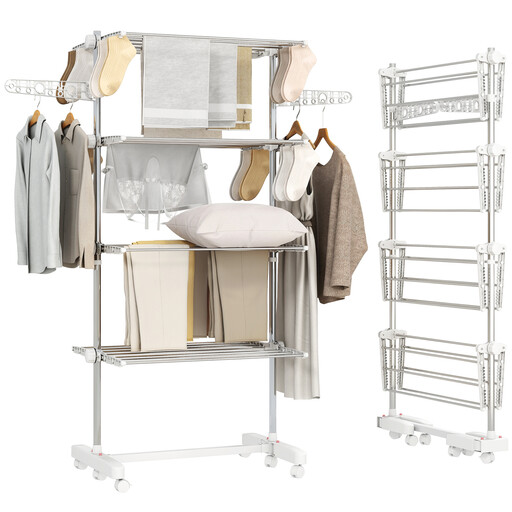
Folding clothes airer with four shelves, side arms and wheels, white
Suitable if you want to hang several items of laundry and be able to move and fold away the airer.
The description lists a steel frame, four shelves and wheels with brakes. Maximum 6 kg per shelf; distribute the laundry evenly and apply the brakes during use.
View at Joybuy
 No image available
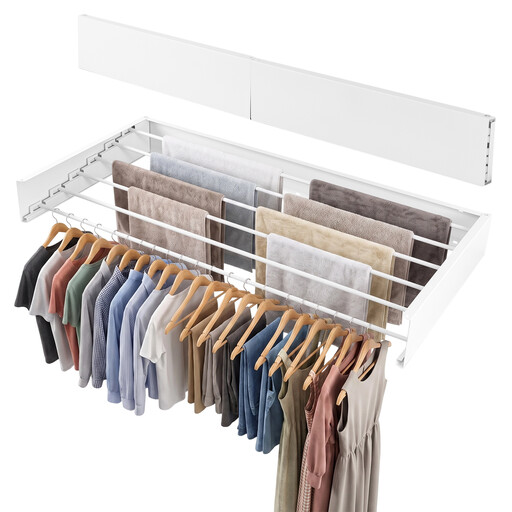
Extendable, foldable wall-mounted airer, 100 cm
Suitable if you want hanging space on the wall and don’t want a permanent floor-standing airer.
The description lists six bars and a load capacity of 15 kg. When folded, it projects 3 cm from the wall; wall mounting requires drilling.
View at Joybuy
 No image available
Electric heated towel rail with top shelf
Suitable if you want a permanent place to hang towels and flannels and prefer wall mounting.
The description lists touch controls, a digital temperature display and dimensions of 58.5 × 55 cm. It’s designed for wall mounting.
View at Joybuy
Frequently asked questions
Do I need a heated airer for a few flannels?
Not necessarily: an unheated airer may be enough if you hang the flannels with space between them and ventilate the room. Where possible, Milieu Centraal recommends drying laundry on a line or in an unheated room; choose extra heat based on your own needs.
Do I need to ventilate the room when using a heated airer?
Yes. Bear in mind the moisture from drying laundry and ventilate the room. Milieu Centraal recommends extra ventilation when drying laundry indoors; a heated rail won’t remove the moisture by itself.
How can I estimate the electricity use of a heated airer?
Multiply the stated power in kW by the number of hours it’s used to estimate energy use in kWh; multiply that figure by your own tariff per kWh to work out the cost. The stated power isn’t a measured figure for drying a full load of laundry.
Can any electric clothes airer be used in a shared bathroom?
No. That can’t be determined just from the word ‘electric’ or an IP rating. Check the instructions for the exact model and assess the intended location and connection before use.
Do I need permission to attach an airer to the wall of a rented home?
According to the Dutch government, you don’t need permission for a minor change that can be reversed without much expense, such as drill holes that can be repaired; you do need permission for a renovation. Assess the specific fixings and tenancy agreement separately, and don’t treat changes to the electrical installation like an ordinary movable airer.


