
Sportspeople who need their top again soon
If you exercise regularly, you may weigh up the benefit of extra heat against the wait for air-drying. A shorter drying time isn’t guaranteed.


A heated clothes airer is worth considering if a standard airer isn’t suitable for your needs and the care label on your sports tops allows them to be dried with heat. An unheated airer is still an option if you have enough time to air-dry your clothes. Also check the space and ventilation: heat doesn’t remove moisture, and manufacturers’ drying-time claims aren’t a measurement for your utility room.
If you exercise regularly, you may weigh up the benefit of extra heat against the wait for air-drying. A shorter drying time isn’t guaranteed.
If you want to protect a print or stretchy sections, use the garment’s care label and the airer’s instructions as your guide. Nike Netherlands recommends checking the garment’s label.
If space is limited, make sure the set-up fits the available room. When drying clothes indoors, it’s also important to remove moisture. Milieu Centraal includes ventilation as part of preventing damp problems.
Choose this if: your tops have enough time to air-dry and you don’t need active heat.
Bear in mind: drying time in your space hasn’t been established; make sure there’s also enough ventilation to remove moisture.
Choose this if: you want to hang several tops separately, have enough floor space and their care labels allow heat.
Bear in mind: the airer uses electricity and takes up space when fully opened. Its stated temperature and power rating don’t prove how long clothes will take to dry or whether it’s safe for your fabrics.
Choose this if: keeping floor space clear is important and the set-up and mounting location suit your utility room.
Bear in mind: a compact size alone doesn’t tell you how many tops will fit. Check the power connection and fixings too.
The points below can help you choose an airer that suits your clothing-care needs, ventilation, available space and running costs.
| What to consider | What to look for when buying | Who is this important for? |
|---|---|---|
| Waiting time | Compare how many tops you can hang separately and which parts of the airer are heated. Don’t assume there’s one set drying time. | If I need my top again soon, waiting time is a key factor. Around 27% of consumers consider this their main priority. |
| Clothing care | Check the care label and the airer’s instructions, especially for prints and stretchy sections. | If I’m drying tops with prints or stretchy sections, I want to follow the care instructions before using heat. Around 27% of consumers put clothing care first. |
| Removing moisture | Check how fresh air gets in and how damp air is removed from the utility room. | If I dry clothes indoors, I want to prevent moisture from building up. Around 20% of consumers prioritise moisture removal. |
| Space and hanging | Measure the available space and compare it with the airer’s dimensions when open, the access route and any possible mounting location. | If my utility room is short on space, the airer needs to fit without blocking the way through. Around 13% of consumers mainly consider space. |
| Electricity use | Compare the stated power rating over the same length of time: kWh = watts × hours ÷ 1,000. Multiply this by your own rate per kWh. | If I want to keep electricity costs down, I compare the energy use of a heated airer with an unheated one. Around 13% of consumers prioritise running costs. |
The stated power rating doesn’t tell you how much energy a full drying cycle uses; the length of time you use the airer matters too.
Compare energy use only over the same length of time and use your own electricity rate. Don’t treat the power rating as a measured figure for energy use per drying cycle.
Even when you use a heated airer, moisture from clothes drying indoors enters your home. Milieu Centraal recommends ventilation to help prevent damp problems.
Check how well your utility room removes moisture, whichever type of airer you choose.
A general claim about an airer doesn’t replace the care instructions for the specific top.
Check the garment’s care label and the airer’s instructions before placing a top on heated sections.
Aosom Netherlands lists the freestanding, foldable heated airer 850-198V90 for anyone looking for several hanging positions.
DOMO describes the DO7117DR as a heated airer that can be used freestanding or wall-mounted.
Brabantia Netherlands offers folding clothes airers and drying towers, among other unheated alternatives.
Leifheit Netherlands offers Pegasus clothes airers for anyone comparing unheated drying solutions.
This product selection is suited to drying clothes on an airer.
 No image available
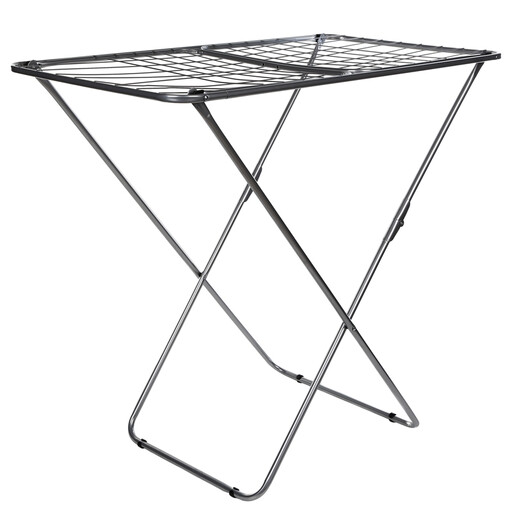
A clothes airer for hanging clothes. Check that it suits your needs and fits the available space in your utility room.
Drying length: 18 m.
No, you can’t assume that’s suitable for every top. Check the garment’s care label and the airer’s instructions, especially for prints or stretchy sections. Being advised to avoid tumble-drying doesn’t automatically mean direct contact with heated bars is suitable.
Yes. When drying clothes indoors, make sure moisture can be removed. Milieu Centraal recommends ventilation to help prevent damp problems; a heated airer doesn’t remove the need for it.
Before installation, check the instructions, whether the fixing location is suitable and whether there’s access to a power connection. DOMO lists mounting kits for the DO7117DR, but that doesn’t mean every wall or utility room is suitable.
No. According to ACM ConsuWijzer, you have a legal guarantee as well as any manufacturer’s or retailer’s guarantee. The retailer is your point of contact if a product doesn’t meet what you could reasonably expect from it during normal use.
Electrical appliances placed on the market in the Netherlands must meet the applicable European safety requirements. Ondernemersplein states that the manufacturer must apply the required CE marking and draw up an EU declaration of conformity for an appliance that meets the requirements. This isn’t an independent practical test of a specific model.