Who is a heated clothes airer relevant for?

People drying small T-shirt loads in a limited space

You regularly wash a few cotton T-shirts and want to hang them separately, but don’t have room to leave a large airer set up permanently. GINETEX’s care symbols can help you check the drying method permitted by the garment label.

People who often dry laundry indoors

As well as considering the airer’s design, you’ll want to check whether you can ventilate the room sufficiently while your laundry dries. Milieu Centraal recommends extra ventilation when drying clothes indoors.

People who want to factor in electricity use

You’re considering a heated airer for convenience, but want to weigh up whether an unheated airer would do the job each time. An unheated airer uses no electricity to dry your laundry.

What should you look for when choosing?

Unheated clothes airer

Choose this if: your T-shirts can dry without extra heat and you want to avoid using electricity for the airer.

Consider: the drying area still needs good ventilation; make sure there are also enough separate hanging spaces.

Heated winged airer

Choose this if: you want to spread your shirts across separate rails and have room to set the airer up fully.

Consider: it uses electricity, and the stated drying length doesn’t tell you how many shirts you can hang without overlapping them.

Compact heated rail airer

Choose this if: you have limited space to set it up and only dry a few items at a time.

Consider: fewer rails may mean you can’t hang all your T-shirts separately at the same time.

Heated towel rail

Choose this if: you’re also looking for a towel rail and the set-up suits your space.

Consider: the design won’t necessarily be suitable for hanging several wide T-shirts separately.

What to consider What to look for when buying Who should pay particular attention?
Hanging T-shirts without overlap Check the number of usable rails, the space between shirts, the dimensions when set up and the garment care label. I want to hang my cotton T-shirts separately; the total drying length alone doesn’t tell me how many shirts will fit. Around 25% of consumers prioritise separate hanging space for T-shirts.
Set-up and storage space Check the dimensions both when set up and when stored, and make sure doors and walkways remain clear. I have limited floor space and want to put the airer away after a small load of washing. Around 20% of consumers prioritise the space available.
Removing moisture Consider whether you can bring in fresh air and remove humid air while your laundry dries. Milieu Centraal recommends extra ventilation when drying clothes indoors. If I often dry clothes indoors, I want to be able to remove humid air rather than just focus on the airer. Around 20% of consumers prioritise managing indoor humidity.
Electricity use per drying session Compare the stated power in watts and how long you’ll use the airer; only calculate using the same assumptions and your own electricity tariff. I want to know how long the airer will be on and what that means for my electricity use. Around 15% of consumers prioritise electricity use per use.
Safe positioning and use Check the model-specific instructions, connection and permitted set-up. Review the relevant conformity documentation; an IP rating doesn’t give general permission to use the airer anywhere in a bathroom. Before setting up an electric airer, I want to check where it can be placed and review the product documentation. Around 20% of consumers make safe use their first selection criterion.

Avoid common buying mistakes

  • Confusing drying length with space for the same number of T-shirts

    The total length adds together all the rails, but each shirt needs space to hang without overlapping.

    Look at the rail layout and dimensions when set up, and think about how many shirts you usually want to hang at once.

  • Assuming that heat automatically saves electricity

    A heated airer uses electricity while switched on; an unheated airer uses no electricity itself.

    Consider heating in relation to a specific need, and calculate electricity use from the stated power and how long you’ll use it.

  • Expecting heat to remove moisture from the room

    A heated airer won’t automatically remove moisture from the indoor air when you dry laundry inside. Milieu Centraal recommends extra ventilation when drying clothes indoors.

    Consider how well you can ventilate the drying area as well as the airer’s design.

  • Taking an IP rating as approval for any bathroom location

    A rating applies to a specific model and doesn’t replace its positioning and installation instructions.

    For your chosen set-up, check the model’s manual, connection and permitted positioning.

Brands to consider

Dirt Devil

The DD6003 is a heated, foldable winged airer for anyone looking to hang several T-shirts separately.

  • The product listing specifies 20 rails, 12 m of drying space, 230 W and dimensions of 147 × 54 × 94 cm when set up.
  • Drying length doesn’t tell you how many shirts will fit without overlapping; also check how much space the airer takes up when set up.

Wintem

The ClassiDry is a foldable heated rail airer that may be worth comparing if you have a small load of laundry.

  • The Dutch product listing specifies eight heated rails and 120 W.
  • Consider whether the number of rails provides enough separate hanging spaces for your T-shirts; the information given doesn’t specify drying time per load.

DOMO

DOMO describes the DO7117DR as a heated airer that can be used freestanding or wall-mounted.

  • DOMO specifies 150 W, a built-in timer and IPX4 for this model.
  • The towel-rail design needs to be assessed separately for T-shirt hanging space. The IPX4 rating doesn’t replace the positioning instructions.

Dry:Soon

The range includes heated drying towers, including a Mini version; the design is another option to compare.

  • For a larger, three-tier model, the manufacturer specifies 21 m of drying space and a 15 kg capacity.
  • A larger drying tower may take up more space than you need for small loads alone. These model specifications don’t confirm a Dutch version or availability.

Clothes airers at Joybuy

This selection includes a heated towel rail, a foldable clothes airer and a heated winged airer. Compare the hanging design, the space available and the terms of use for your small T-shirt loads.

Heated towel rail with touch controls, digital temperature display and wall mounting

Heated towel rail with touch controls and digital temperature display

May suit anyone looking for a wall-mounted heated towel rail; check whether the design provides enough hanging space for several T-shirts and whether the installation suits your space.

The product title specifies touch controls, a digital temperature display and a top shelf. Before buying, check the relevant product documentation and the instructions for your intended location.

Joybuy
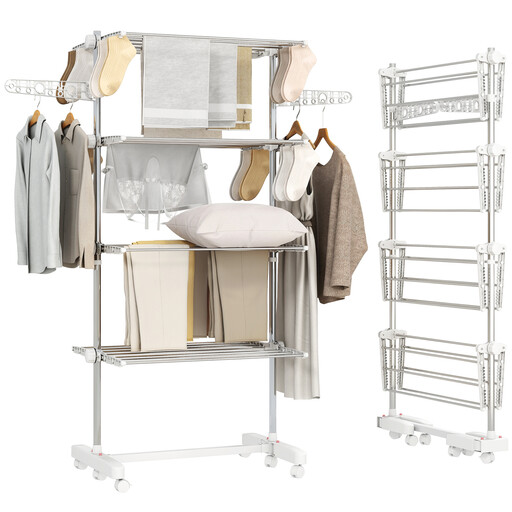
Foldable clothes airer with four shelves, side arms and wheels

Foldable clothes airer with four shelves, side arms and wheels

An option to consider if you want to spread out several items at once and fold the airer away after use.

The product title specifies four shelves, side arms and wheels. Before buying, check the dimensions and whether it will fit in the space you have available.

Joybuy

Foldable heated clothes airer with two side wings, 230 W

Foldable heated clothes airer with two side wings, 230 W

May be suitable if you want to spread small loads across a heated winged airer and have enough room to set it up fully.

The product title specifies 230 W and two side wings; the stated dimensions when set up are 144 × 53 × 91 cm. Use it in accordance with the product-specific instructions, including the stated requirements for a stable, level surface, ventilation and clearance from walls. Also check the relevant product documentation before buying.

Joybuy

Frequently asked questions

Can I put any cotton T-shirt on a heated airer?

No. Follow the care label on the specific T-shirt and the airer’s instructions for use. For natural drying, GINETEX distinguishes between hanging garments up to dry and drying them flat, among other methods.

Do I need to ventilate when using a heated clothes airer?

Yes. Milieu Centraal recommends extra ventilation when drying clothes indoors. Heating the airer doesn’t remove humid air from the room.

How can I estimate electricity use per drying session?

Multiply the stated power in watts by the number of hours you use the airer, then divide by 1,000 to estimate its energy use in kWh at that power. This calculation doesn’t measure the drying time required or actual energy use; to estimate the cost, multiply the result by your own electricity tariff.

What if my new clothes airer breaks too soon during normal use?

According to ACM ConsuWijzer, you have a legal guarantee as well as any manufacturer’s guarantee. If the product doesn’t meet what you could reasonably expect from it, the seller must resolve the problem in accordance with the applicable terms.

Is a CE mark enough to prove that any electric airer is safe for my bathroom?

No. A CE mark isn’t general approval for every location. The mark is only required for products covered by the relevant EU rules; for your intended location, you should also follow the installation instructions for the specific model.
