
Renter with limited storage space
You want to be able to put your airer away after use, so you’re comparing its size when set up with its folded dimensions. DreamGoods and Brabantia describe airers designed for different space requirements.


A heated clothes airer can be a good choice for drying cotton shorts in a small rented home if a standard airer doesn’t fit your drying routine and you’re happy with the electricity use. Choose one based on the space available both when it’s set up and when it’s stored away, and make sure moist air can escape: heat doesn’t replace ventilation. Before buying, also check the electrical safety requirements that apply to the specific model.
You want to be able to put your airer away after use, so you’re comparing its size when set up with its folded dimensions. DreamGoods and Brabantia describe airers designed for different space requirements.
You’re considering heat because you want your cotton shorts to dry in time between washes. Compare the hanging space and settings, but don’t assume they’ll dry in a set time; DreamGoods and Silvergear describe heated models.
You’re comparing a heated airer with drying without electric heat, and weighing up the electricity use against your drying routine. Milieu Centraal recommends line-drying laundry where possible.
Ventilation is still important when drying laundry indoors: Milieu Centraal points out that drying laundry adds moisture to the indoor air.
A good fit if: you can fold the airer away after a small wash and have enough floor space for it when it’s in use.
Bear in mind: the unfolded wings take up space, and heating uses electricity. The drying time for cotton shorts can’t be determined from the specifications provided.
A good fit if: floor space is limited and the vertical layout has enough room to hang your shorts.
Bear in mind: a tower uses vertical space and electricity; whether it has a cover, timer or temperature setting depends on the model.
A good fit if: your shorts dry in time without extra heat and you want to avoid the electricity use of a heated airer.
Bear in mind: drying time depends on the room and conditions; even with an unheated airer, moist air needs to be removed.
| Concern | What to look for | Who it matters to |
|---|---|---|
| Space and storage | Measure the available floor space and the spot where the folded airer will go. | If I need to put the airer away after use, I want to know whether it will block a walkway when unfolded and fit in my storage space when folded. Around 33% of consumers put space first. |
| Getting shorts dry in time | Check the hanging layout and follow the care label and instructions. | I want to be able to wear my shorts again in time, so I’m looking for enough room to hang them spread out, without relying on a set drying time. Around 27% of consumers prioritise having dry shorts in time. |
| Moisture in the home | Check how well the room is ventilated and whether moist air can escape. | When I dry laundry indoors, I want somewhere air can circulate around the shorts and moist air can escape. Around 20% of consumers put moisture control first. |
| Electricity use | Compare the wattage with how long you’ll use the airer and your own electricity tariff. | I want to know how much electricity heating uses before weighing it up against drying without electric heat. Around 20% of consumers put running costs first. |
The wings can increase the width needed while drying, so the airer may not fit in your chosen spot or could block a walkway.
Measure both the space you’ll need to use it and the spot where it will be stored when folded.
An airer that blocks a passageway when unfolded may be impractical in the place where you want to use it.
Heated laundry still releases moisture into the indoor air. Milieu Centraal warns that poor ventilation can make damp and mould problems worse.
First, choose a spot where moist air can escape, and follow the ventilation instructions for the room and the airer.
The stated power rating alone doesn’t tell you the cost of a full drying cycle; how long you use the airer also matters.
For the same model, compare the power rating and hours of use with your own electricity tariff before weighing up the cost.
DreamGoods describes both a foldable 12 m electric clothes airer and a 21 m model. Compare the features of each version.
Silvergear describes a heated winged airer and a heated tower airer; their designs may help you decide which suits your available space.
Brabantia describes, among other options, a tower airer and an airer that hangs over a door as unheated alternatives for smaller spaces.
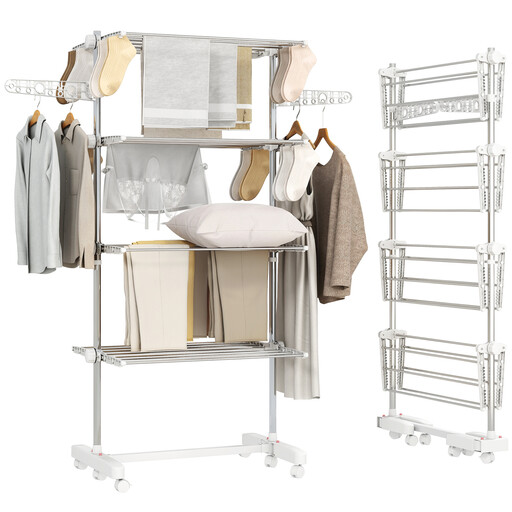
These products offer two ways to dry laundry indoors: a wheeled airer with shelves and side arms, and a folding electric heated airer. Compare the space they need when in use and in storage with what you have available.
 No image available
A wheeled airer with shelves and side arms for hanging laundry.
Four shelves and two rotating side arms; maximum 6 kg per shelf. Folded dimensions: 172 H × 80 L × 13 W cm. Spread laundry evenly and lock the brakes during use.
 No image available
A heated model with fold-out side wings for indoor drying; the stated features don’t give a set drying time for cotton shorts.
Power: 230 W. Dimensions when unfolded: 144 × 53 × 91 cm. Use it on a stable, level surface, with ventilation and at least 31 cm from walls. Before buying, check which safety requirements apply to this electrical model and whether it carries the relevant CE marking. The NVWA describes the requirements for electrical equipment covered by the relevant Dutch regulations.
Yes. Heating doesn’t remove moist indoor air by itself. Check how well the drying space is ventilated, and ventilate more while laundry is hanging there; Milieu Centraal highlights the importance of ventilation when there’s moisture in the home.
Divide the wattage of the exact model by 1,000, then multiply it by the number of hours it’s used to calculate consumption in kWh. The cost then depends on your own electricity tariff; the wattage alone doesn’t tell you how long a drying cycle takes.
Follow the instructions for the specific model. According to the product information, the 230 W folding Joybuy airer needs a stable, level surface, ventilation and at least 31 cm of clearance from walls; don’t automatically apply these instructions to another model.
For a standard online consumer purchase, you’ll generally have up to 14 days after delivery to change your mind, subject to exceptions. ACM ConsuWijzer also explains that the seller is responsible for the statutory guarantee if a product, when used normally, doesn’t do what you could reasonably expect.
CE marking is required for electrical equipment covered by the Dutch Commodities Act Decree on Electrical Equipment. For the low-voltage rules, the NVWA specifies a nominal AC voltage of 50 V to 1,000 V. Check whether those rules apply to the specific model; a claim on a sales page doesn’t by itself prove that the model meets all applicable requirements.