
Washing shirts with a Monday deadline
You do the washing just before the working week and want to know whether your shirts will fit with enough space between them. The stated wattage alone won’t tell you how long your cotton shirts will take to dry.


Start with an airer that lets you hang your shirts with plenty of space around them and fits unfolded in a well-ventilated room. Then compare heating, wattage and any accessories. A compact heated airer takes up less space, while an unheated one uses no electricity for heating but is only suitable if your schedule allows enough drying time. For an electric model, check the instructions and the required CE marking for the exact product; the NVWA explains the rules for applicable electrical products.
You do the washing just before the working week and want to know whether your shirts will fit with enough space between them. The stated wattage alone won’t tell you how long your cotton shirts will take to dry.
You have limited floor or storage space, so you’re weighing up the airer’s dimensions against how many shirts you can hang freely. Product information from DOMO and Joybuy makes the dimensions and hanging options relevant to your choice.
You want to dry clothes indoors, but you’re mindful of moisture in your home and electricity use. Milieu Centraal discusses line drying or drying in an unheated room; the Fire Brigade advises allowing electrical appliances to dissipate heat adequately.
First decide how many shirts you want to hang freely and where you have room for them. Then consider the drying time available, ventilation and electricity use.
| What to consider | What should you look for? | Who should pay closer attention? |
|---|---|---|
| Dry by Monday | Match the number of shirts and the space between them to the drying time you have; wattage alone doesn’t predict drying time. | If I do the washing just before the working week, I want to know whether my shirts can dry with enough space around them. Around 33% of consumers say having dry shirts on time is their main concern when buying. |
| Room to hang clothes freely | Check the usable height, hanger openings and the airer’s dimensions when set up. | If I want to dry several shirts at once, I make sure they can hang freely without touching other washing or the floor. Around 27% of consumers put having enough hanging space first. |
| Space indoors | Compare the dimensions when the airer is unfolded and folded away; make sure there’s ventilation and follow the model’s placement instructions. | With limited floor space, I want to find a suitable spot without overlooking ventilation. Around 20% of consumers give suitability for their drying space top priority. |
| Electricity and electrical use | Use the wattage and running time to calculate your own kWh use; check the instructions and the required CE marking for the exact model. | If I care more about running costs and electrical safety than extra drying space, I want to be able to assess the model information properly. Around 20% of consumers put these points at the top of their list. |
The stated wattage alone won’t tell you when your cotton shirts will be dry. A wattage figure doesn’t guarantee a drying time for your load.
Allow some flexibility in your schedule and compare models by their usable hanging space and stated wattage, not by an isolated speed claim.
Washing releases moisture into the room. Milieu Centraal identifies high humidity as a factor in mould growth.
Choose a spot you can ventilate and follow the placement instructions for the airer you choose.
A cover may be designed for a specific model; the name or shape of a tower airer doesn’t prove that any accessory will fit.
Check that the cover is explicitly compatible with the exact model and that the electric version is intended for use in the Netherlands.
Worth considering if you’re looking for a foldable heated rail airer that lets you spread several shirts out.
The DO7117DR heated clothes airer is worth considering if a compact set-up is important to you.
Worth considering if you’re looking at a vertical tower airer and want a compatible cover.
This selection from Joybuy includes a wall-mounted airer, a folding airer and a heated winged airer. Compare them by hanging space and placement; for the electric model, check the instructions and marking for the exact version.
 No image available
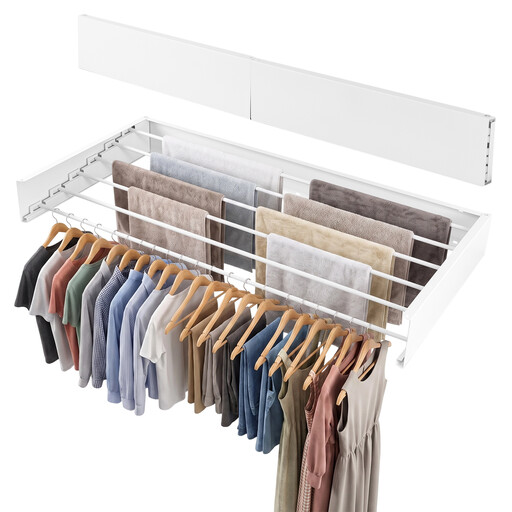
This wall-mounted airer could suit you if you want to keep shirts off the floor and can install it on a wall.
The Joybuy product description lists six drying rails, dimensions of 100 × 50 cm when extended and a folded profile of 3 cm. Installation requires drilling.
 No image available
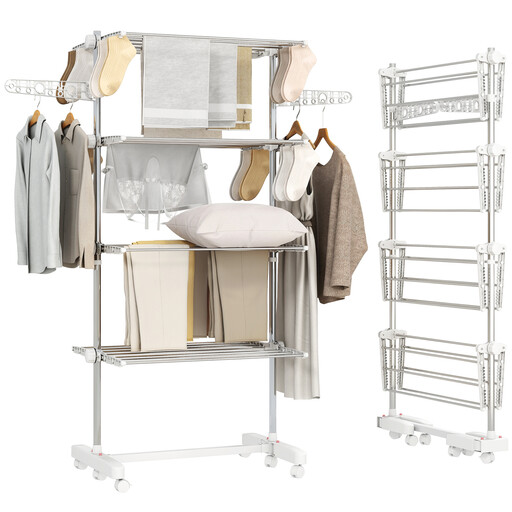
This airer could suit you if you want to spread your washing across several levels and use hangers on the side wings.
The Joybuy product description lists four main shelves, two rotating side wings and several hanger openings. Distribute the washing evenly, keep to a maximum of 6 kg per shelf and lock the brakes.
 No image available
This heated winged airer could suit you if you want to spread several garments out and have a suitable spot indoors.
The Joybuy product information lists dimensions of 144 × 53 × 91 cm. Use it on a stable, level surface with good ventilation and at least 31 cm of clearance from walls. Before buying, check the required CE marking for the exact model.
Only a cover designed for the exact airer is a suitable choice. Follow the model instructions; a cover on its own won’t tell you how long your shirts will take to dry.
Choose a stable spot you can ventilate and follow the instructions for the specific model. The Joybuy product description for the 230 W winged airer specifies at least 31 cm of clearance from walls for that version; don’t automatically apply this distance to other models.
Convert the stated wattage from watts to kilowatts, multiply it by the number of hours used, then multiply that by your own price per kWh. For the 230 W model listed by Joybuy, four hours of continuous use at its nominal power works out mathematically to 0,92 kWh; this is not a measured figure.
Follow the instructions for your model. For the winged airer in the Joybuy product description: switch it off after use, unplug it before cleaning, let it cool down and don’t immerse it in water.
CE marking is required for electrical products covered by the applicable Dutch rules. The NVWA describes the marking as a declaration by the manufacturer, not an independent inspection of every individual product. If a product is faulty, contact the seller; according to the Dutch government, there is no fixed general statutory guarantee period in the Netherlands.