When choosing a heated clothes airer, focus on how much space shirts need on hangers and how much room the airer takes up when in use. A compact model may suit a few items, while an airer with hanger supports offers more options for hanging shirts; neither feature alone proves that shirts will dry faster or cost less to dry. If drying time is less important, a standard airer may be an alternative. For an electric model, check the markings and instructions for the specific product.
Which airer is right for you?
If space in your laundry area is limited
Measure how much room the airer takes up while drying, as well as where you can store it afterwards. Product information from DOMO, InnovaGoods and Leifheit shows that dimensions in use and when stored vary by model.
If you want to dry shirts on hangers
Compare the number of hanger supports with the space your shirts need. InnovaGoods lists hanger supports for the Dupledry; the number of bars is not the same as the number of spaces for shirts.
If you dry clothes indoors and are concerned about damp
Make sure the room is ventilated, even when using a heated airer. Milieu Centraal notes that drying laundry adds moisture to the indoor air.
What should you look for?
Compact heated bar airer
Choose this when: floor or wall space is limited and you only dry a few items at a time. DOMO describes the DO7117DR as suitable for standing or wall-mounted use.
Keep in mind: it has one power setting, and you’ll need to check whether a shirt can hang freely; a bar airer is not automatically suitable for several shirts on hangers.
Folding heated airer with wings
Choose this when: you have enough room while drying and want to store the airer afterwards. InnovaGoods lists twenty heated bars for the Warmmat.
Keep in mind: the stated dimensions in use are approximately 148 × 112 × 54 cm, so folding away does not mean it takes up little space while in use.
Heated drying pod with hanger supports
Choose this when: it’s important to hang shirts individually on hangers. InnovaGoods lists six hanger supports for the Dupledry.
Keep in mind: the stated power of 1200 W alone does not tell you how long a cotton shirt will take to dry.
Unheated folding airer
Choose this when: you can wait for your laundry to air-dry and don’t need an additional heated appliance. Leifheit lists 10 m of drying space for the Classic 100 Easy.
Keep in mind: there is no heating function; make sure the room is well ventilated when using this airer too.
| What to consider |
What should you check? |
Who is this important for? |
| Space and storage |
Measure the available floor space and height, then compare the dimensions when the airer is in use with those when it is folded away. |
If you have a small laundry area, you’ll want to store the airer without it blocking the way while drying. Around 31% of consumers rank space and storage as their top priority. |
| Shirts on hangers |
Check how many hanger spaces there are, the distance between items and whether a shirt can hang freely. |
If you want to dry cotton shirts on hangers, look for enough hanging space rather than just counting the bars. Around 25% of consumers put hanger space for shirts first. |
| Damp in the home |
Check whether the laundry area can be ventilated and whether you can hang clothes with space between them. |
If you dry clothes indoors, you’ll want to be able to remove damp air from a small room; heating alone won’t do that. Around 25% of consumers put moisture control first. |
| Electricity per drying session |
Compare the power rating, the actual time the airer is switched on and your electricity tariff; the power rating alone doesn’t tell you the energy used per drying session. |
If you mainly want to weigh up electricity use, look at the time needed for a full drying session, not just the wattage. Around 19% of consumers rank running costs as their top priority. |
Common buying mistakes
-
Assuming ‘foldable’ means compact while drying
According to InnovaGoods, the Warmmat measures approximately 148 × 112 × 54 cm when in use. An airer can fold away after use and still take up a lot of room while drying.
Measure the space available for use and the storage space separately before choosing a model.
An airer that’s too large may block a walkway or not fit where you planned to put it.
-
Assuming the number of bars equals the number of spaces for shirts
The number of bars doesn’t tell you how many shirts can hang with enough space between them.
Check the hanger layout and measure whether a shirt can hang freely.
-
Assuming heating will solve damp in the home
Heating does not automatically remove damp air from indoors. Milieu Centraal highlights the importance of ventilation in reducing damp in the home.
Check whether the laundry area can be ventilated properly if you regularly dry wet washing there.
-
Assuming a lower wattage means lower costs per shirt
The stated power rating doesn’t tell you how much electricity a full drying session uses; the time the airer is switched on matters too.
Compare energy use on a like-for-like basis using the calculation kWh = kW × hours, and use your own rate per kWh.
Running costs depend on how long the airer is switched on and your electricity tariff.
Brands and models compared
DOMO
According to DOMO, the DO7117DR can be used freestanding or wall-mounted, so its placement may be a useful consideration in a small laundry area.
- The manufacturer lists 150 W, one setting, a timer and IPX4.
- The stated features do not confirm the capacity or drying time for several cotton shirts. IPX4 does not mean the model can be placed anywhere in a bathroom.
InnovaGoods
The Warmmat is a heated bar airer with wings; the Dupledry is a heated drying pod with hanger supports. They offer different layouts to compare against your available space and preference for hangers.
- According to the manufacturer, the Warmmat has twenty bars, adjustable temperature and a timer; the Dupledry has six hanger supports and a stated power rating of 1200 W.
- According to the manufacturer, the Warmmat takes up approximately 148 × 112 × 54 cm when in use. Claims about speed or results on clothes are not independently verified drying performance.
Leifheit
The Classic 100 Easy is a folding, unheated alternative if you want to dry clothes without active heat.
- Leifheit lists 10 m of drying space and dimensions of 93 × 102 × 52 cm.
- It has no heating function, so don’t expect it to dry clothes in the same way as an electric airer.
Brabantia
The HangOn 23-metre Tower Dryer is an unheated alternative that makes use of height and hooks for hangers.
- Brabantia lists three foldable drying levels, wheels and hooks for hangers.
- The product information does not confirm that the tower will fit in every small laundry area or dry cotton shirts faster.
Products at Joybuy
The product below is a freestanding clothes airer; check whether it suits your preference for heated or air-drying.
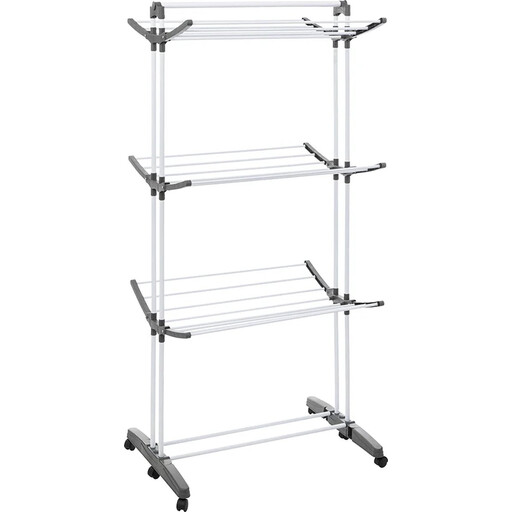 No image available
5five Sinai Cloth Dryer, 24 m
The product information describes a freestanding, folding clothes airer; check whether it suits the space available and your preferred drying method.
Drying length: 24 m. Material: metal. Dimensions in use: 125 × 62 × 172 cm.
Joybuy
Frequently asked questions
What should I look for in an electric clothes airer for the Dutch market?
Check the applicable CE marking and the instructions for the specific electric model. Equipment covered by the relevant EU rules must comply with those rules; the Dutch government and EUR-Lex set out the requirements.
Can any heated clothes airer be used in the bathroom?
No, don’t assume that all models are suitable for bathrooms. DOMO lists IPX4 for the DO7117DR, but check the manual and the specific positioning and connection before using it there.
What can I do about damp when drying shirts indoors?
Make sure fresh air can enter and damp air can escape. Milieu Centraal notes that drying laundry adds moisture to the indoor air; a heated airer is no substitute for ventilation.
How do I calculate the electricity used by a clothes airer?
Divide the power rating in watts by 1000, then multiply it by the number of hours the airer is switched on to calculate kWh. For example, 150 W for one hour is 0.15 kWh; this calculation is not a measured figure for a full drying session. Multiply the result by your own rate per kWh to work out the cost.
Am I always entitled to exactly two years’ legal guarantee in the Netherlands?
No. According to the Dutch government, there is no fixed legal guarantee period of exactly two years in the Netherlands. You are entitled to a product that meets what you can reasonably expect from it; if a product is faulty, the retailer is your point of contact.


