
People using a small, shared laundry room
You want to keep the walkway clear and put the airer away after use. Compare its dimensions when open and when stored; Silvergear describes both a heated winged airer and a drying tower.


First, choose an airer that lets your summer dresses dry without being crammed together, in line with their care labels, and that fits in the shared space both when open and when stored away. A heated model may be worth considering if you have a limited time slot. If you have enough time, an unheated airer may do the job and uses no electricity itself. In either case, make sure the room is ventilated and follow the instructions if you choose an electric model.
You want to keep the walkway clear and put the airer away after use. Compare its dimensions when open and when stored; Silvergear describes both a heated winged airer and a drying tower.
You follow each dress’s care label and don’t rely on a general claim about suitability for clothing in place of checking it. GINETEX explains that general programme information does not always show whether a particular appliance is suitable for a textile.
You want to make good use of your allocated time slot, while also considering ventilation and how long the airer will be in use. Milieu Centraal and Brabantia highlight the importance of ventilation or air circulation when drying clothes indoors.
First measure the available floor space, walkway and storage area. Then decide which drying method suits your dresses’ care labels and the time you have.
| What to consider | What should you check? | Who is this important for? |
|---|---|---|
| Space and storage | Measure the floor space and walkway, then compare them with the airer’s dimensions when open and when stored. | I want to keep the walkway clear and put the airer away after my turn. Around 28% of consumers prioritise sharing space and storage. |
| Drying method for the dress | Read the care label and instructions; check that the dress can lie or hang without being crammed together. InnovaGoods lists six temperature settings of 35–60 °C for Warmmat. | When drying delicate dresses, I want to follow the instructions for each item rather than rely on a general product claim. Around 22% of consumers prioritise textile care. |
| Moisture and ventilation | Check how the room is ventilated and whether clothes can hang with space between them. Milieu Centraal discusses indoor ventilation; the Consumentenbond describes a dehumidifier as a separate option for a suitable room. | I want to prevent moisture building up in a room I share with others. Around 22% of consumers put moisture control first. |
| Available time slot | Check whether your chosen model has a timer and how it works; a timer doesn’t guarantee that clothes will be dry by then. Warmmat lists a timer of up to 12 hours. | If I can only use the laundry room for an agreed period, I want to know whether the settings will suit that time. Around 17% of consumers prioritise their available drying time. |
| Electricity use | Compare the wattage, length of use and your own electricity tariff. InnovaGoods lists 230 W for Warmmat; an unheated airer uses no electricity itself. | I want to limit extra electricity use when heating isn’t necessary. Around 11% of consumers prioritise electricity costs. |
A lower stated wattage doesn’t, by itself, prove that a full drying session will cost less or that dresses will dry faster.
Compare the wattage and expected running time on the same basis. Include an unheated airer in your decision if you don’t need the extra warmth.
A particular dress may have its own care instructions, which determine the right way to dry it.
Follow the dress’s care label and the airer’s instructions, even if the product description broadly says it is suitable for clothing.
A heated airer doesn’t remove the evaporated water from the shared room. Ventilation is therefore a separate consideration when drying clothes indoors.
Check how you can ventilate the room and leave space between clothes as they hang. The Consumentenbond describes a dehumidifier as a separate option for a suitable room.
According to its brand pages, Silvergear offers both a heated winged airer with a cover and a heated drying tower, so you can choose a shape that suits your shared space.
The Warmmat winged airer is an electric alternative with a folding frame.
An electric winged airer to compare if you’re looking for adjustable heat and a timer.
A point of comparison for unheated clothes airers if you don’t need extra heat.
These products are suited to drying clothes in a shared space: a folding airer with several shelves and an electric heated winged airer.
 No image available
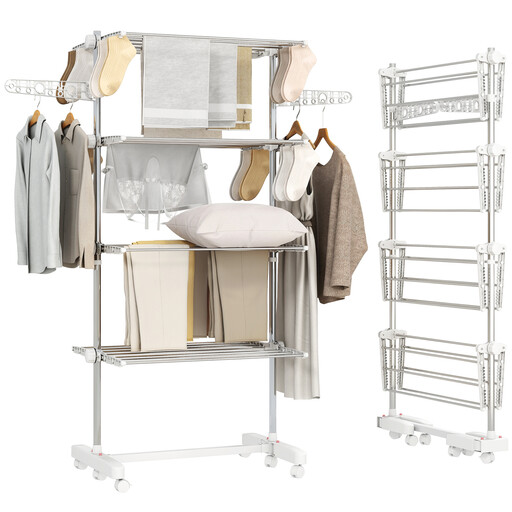
An option if you want several ways to hang or spread out clothes and to fold the airer away after use.
Four shelves and swivel side arms with hanger slots.
Folded dimensions: 172 × 80 × 13 cm; six wheels with brakes.
Distribute your washing evenly, load each shelf with no more than 6 kg and lock the wheels while in use.
 No image available
An option if you’re looking for a heated drying surface with fold-out wings and can make enough floor and storage space available.
Wattage: 230 W; dimensions when open: 144 × 53 × 91 cm; stated temperature: 45–55 °C.
Use indoors on a stable, level surface with adequate ventilation and at least 31 cm of clearance from walls. Switch the airer off and unplug it after use.
You can’t decide that based on the clothing category alone. Check the drying instructions for the individual dress and the airer’s manual; a manufacturer’s general claim about suitability for clothing isn’t enough.
Follow the instructions for the exact model. For the Joybuy airer with two side wings, Joybuy specifies a stable, level surface, adequate ventilation and at least 31 cm of clearance from walls; switch it off and unplug it after use. These instructions don’t automatically apply to other models. The Brandweer recommends switching electrical appliances off completely.
Multiply the wattage in kilowatts by the number of hours of use to estimate the energy used in kilowatt-hours. InnovaGoods lists 230 W for Warmmat; three hours of continuous use works out at 0.69 kWh. This isn’t a measured figure for each drying session. Multiply the result by your own price per kWh to estimate the cost.
In the Netherlands, you have a statutory guarantee as well as any manufacturer’s warranty. If the product doesn’t meet what you could reasonably expect, the seller must offer an appropriate solution free of charge, according to ACM ConsuWijzer. The guarantee period isn’t automatically two years for every product.
Electrical equipment covered by the EU Low Voltage Directive, including equipment for 50–1.000 V AC, must comply with the applicable safety requirements and carry a CE mark when sold in the EU. EUR-Lex describes the scope of the directive. The mark is the manufacturer’s declaration of conformity, not proof that an individual model has been independently tested.