
A small load of napkins
You want to dry a few fabric napkins after a weekend away and are wondering whether you need an electrical appliance for the job.


If you only have a few napkins to dry at their own pace, an unheated airer is often a practical choice, as it uses no electricity for heating. If you regularly dry more washing indoors and time matters, a heated airer may suit you, provided there is enough room to spread everything out and you follow the care instructions and placement guidance. The sources don’t provide a reliable drying time for your napkins.
You want to dry a few fabric napkins after a weekend away and are wondering whether you need an electrical appliance for the job.
You dry other washing indoors as well as napkins, and are considering drying space, storage and electricity use.
Your napkins may have a special finish or embroidery, for example, and you want to check which drying method is suitable according to their care instructions.
Start by considering how much washing you have and how often you dry it. Then decide whether you really need heating, extra drying space or a compact set-up.
| What to consider | What should you check? | Who is this important for? |
|---|---|---|
| With or without heating | Consider how many napkins you’ll spread out at once and whether they can dry at their own pace without heating. | If you only dry a few napkins after a weekend away, you’ll want to know whether an airer you already own or an unheated one will do the job. For around 34% of consumers, this small, occasional load is their main reason for buying. |
| Drying space and electricity use | Compare the usable drying space and the stated power rating. To calculate kWh, multiply the power in kW by the actual hours of use. | If you regularly dry other washing indoors too, you’ll want enough space without losing sight of electricity use. This combination is a priority for around 25% of consumers. |
| Placement and ventilation | Measure the airer when fully open, follow the recommended clearance and make sure moist air can escape. | If you have limited floor or storage space, you’ll want to know in advance where the airer will fit and how you can ventilate the room. Around 25% of consumers say limited space for setting up and storing an airer is their main concern. |
| Care instructions | Check the napkins’ care label and the airer’s instructions before hanging textiles over heated rails. | If your napkins have embroidery or a special finish, for example, you’ll want to take their care requirements into account, even if another drying method seems more practical. For around 16% of consumers, caring for a particular textile is the main priority. |
The stated wattage alone doesn’t tell you how much it costs to dry a load; you also need to consider how long you use the airer for and your electricity tariff.
Compare the power rating and the expected running time. Calculate energy use in kWh by multiplying the power in kW by the actual hours of use.
A heated airer uses electricity for as long as the heating is switched on.
Drying washing adds moisture to the air indoors, even when you use an airer with a cover.
Make sure there’s enough fresh air coming in and moist air escaping while your washing dries.
The finish, colour and embroidery can affect how you should care for your napkins.
Check the care instructions before hanging them over heated rails.
An unsuitable drying method could damage delicate textiles or their finish.
The brands listed offer different types of airer. Compare specific models, and don’t treat manufacturers’ specifications as independent drying tests.
According to the manufacturer, the DO7117DR is a compact heated airer that can be freestanding or wall-mounted.
Product descriptions show that its range includes both a heated airer with a cover and a heated drying tower.
Brabantia’s range includes folding and hanging unheated airers, as well as drying towers.
Dry:Soon is an example of a brand offering a heated, multi-tier airer with a cover.
These Joybuy products include both unheated and electrically heated options, with choices for a small load of napkins or a larger amount of washing.
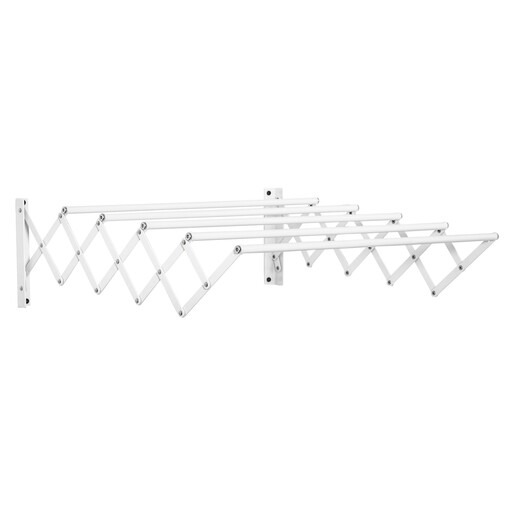 Image unavailable
An unheated option for a few napkins that can dry at their own pace.
Five rails; dimensions 63.5 × 60 × 20 cm; 10 kg load capacity. The airer folds flat against the wall and requires wall mounting.
 Image unavailable
A heated option if you want to spread out napkins and other washing indoors.
Stated power rating 230 W; dimensions when fully open 144 × 53 × 91 cm. The airer folds away. Use it indoors on a stable, level surface with good ventilation and at least 31 cm of clearance from walls. Use an earthed socket and unplug it after use.
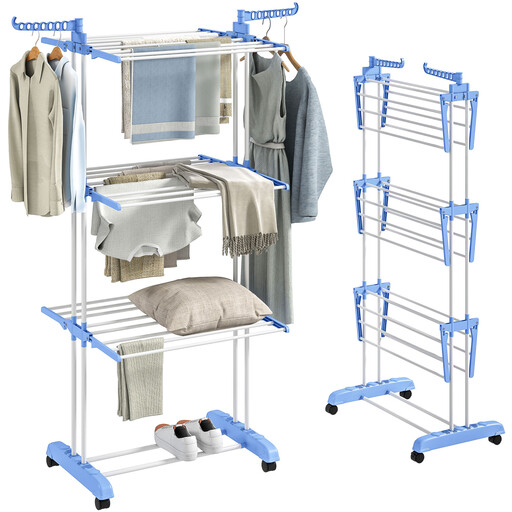 Image unavailable
An unheated tower for drying napkins alongside other washing.
The description lists three adjustable drying racks, two side wings and fourteen extra hanging slots. The racks fold away or can be removed, and four wheels make it easy to move. Assembly is required.
No, not just to let them air-dry. If time isn’t a priority, an unheated airer is an option that uses no electricity for heating. Check the care instructions and ventilate the room when drying washing indoors.
That depends on the specific model and its placement instructions. DOMO lists IPX4 for the DO7117DR; that specification doesn’t automatically apply to other airers and doesn’t replace the user manual.
Multiply the stated power rating in kW by the actual hours of use to estimate consumption in kWh. Multiply that figure by your own rate per kWh. Comparing wattages alone won’t tell you how much electricity each drying session uses.
For a consumer purchase in the Netherlands, ACM ConsuWijzer says the seller must offer a solution if the product doesn’t meet what you could reasonably expect when used normally. A shorter commercial warranty doesn’t take away your statutory rights.
Applicable European product requirements apply to electrical appliances. Ondernemersplein, the Dutch government’s business information portal, explains that after assessing the requirements, the manufacturer must affix a CE mark and draw up an EU Declaration of Conformity. Check the product information for the specific model.