If you’re moving soon and want to take your airer with you after use, a folding heated model is often a better choice than a permanently mounted one. First, check its dimensions when fully open and the space between the rails. Heating can help when you’re short on drying time, but it won’t guarantee a set drying time: follow the care label, ventilate the room and only pack your T-shirts once they’re dry.
Who is this buying guide for?
Moving house with little time to dry clothes
If you’re moving, you’ll want to dry your cotton T-shirts before packing them. Look for enough room to hang them with space between them, and check how the heating is controlled. A timer setting doesn’t guarantee a set drying time. DreamGoods describes heated airers with timer settings.
Moving house with a small room
You’ll need space for the airer while it’s in use, as well as somewhere to store it or take it with you afterwards. Compare the open dimensions of a winged or tower airer with the space available for a permanently mounted model.
Careful indoor dryer
If you dry clothes indoors, you’ll want to follow the care labels and consider the moisture released into the room. Milieu Centraal recommends extra ventilation when drying clothes indoors.
What should you look for when buying?
First, measure the space the airer will take up when in use and think about how you’ll transport it on moving day. Then check whether the heat settings are suitable for your T-shirts and whether you can ventilate the room.
| Your concern |
What to look for |
Who is this important for? |
| T-shirts dry in time |
Compare the usable rails, spacing and timer on the exact model. DreamGoods lists 34 heated rails and a 1–9-hour timer for its 21 m model. |
If I need my T-shirts dry before packing, I want to be able to hang them with space between them without relying on a set drying time. Around 25% of consumers prioritise having dry T-shirts in time. |
| Space and moving the airer |
Measure the airer when fully open and check how it folds or whether it needs to be installed. DreamGoods describes folding models; Foxydry describes a ceiling- or wall-mounted model that needs fixing in place. |
I want the airer to fit in my current room and be easy to take with me after the move. Around 25% of consumers prioritise portability. |
| Looking after your T-shirts |
Follow the care label on each T-shirt and the airer’s instructions. DreamGoods lists an adjustable temperature of around 30–70 °C for its 21 m model; GINETEX explains the meaning of care symbols. |
If a T-shirt has a print or another delicate finish, I want to adjust how I treat it accordingly, rather than considering the fabric alone. Around 19% of consumers prioritise protecting their textiles. |
| Moisture in the room |
Leave space between T-shirts and make sure damp air can escape. Milieu Centraal recommends extra ventilation when drying clothes indoors. |
I want to dry my washing indoors without overlooking the need to ventilate the room. Around 19% of consumers prioritise removing moisture. |
| Electricity use |
Compare the stated wattage of the exact model and how long you’ll use it for. DreamGoods lists 230 W for its 21 m model; Silvergear lists 300 W for its drying tower. The difference alone doesn’t tell you which airer will dry a load faster. |
If I want to estimate electricity use for my own drying time, I need to know both the wattage and the duration. Around 12% of consumers prioritise electricity costs. |
Common mistakes
-
Assuming wattage tells you the cost of a drying session
The stated wattage isn’t the same as the energy used to dry a full load. Without comparable usage times and drying results, wattage alone won’t tell you which model is cheaper to run.
For your chosen usage time, calculate kWh = kW × hours and compare models only on the same assumptions.
-
Thinking a cover can replace ventilation
Clothes drying indoors release moisture into the room. A cover around the airer won’t remove that moisture from the room by itself.
Plan for airflow in and out, and don’t hang T-shirts too close together. Milieu Centraal recommends extra ventilation when drying clothes indoors.
-
Checking only the folded dimensions
A folding airer still takes up floor space when it’s in use. A ceiling- or wall-mounted model needs to be fixed in place.
Measure both the space you’ll need for drying and the room available on moving day.
With a permanently mounted model, you’ll also need to allow for the work involved in installing it and taking it down later.
-
Assuming a similar-looking airer is the same model
Similar wattage or design doesn’t prove that two airers are the same brand and model.
Before buying, check the brand name, full model name and product documentation for the exact version you’re considering.
Brands to consider
DreamGoods
Offers folding heated airers with different stated drying lengths.
- According to DreamGoods, the 21 m model has 34 heated rails, a power rating of 230 W, an adjustable temperature of around 30–70 °C and a 1–9-hour timer.
- The 12 m product page mentions a timer, but doesn’t clearly specify the power rating for each variant. Stated features don’t guarantee a drying time.
Silvergear
Offers a heated winged airer and a heated drying tower; the shape determines how you use your floor space.
- Silvergear lists 20 heated rails and 230 W for its winged airer, and 300 W for its drying tower.
- These figures are product specifications, not measurements of energy use or drying performance per load. Check the instructions for the model you choose.
Foxydry
The Pro is an electric ceiling- or wall-mounted airer with fans, designed for a permanent drying space.
- According to Foxydry, the fan settings and power ratings vary by function.
- Because it needs to be installed, this model is less convenient to take with you when moving house.
Leifheit
Also offers non-heated airers, which can be an option if you have enough time and a suitable place to dry your clothes.
- Leifheit lists drying lengths of 18 m and 23 m for different Pegasus models.
- These models aren’t heated, and there are no comparable drying-time measurements for heated airers to compare their performance with.
Products on Joybuy
This selection includes a folding heated winged airer and a folding airer with several shelves. For the second model, check that the version suits the way you want to dry your clothes.
 Image unavailable
Folding electric heated clothes airer with two side wings, 230 W, 144 × 53 × 91 cm
A good choice if you want to spread out your T-shirts while they dry and fold the airer away afterwards. The stated dimensions are 144 × 53 × 91 cm and the stated power rating is 230 W.
Use it indoors on a stable, level surface with adequate ventilation, and keep it at least 31 cm from walls, as stated in the product description. Use an earthed socket that matches the appliance label, and unplug it after use.
View on Joybuy
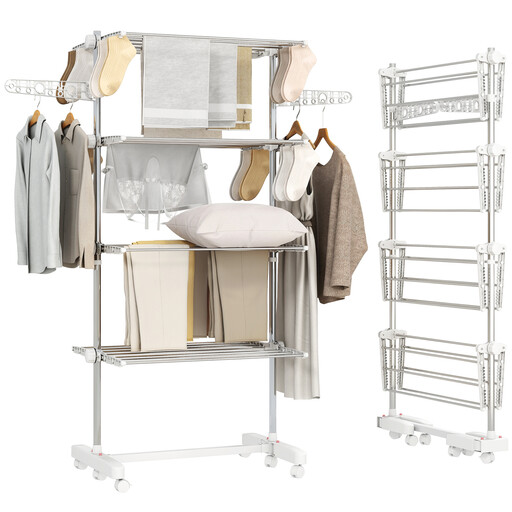 Image unavailable
Folding clothes airer with four shelves, side arms and wheels
Ideal if you want to spread clothes across several shelves and side arms, and move the airer around indoors.
Spread the washing evenly and lock the castors while the airer is in use.
View on Joybuy
Frequently asked questions
Can you hang cotton T-shirts on the highest heat setting?
Don’t decide based on the fabric alone. Check the care label on each T-shirt, look out for any delicate finishes and follow the airer’s instructions. An adjustable temperature doesn’t mean every setting is suitable for every garment.
Should you ventilate the room while the heated airer is on?
Yes. When drying clothes indoors, make sure damp air can escape. Milieu Centraal recommends extra ventilation when drying clothes indoors; a cover around the airer doesn’t replace room ventilation.
How do you clean an electric clothes airer safely?
Follow the instructions for the exact model. For the winged airer described on Joybuy, the instructions are to switch it off, unplug it and let it cool down before cleaning. Don’t use it if the cable is damaged. These instructions apply to that model.
What are your rights if an airer bought online isn’t suitable or breaks down too soon?
In the Netherlands, ordinary online consumer purchases generally come with a statutory 14-day cooling-off period after delivery, subject to exceptions; ACM ConsuWijzer explains how this period works. This is separate from your statutory rights if the product is faulty: if it breaks during normal use sooner than you could reasonably expect, the seller is responsible for providing an appropriate remedy free of charge.


