
Someone using a shared utility room
You want others to be able to get past the airer while it’s in use and once the washing is dry. So compare how much space it takes up when open, how you’ll store it and whether it can be installed.


Choose based on the available floor and walking space, and the care instructions for your sports tops. A folding airer takes up space while in use, while a ceiling- or wall-mounted airer keeps the floor clear but needs to be installed. Only use heat if it’s suitable for the fabric, and make sure the room is ventilated even when using a heated airer. An unheated airer may be enough if you don’t need extra warmth. Before buying, check the product documentation for the electrical compliance requirements that apply to the exact model.
You want others to be able to get past the airer while it’s in use and once the washing is dry. So compare how much space it takes up when open, how you’ll store it and whether it can be installed.
You air-dry your tops and check the care label before using heat. Advice for merino wool doesn’t automatically apply to every sports top.
You’re looking for somewhere to dry clothes where moist air can be removed, and weighing up the use of extra heat against electricity consumption.
Choose this if: you want to clear the shared floor once the washing is dry, and your tops’ care instructions allow for the heat you plan to use.
Bear in mind: the airer takes up floor space while it’s open; the stated wattage doesn’t tell you how quickly your tops will dry.
Choose this if: you want to keep the shared floor clear and have a suitable place to install it. Foxydry describes the Pro as offering ventilation with room-temperature and warm air.
Bear in mind: you’ll need to check in advance that the installation location and electrical connection are suitable.
Choose this if: you want to dry your tops without extra heat and have a well-ventilated spot.
Bear in mind: the airer doesn’t add heating or ventilation; drying clothes indoors still releases moisture into the room.
When drying sports tops in a shared utility room, the main considerations are space, fabric care, ventilation and whether you need extra heat.
| What to consider | What to look for | Who is this important to? |
|---|---|---|
| Walking space and storage | Check the dimensions when the airer is in use and how it stores away; for a fixed airer, check whether installation is possible. | I want to keep the walkway clear after drying and be able to put the airer away. Around 29% of consumers prioritise clear walking space and storage. |
| Suitability for sports tops | Read the care label and instructions on contact with heated bars; check whether unheated drying is an option. | I want to dry my tops in line with their care instructions and avoid using unsuitable heat. Around 29% of consumers put fabric care first. |
| Moisture and ventilation | Check whether moist air can be removed from the drying area; don’t treat airer ventilation as a substitute. | I dry clothes indoors and want moist air to be able to escape from the utility room. Around 24% of consumers prioritise moisture control and ventilation. |
| Electricity consumption | Compare the stated wattage for each function; estimate consumption using the running time as well. | I want to know which electrical function I need and how long it will be on. Around 18% of consumers prioritise electricity consumption and running time. |
Care advice for a garment doesn’t automatically mean it’s suitable to come into contact with heated bars.
Check the care label on the specific top and the airer’s instructions. If in doubt, choose a suitable unheated drying method.
Even when drying clothes indoors with extra heat, moist air needs to be able to escape from the room.
Check the ventilation options in the shared drying area before setting up an airer. Milieu Centraal recommends extra ventilation when drying clothes indoors.
The Foxydry Pro is an electric ceiling- or wall-mounted airer with ventilation. It may be a good fit if a freestanding airer would get in the way in a shared space.
The TopDry Pro is an electric ceiling-mounted airer for anyone who can use a fixed drying spot above the shared floor.
The Drywing is described as a freestanding, folding electric airer with side wings. This type may suit you if you want to put the airer away after use.
The unheated Concerto drying tower is a passive option if you’re looking for a compact drying spot without extra heat.
These product picks are suited to drying clothes indoors in a shared space: a folding, unheated drying tower and a folding electric heated airer.
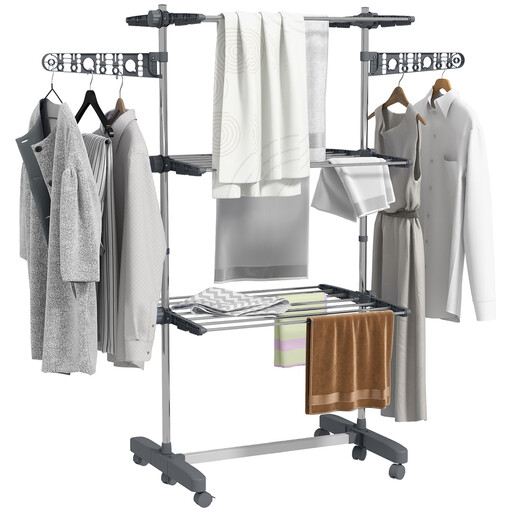 Image unavailable
Suitable if you want to air-dry clothes indoors and store the airer more compactly after use.
Dimensions when in use: 142 × 55 × 152 cm. According to the description, the folded airer is 13 cm deep; the title lists 6 wheels.
 Image unavailable
Suitable if you want to be able to put a heated airer away. Before buying, check that heat is suitable for the care instructions on your tops.
The stated dimensions are 144 × 53 × 91 cm and the power is 230 W. The description says to use it indoors on a stable, level surface with good ventilation and at least 31 cm of clearance from walls.
The instructions specify an earthed socket that matches the mains voltage on the appliance label. Before buying, check the product documentation for the electrical compliance requirements that apply to this exact model.
No, don’t assume that. Check the care label on the specific top and the airer’s instructions; advice for one type of clothing doesn’t necessarily apply to all sports tops.
No, air circulation from the airer doesn’t replace ventilation in the room. Milieu Centraal recommends extra ventilation when drying clothes indoors, so that moist air can escape.
Follow the instructions for the exact model. Brandweer Nederland warns that a coiled extension cable can get hot. Unplug the airer before cleaning and let it cool down if the model-specific instructions say to do so.
Check the wattage of the function you’ll use, and factor in how long it will run. Comparing wattage alone won’t tell you the electricity used per drying cycle.
The applicable European requirements apply to electrical equipment placed on the market in the Netherlands. According to the Dutch government (Business.gov.nl), once the technical and administrative requirements have been met, the manufacturer must affix the CE marking and draw up an EU Declaration of Conformity. CE is not an independent quality mark, so check the documentation for the exact model.