What should you look for when buying?
Check the care labels and available hanging space first. Then decide whether you need heat and choose a design that works in your home.
| What to consider |
What to look for |
Who is this important for? |
| Fabric care |
Read the full care label and check that the dress can hang freely, without unsuitable contact with heated rails. |
For a dress made from delicate fabric, I want to follow the care instructions and avoid contact with warm rails; that’s why around 36% of consumers put fabric care first. |
| Space for weekly laundry |
Compare the total drying length, maximum load and clear space between rails or tiers. |
If dresses and everyday clothes need to dry together, I want enough usable space without crowding the items. Around 29% of consumers give capacity for mixed weekly laundry top priority. |
| Positioning and storage |
Check the dimensions when set up and folded away, the installation requirements and the clearance for long dresses. |
When floor or storage space is limited, I want to know that the airer will fit without permanently taking up room to move around; around 21% of consumers focus mainly on the space it takes up. |
| Power and ventilation |
Consider the wattage and expected running time, and check whether you can ventilate the room. |
If I’m drying clothes indoors and want to limit electricity use, I compare a heated airer with an unheated one and make sure the room is ventilated. Around 14% of consumers prioritise running costs and indoor air quality. |
Joybuy products
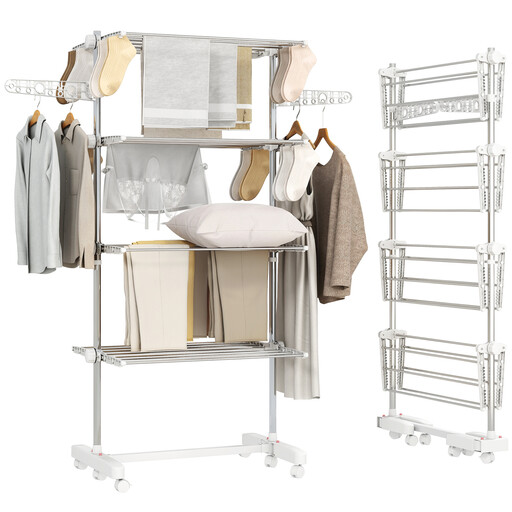
This Joybuy selection includes a folding airer with shelves and a folding heated airer with side wings. Compare the designs to find one with enough clear space for your dresses and other weekly laundry.
 No image available
Folding clothes airer with four shelves, side arms and wheels – white
The shelves and side arms give you different ways to spread out clothes from a mixed load.
Distribute the laundry evenly and lock the castors while the airer is in use.
Joybuy
 No image available
Folding electric heated clothes airer with two side wings, 230 W, silver
The side wings provide extra hanging space for mixed laundry; check that long dresses can hang freely.
The product title states 230 W and dimensions of 144 × 53 × 91 cm. The product information says to use the airer on a stable, level surface, ensure adequate ventilation, keep it at least 31 cm from walls and plug it into an earthed socket.
Check the care label on each dress; a ban on tumble drying does not automatically mean that contact with heated rails is suitable.
Joybuy
Frequently asked questions
Can you put a dress marked ‘do not tumble dry’ on heated rails?
That doesn’t follow from that symbol alone. Check the full drying instructions and the dress’s fabric and finish; a ban on tumble drying is not permission for direct contact with a heated rail.
Do I need to ventilate the room when a heated airer is drying my laundry?
Yes. Ventilation is still important when drying clothes indoors, even with a heated airer. Milieu Centraal recommends extra ventilation when you dry laundry indoors.
How do I calculate the electricity costs of a heated clothes airer?
Multiply the power in kilowatts by the actual running time in hours to calculate energy use in kWh. Then multiply that by your own rate per kWh. Wattage alone doesn’t tell you how long your laundry will take to dry.
What can I do in the Netherlands if an airer breaks too soon during normal use?
Contact the seller about your statutory warranty rights. According to the Dutch government, there is no fixed statutory warranty period for all products in the Netherlands; what you can expect depends, among other things, on the product and normal use.
What product information matters for an electric clothes airer?
For electrical equipment within the scope of the EU Low Voltage Directive, distributors must check, among other things, the CE marking and the required documents, instructions for use and safety information. EUR-Lex describes these obligations. Check the information for the exact model, and don’t treat a mention in an advert as proof on its own that a specific airer complies.


