
People with limited floor space
You want to hang shirts without leaving an airer permanently on the floor. Compare its dimensions both in use and when stored with the space taken up by a wall- or ceiling-mounted model.


Start by finding a spot where you can hang shirts with space between them and where moist air can be extracted. Then decide whether extra heat would be useful. A folding heated airer is suitable for occasional use, while a ceiling- or wall-mounted model frees up floor space but needs installing. An unheated airer avoids using electricity for heat, but check the specific CE marking and product documentation for any electrical model before buying.
You want to hang shirts without leaving an airer permanently on the floor. Compare its dimensions both in use and when stored with the space taken up by a wall- or ceiling-mounted model.
You dry your washing at home and want to know how moist air is extracted. Milieu Centraal stresses that extra ventilation is important when drying washing indoors; a heated airer does not replace ventilation in your home.
You want to hang shirts according to their care instructions and weigh up using heat against electricity consumption and running time. Clevercare recommends spreading cotton garments out well when hanging them up to help prevent them losing their shape.
First assess ventilation and the space available. Then decide whether you need extra heat and how often you intend to use it.
Suitable for: occasional extra heat when the airer fits in the room unfolded and you want to put it away after use.
Consider: heating uses electricity and does not extract moisture from your home.
Suitable for: situations where keeping the floor clear is important and there is a suitable permanent spot.
Consider: the installation, fixings and electrical connection must be suitable for the model you choose.
Suitable for: when you do not need extra electric heat and can give your washing enough time and space to dry.
Consider: you still need enough drying space and ventilation; a wall-mounted airer needs a suitable place to attach it.
| What to consider | What should you look for? | Who is this important for? |
|---|---|---|
| Space and storage | Measure the available floor space or mounting area and compare it with the dimensions of the model you are considering. | If I have limited room to move around, I want to know whether the airer fits when unfolded and where I can store it. Around 31% of consumers put space and storage first. |
| Moisture extraction | Check how the drying area is ventilated; use mechanical extraction in line with your home’s instructions. | When I dry clothes indoors, I want to be able to extract moist air and not confuse ventilation with heating. Around 31% of consumers give moisture extraction top priority. |
| Cotton shirts | Follow the care label, spread shirts out and check that the temperature setting is suitable for the fabric. | When I hang cotton shirts up, I want to give them enough space and follow their care instructions. Around 23% of consumers choose shirt care as their main consideration. |
| Electricity consumption | Compare the power used at each setting with the running time. A timer sets the duration, but does not tell you whether clothes are dry. | Anyone looking to keep running costs low will want to know how long a heated setting is actually needed and whether installation or accessories affect the cost. Around 15% of consumers put running costs first. |
The percentages show how consumers in a scenario are divided when each names one main purchase concern; they are not market shares or survey results.
A heated airer does not automatically extract moist air from your home. Drying clothes indoors means you need to think about ventilation.
Assess the ventilation in the drying area before choosing a heated model. If you use mechanical extraction, follow your home’s instructions.
The stated power rating or drying length alone does not tell you how long cotton shirts will take to dry. The load and ventilation also make a difference.
Compare how much space there is to spread shirts out, and take account of the settings and ventilation requirements for the exact model.
A fixed airer is only practical if the mounting point and connection are suitable for the model you choose.
Before buying, check the model’s instructions, the mounting point and the connection required.
A matching power rating or appearance does not prove that a product is the same brand and model.
Check the identity and documentation of the specific model separately; do not treat a resemblance as proof that the product complies with requirements.
Silvergear describes both a heated airer with a cover and a heated drying tower. These designs suit different drying-area layouts.
The PRO 2025 model described is a 21 m folding heated airer with temperature and timer settings.
Foxydry describes the Pro as a motorised ceiling- or wall-mounted airer with cool- and warm-air functions, for situations where installation is possible.
The NVWA states that CE marking is mandatory for electrical products covered by the relevant CE rules. Before choosing, check the marking and product documentation for the specific electrical model.
These products are suitable for hanging shirts in an upper-floor flat, with a choice of a folding airer or an electrically heated model.
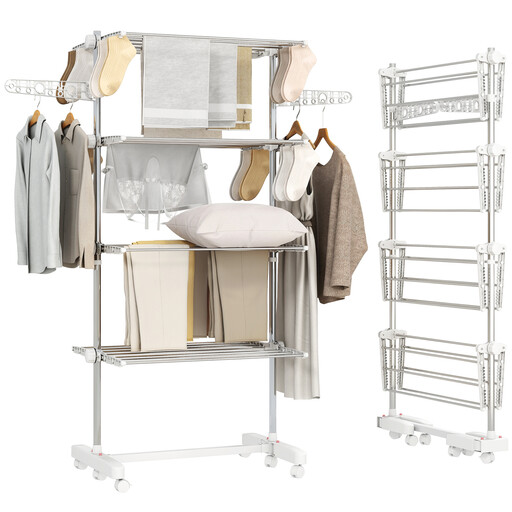 Image unavailable
Suitable if you want to hang shirts on hangers and fold the airer away after use.
Four shelves with side arms and wheels; maximum load capacity 30 kg and maximum 6 kg per shelf. Folded dimensions: 172 × 80 × 13 cm.
Spread the washing evenly and lock the wheel brakes while using the airer.
 Image unavailable
Suitable if you want to use extra heat occasionally and put the airer away after use.
Power: 230 W. Dimensions: 144 × 53 × 91 cm. Recommended maximum load: 10 kg.
Use indoors on a stable, level surface, with sufficient ventilation and at least 31 cm clearance from walls. Before buying, check the CE marking and product documentation for this specific model.
Use an earthed socket that is suitable for the appliance rating label. Switch the appliance off and unplug it after use.
No, a heated airer does not replace ventilation in your home. Milieu Centraal recommends extra ventilation when drying washing indoors. Use mechanical extraction in line with your home’s instructions and make sure there is enough air coming in.
Follow the care label and, where possible, hang cotton shirts out well. Clevercare recommends spreading cotton out to help prevent it losing its shape; also leave garments room for air to circulate.
Check that the mounting point and connection are suitable for the model you choose, and follow the model’s instructions. If you use a cable reel, unwind it fully and follow the installation method required for the model.
No, wattage alone is not a reliable way to compare the cost of each drying cycle. Calculate electricity consumption for each setting by multiplying the power in kW by the hours of use, and bear in mind that the time needed may vary.
CE marking is mandatory for electrical consumer products covered by the relevant CE rules; check the marking and product documentation for the specific model. ACM ConsuWijzer explains that your statutory guarantee applies alongside any seller’s guarantee, and that a product must perform as you could reasonably expect when used normally.