
Need your aprons again soon?
If you need your aprons again before the next school day, focus on how many you can hang separately. A product listing alone does not prove how long aprons will take to dry.


Choose an airer that lets you hang aprons separately with space between them. A folding winged airer may suit a smaller load, while a drying tower offers more hanging space but needs more floor space and headroom. A heated airer uses electricity but does not remove the evaporated moisture, so consider its wattage and how long you’ll use it for. Ventilate when drying indoors, and check the details and markings on the specific model.
If you need your aprons again before the next school day, focus on how many you can hang separately. A product listing alone does not prove how long aprons will take to dry.
For a larger load, usable hanging space, gaps between items and the airer’s dimensions all matter. A taller airer also needs to fit the space you have at home.
A folding airer can be handy if you want to put it away after use. Good ventilation is still important when drying indoors; Milieu Centraal recommends extra ventilation when laundry is dried inside.
Start by considering how many aprons need to dry at once and how much space you have. Then compare the controls, electricity use and ventilation options.
| What to consider | What should you look for? | Who should consider this? |
|---|---|---|
| Time until you can use them again | Check how many aprons can hang with space between them, and whether the model has an adjustable timer. | If I need the aprons before the next school day, I want to hang them separately; around 29% of consumers say time until reuse is their top priority. |
| Several aprons at once | Compare the number of usable rails, the layout, the dimensions when set up and the stated maximum load. | For a larger wash, I need enough separate hanging spaces that will fit at home; around 23% of consumers prioritise drying a whole load at once. |
| Space and storage | Measure the available floor space and access routes; check both the dimensions when set up and when folded away. | If my drying space is small, I want to be able to put the airer away after use; around 18% of consumers see the space it takes up as their main consideration. |
| Electricity use | Check the wattage of the exact model and bear in mind how long you’ll actually use it for. Only compare models under the same load and usage conditions. | If I want to limit electricity use per drying session, I weigh up heating the airer against drying without heat; an estimated 18% of consumers give this their highest priority. |
| Moisture in the home | Choose a drying spot where air can circulate, and follow the model’s clearance and ventilation instructions. | If I dry laundry indoors, I want to be able to remove the moist air; around 12% of consumers make moisture control their main consideration. |
Wattage alone won’t tell you how much electricity a drying session uses, and it doesn’t prove how long aprons will take to dry. The product listing for the Dirt Devil DD6004 gives conflicting wattage figures.
Compare electricity use for the same amount of laundry and the same length of time. If the wattage details conflict, first check which figure applies to the exact model.
A stated drying length doesn’t tell you how many aprons will fit in the available space with enough room between them.
Measure your aprons and drying area, and check the layout, load capacity and dimensions when set up for the model you’re considering.
Laundry dried indoors releases moisture into the air. Milieu Centraal recommends extra ventilation; heating does not remove that moisture from the home.
Choose a spot where you can ventilate, whether or not the airer is heated.
The Netherlands Food and Consumer Product Safety Authority states that CE marking is mandatory for electrical products. A claim in a product description does not confirm that the specific item you receive carries the marking.
Before buying, check the marking, model identity, rating plate and instructions for the version you’ll receive.
A folding heated airer described in a product listing as an option for a smaller load that can be hung with space between items.
The version described has adjustable time and temperature settings.
The DD6004 is described as a heated drying tower for anyone looking for plenty of separate hanging spaces.
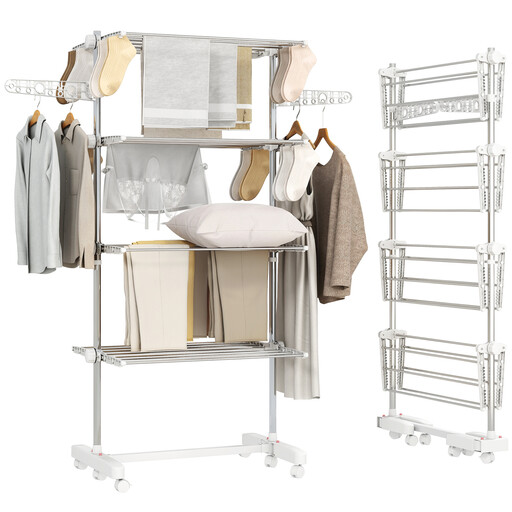
This selection includes a folding airer with shelves and side arms, and a folding heated winged airer. Check which layout suits your aprons and drying space for each model.
 No image available
The shelves and side arms offer a range of hanging positions if you want to hang several aprons without leaving the airer set up permanently.
Stated dimensions: 172 × 142 × 55 cm when open and 172 × 80 × 13 cm when folded. The description specifies a maximum of 6 kg per shelf; distribute the laundry evenly and do not exceed this limit. The airer has six wheels, two of which have brakes.
 No image available
This heated model with two side wings is an option if you want to use heat and be able to fold the airer away after use.
Stated dimensions: 144 × 53 × 91 cm; the product description specifies a temperature range of 45–55 °C and a recommended maximum load of 10 kg. Use it indoors on a stable, level surface, with good ventilation and at least 31 cm clearance from walls. Check the CE marking on the specific item before buying.
Yes. The Netherlands Food and Consumer Product Safety Authority states that CE marking is mandatory for electrical products. Check the marking on the actual product: a claim in an advert alone does not confirm what you’ll receive. CE marking also does not mean that an independent assessment is required.
Yes. Milieu Centraal recommends extra ventilation when laundry is dried indoors. Make sure air can circulate; a heated airer does not remove moisture from the home.
Calculate the energy used for the same amount of laundry and the same length of time: power in kW × hours of use = kWh. To work out the cost, multiply the kWh by your own price per kWh. Only use a confirmed wattage for the exact model; the wattage figures for the Dirt Devil DD6004 conflict.
Follow the instructions for the specific model. The Joybuy product listing for the folding heated airer with two side wings says to switch it off, unplug it before cleaning and let it cool down. Don’t assume the same instructions apply to other models without checking.
Contact the seller if the product doesn’t meet the reasonable expectations you had of it under normal use. According to ACM ConsuWijzer, your statutory guarantee is in addition to any manufacturer’s warranty; in the Netherlands, there is no fixed, general guarantee period for statutory guarantees.