What should you look for when choosing one?
First, choose a drying method that suits the garment care labels. Then compare the hanging space, where you’ll use it and how it works.
Heated winged airer
Suitable if: you want to hang several washable items with space between them and fold the airer away after use.
Bear in mind: a fully opened winged airer takes up floor space. Also check the care label and the required CE marking for the electrical model being offered.
Heated drying tower with cover
Suitable if: you’d rather make use of height than have a wide hanging area.
Bear in mind: check that long or delicate garments can hang freely. A claim that it dries clothes faster is not a guaranteed drying time for your laundry.
Compact heated wall-mounted or freestanding airer
Suitable if: you want to dry a small number of items in a fixed spot. DOMO describes the DO7117DR as suitable for freestanding or wall-mounted use.
Bear in mind: a compact model won’t necessarily hold a full wardrobe. IPX4 alone does not determine where you can place the appliance in a bathroom.
Unheated airer
Suitable if: your clothes can dry in time without extra heat and you don’t need the airer to warm them.
Bear in mind: drying clothes indoors still requires ventilation and enough space to hang them as directed on the care label.
| What to consider |
What to look for |
Who should pay extra attention? |
| Drying method and garment shape |
Check the washing and drying instructions for each item; see whether the airer allows line drying or flat drying. |
I want my workwear to dry according to the care label, even if that takes up more space. Around 33% of consumers put the specified drying method first. |
| Having clothes ready in time |
Compare the number of usable hanging spaces and the timer; don’t assume a set drying time without comparable data. |
If I need my clean workwear before my next working day, I look for enough hanging space and adjustable controls. Around 27% of consumers give having clothes ready in time the highest priority. |
| Space and storage |
Measure the space with the airer fully opened and check how the specific model can be stored after use. |
If I have limited floor or storage space, I want to know where the airer will fit while in use and where I can put it afterwards. Around 20% of consumers put space first. |
| Ventilation and electricity use |
Assess the ventilation available and compare the wattage with the actual time in use; wattage alone doesn’t tell you the running cost per load. |
If I dry clothes indoors, I want to be able to remove moisture and know whether extra heat is needed. Around 20% of consumers start by considering indoor conditions and running costs. |
Joybuy products for workwear
This Joybuy selection includes a heated winged airer and an unheated wall-mounted airer. Choose according to the care label, the space available and whether your clothes can dry in time without extra heat.
 No image available
Electric heated airer with 2 side wings, 230 W, 144 × 53 × 91 cm, silver
The central drying area and two side wings give you space to spread out workwear when the care label allows line drying.
Rated power: 230 W. Stated temperature: 45–55 °C. Dimensions: 144 × 53 × 91 cm. Recommended maximum load: 10 kg.
Use the airer indoors on a stable, level surface, with good ventilation and at least 31 cm clearance from walls. Check the drying instructions for each item, and check that the electrical model being offered has the required CE marking.
View at Joybuy
 No image available
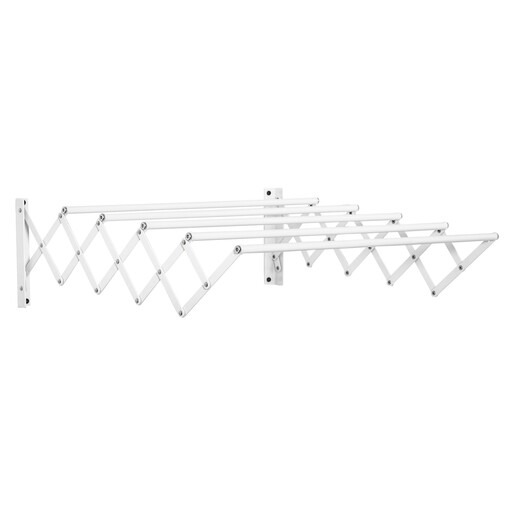
Folding wall-mounted airer with 5 rails, 63.5 × 60 × 20 cm, white
This unheated airer is an option if natural drying is sufficient and you want to save floor and storage space.
Five rails. Dimensions: 63.5 × 60 × 20 cm. Stated maximum total load: 10 kg.
Check that the wall mounting is suitable for your drying area, and follow the care label for each item, which may specify line drying or flat drying.
View at Joybuy
Frequently asked questions
Can every washable item be dried on a heated airer?
No. Check the washing and drying instructions for each item: GINETEX distinguishes between natural drying methods, including line drying and flat drying. A general product claim does not replace those instructions.
How can I prevent damp problems when drying clothes indoors?
Make sure air can circulate in and out while your laundry dries indoors. Milieu Centraal explains that inadequate ventilation can cause moisture to build up and encourage mould; a heated airer will not remove that moisture from your home by itself.
How can I estimate the electricity use of a heated airer?
Multiply the stated power in kilowatts by the number of hours in use to calculate an estimate in kilowatt-hours. 230 W is 0.23 kW; four hours at that power works out at 0.92 kWh. Actual usage and costs depend on how the airer operates, how long it is used and your electricity tariff; this is not a measured figure per load of washing.
Is CE marking required for an electrically heated mains-powered airer?
Yes. CE marking is compulsory for an electrically heated mains-powered airer offered for sale on the Dutch market. The Netherlands Food and Consumer Product Safety Authority describes the requirements that apply to electrical products; the requirement itself does not prove that a specific item meets them.
Can an airer with IPX4 be placed anywhere in a bathroom?
No, IPX4 alone does not mean that. DOMO lists IPX4 for the DO7117DR, but the instructions and electrical installation must be assessed before placing it in a bathroom; that protection rating does not determine a universally permitted location.


