
Limited storage space
You want to be able to fold the airer away after drying. Compare its size when open and folded with the space where you plan to use or store it.


A heated, foldable airer with side wings is worth considering if you regularly dry cotton shorts indoors and have room for it both open and folded away. A standard clothes airer uses no electricity; when drying clothes indoors, ventilation remains important, as Milieu Centraal advises. Before buying an electric model, check its product identification, CE marking and model-specific instructions.
You want to be able to fold the airer away after drying. Compare its size when open and folded with the space where you plan to use or store it.
You often hang cotton shorts indoors and want to weigh up whether using electricity for heat is worthwhile for you. The Consumers' Association lists fabric thickness, humidity and room conditions among the factors affecting drying time for the SpeedDryer; this is not a measurement for these airers.
You dry washing in a small living space and want to be able to remove moisture. Milieu Centraal advises increasing ventilation when drying washing indoors.
Start with the space available and how you want to hang your shorts. Then factor in electricity use and the instructions for safe use.
| What to consider | What should you check? | Who is this most important for? |
|---|---|---|
| Fitting and storage | Compare the airer's dimensions when open and folded with the space you have available. | If I want to put the airer away after every use, it also needs to fit in my cupboard or alcove when folded. Around 33% of consumers prioritise storage space. |
| Hanging space for shorts | Check the position of the bars and whether you can hang your shorts with space between them. | If I hang several pairs of cotton shorts at once, I want to leave space between them. Around 27% of consumers consider hanging space for shorts their top priority. |
| Ventilation and use | Check the ventilation options and the instructions for positioning and connection. For an electric model, also check the CE marking and product identification. | In a small room, I want to be able to remove moisture and use the airer as instructed. Around 20% of consumers prioritise ventilation and safe use. |
| Electricity use | For the same use, compare the power in kW, the operating time in hours and your tariff per kWh. | If I dry clothes indoors often, I want to know whether heating is worth the electricity compared with a standard airer. Around 20% of consumers consider electricity use their top priority. |
An airer with side wings can take up more floor space when open than you have available.
Measure both the drying area and the storage space, and check the dimensions of the specific model.
Watts indicate power, not the electricity used over a full drying cycle.
Compare the power in kW and the operating time in hours with your tariff per kWh. Set that calculation against a standard clothes airer, which uses no electricity itself.
Washing dried indoors still adds moisture to the air. That's why Milieu Centraal advises increasing ventilation.
Ventilate the room and don't hang the shorts too close together. Follow the care label too; Clevercare advises spreading cotton garments out well when hanging them up.
Silvergear offers a heated winged airer and a heated drying tower with a cover.
DreamGoods lists a heated airer with a cover and a stated drying length of 21 m.
According to the manufacturer, the InnovaGoods Warmmat winged airer has adjustable temperature settings and a timer.
This selection from Joybuy includes a heated winged airer and a foldable clothes airer for anyone who wants to hang cotton shorts indoors.
 No image available
This heated winged airer may suit anyone who wants to hang shorts indoors and fold the airer away after use. Check beforehand that it will fit in your space when open.
The product details list 230 W, a temperature of 45–55 °C, a recommended maximum load of 10 kg and dimensions when open of 144 × 53 × 91 cm.
The description specifies indoor use, a stable surface, ventilation and a clearance of at least 31 cm from walls. Before buying, check the CE marking and product identification for the specific item; a product page alone is not an independent safety test.
 No image available
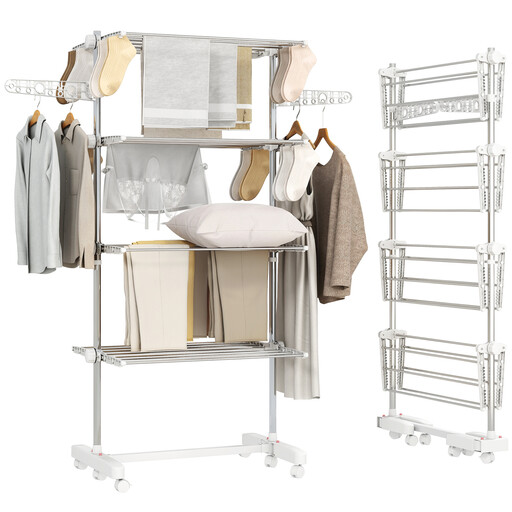
This airer may suit anyone who wants to hang shorts and other clothes on several levels and fold the airer away after use.
The product description lists four main shelves, two side wings, wheels and a maximum load of 6 kg per shelf.
The stated folded dimensions are 172 × 80 × 13 cm. Check whether it will fit in your storage space, distribute the washing evenly and lock the brakes during use.
No, a standard clothes airer uses no electricity itself. Heating is mainly worth considering if you often dry clothes indoors and the electricity use is acceptable for you. Don't assume cotton shorts will always take a set amount of time to dry.
Follow the instructions for the exact model and make sure there is ventilation and enough space around the airer. A Joybuy product page specifies a stable surface and a clearance of at least 31 cm from walls for that particular model; don't automatically apply this measurement to other models.
Multiply the power in kW by the number of hours of use to calculate consumption in kWh. Then multiply that by your own tariff per kWh. A power rating such as 230 W is not, by itself, a measured figure for electricity used per drying cycle.
Electrical equipment within the relevant scope must meet the requirements of the Low Voltage Directive, as implemented in Dutch regulations. The Netherlands Food and Consumer Product Safety Authority advises people buying online to check for the CE marking; a marking or product page is not an independent safety test of the specific item.
In the Netherlands, the seller must offer a solution if a product turns out to be faulty. The Dutch government explains that there is no fixed statutory two-year guarantee period for all products.