
Anyone who wants their underwear dry before visitors arrive
They want to know whether a few freshly washed items can dry in time, without treating an unconfirmed drying time as a guarantee.


A standard airer may be enough if you have plenty of time and can ventilate the room well. A heated airer can add warmth, but it cannot guarantee that your underwear will be dry before you leave. Choose based on the amount of washing, the space available and the garment care instructions. For an electric model, also check the manual, the intended location and the relevant product marking.
They want to know whether a few freshly washed items can dry in time, without treating an unconfirmed drying time as a guarantee.
They want to be able to lay garments out or dry them flat according to the care label, rather than assume every fabric can go directly on warm rails.
They need to consider how much room the airer takes up while in use, and how to ventilate the space when drying washing indoors.
First work out how much time and space you have. Then check that the drying method suits your underwear and the place where you plan to use the airer.
| Buying concern | What should you look for? | Who might find this important? |
|---|---|---|
| Dry before visitors arrive | Compare the time available with the amount of washing you can spread out; wattage or a timer does not tell you exactly how long drying will take. | If I need a few items dry before visitors arrive, I want to know how much time I have and how much washing I can spread out at once. Around 33% of consumers say having items dry before visitors arrive is their main buying concern. |
| Taking care of delicate underwear | Read the care label and check whether the instructions explain how to place items on or near the airer. | If the label specifies a particular drying method, I want to follow it without unnecessary direct contact with warm rails. Around 27% of consumers prioritise fabric care. |
| Space and storage | Measure the space where you’ll use the airer and where you’ll store it; for a folding model, check its dimensions in both positions. | If I have limited floor space, I want to know whether the airer will fit when open and can be put away after use. Around 20% of consumers are mainly concerned about how much space it takes up. |
| Ventilation and electrical use | Assess the ventilation, the manual and whether the intended location is suitable; don’t assume an IP rating alone means an airer can be used in a bathroom. | If I dry washing indoors, I want to be able to remove moisture from the air and use the electric airer in a suitable place, following the instructions. Around 20% of consumers put indoor air quality and safe use first. |
A power rating won’t tell you when a particular garment will be dry. The result depends on more than just the airer, so don’t plan when to leave based on an assumed drying time.
Compare the amount of washing you want to spread out with the time available, and follow the care labels.
The airer uses electricity while it’s heating; wattage alone doesn’t tell you how much energy one drying session will use.
Even with a heated airer, moisture from drying washing gets into the air indoors. Milieu Centraal lists drying washing as a source of moisture in the home.
Before buying, decide where you can put the airer and how you’ll ventilate the room.
A product-specific protection rating doesn’t replace the manual or the instructions for positioning and connecting the appliance.
Read the manual for the exact model and assess the intended location separately.
A folding winged airer may take up little room when stored, but need more floor space while you’re drying clothes.
Measure both the space for use and the storage area, and compare the chosen model’s dimensions in both positions.
DOMO says the DO7117DR is designed to be used as a freestanding or wall-mounted model, making it an option if you’re looking for a compact setup.
The Dutch product listing for the DD6003 describes a folding heated winged airer for spreading out washing.
Lakeland describes multi-tier heated airers as another layout to compare.
These models include heated airers for spreading out washing and a folding clothes airer. Check whether each version suits the amount of underwear, the space available and your intended drying method.
 No image available
The side wings give you space to spread out several items; check that the airer fits in your chosen spot when open.
The product title lists 230 W, dimensions of 144 × 53 × 91 cm and a folding design.
A power rating won’t tell you how long your underwear will take to dry. Follow the care label and the instructions.
 No image available
A wall-mounted model may suit you if you’re looking for a heated rail to attach to the wall; check that its design and instructions are suitable for drying underwear.
The product title lists touch controls, a digital temperature display and a top shelf.
Before installation, check the manual and make sure the intended location is suitable.
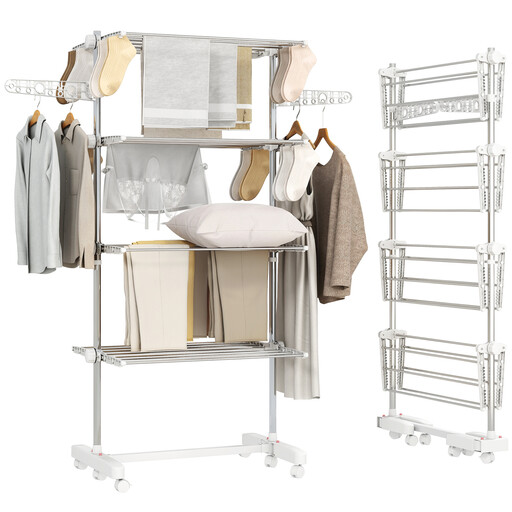 No image available
The shelves and side arms offer different places to spread out clothes; check that the layout suits your underwear and its drying instructions.
The product description lists four shelves, two side arms and six wheels, two of which have brakes.
Check the dimensions both open and folded before choosing where to put it.
No, a heated airer can’t guarantee that your underwear will be dry in time. Power ratings and the airer’s layout don’t establish a drying time; spread the items out and allow for the time you have.
No, don’t assume that. Follow the care label and the airer’s instructions; if the label says to dry flat, place the item flat on a suitable surface.
Yes, ventilation still matters when you dry washing indoors. Milieu Centraal lists drying washing as a source of moisture in indoor air; a heated airer won’t remove that moisture from your home by itself.
Follow the manual for the exact model. Joybuy’s product page for a winged airer says to switch the appliance off, unplug it and let the airer cool down; check the instructions before applying this advice to another model.
CE marking is required for electrical equipment covered by the Dutch Electrical Equipment (Commodities Act) Decree. For the applicable low-voltage rules, the Netherlands Food and Consumer Product Safety Authority lists a nominal AC voltage of 50–1000 V, among other requirements. Check the marking on the specific product, as a product description or IP rating alone doesn’t prove compliance.