
People who share a utility room
If several people use the space, check how much room the airer takes up when open and how easy it is to put away afterwards.


Start by finding a spot where the airer won’t get in anyone’s way when it’s unfolded, and where moist air can be ventilated. A heated, folding airer could be a good fit if you regularly need extra drying space. If drying time is less important, an unheated airer avoids the electricity used for heating. Before buying an electric model, check the CE marking and the instructions for that exact version.
If several people use the space, check how much room the airer takes up when open and how easy it is to put away afterwards.
If you often dry tea towels indoors, consider whether you need extra heat or whether air-drying will do. Milieu Centraal highlights the importance of ventilation when drying clothes indoors.
A good fit if: you regularly want extra heat and the airer fits in the shared space when open.
Bear in mind: electricity use, ventilation, and checking the CE marking and model-specific instructions.
A good fit if: tea towels can dry in time without extra heat and you want to put the airer away after use.
Bear in mind: the airer doesn’t provide heat, and moist air still needs to be ventilated when drying naturally.
Start by considering ventilation and the space available, then weigh up your drying needs against electricity use. Milieu Centraal recommends paying attention to ventilation when drying clothes indoors, as drying laundry adds moisture to the air.
| What to consider | What to look for | Who is this important for? |
|---|---|---|
| Ventilation and safe use | Check that there is adequate airflow in and out. For an electric model, also check the CE marking and the instructions. The NVWA explains when CE marking is mandatory for electrical products. | If I dry tea towels in a shared space, I want to be able to ventilate moist air and use the airer according to the instructions. Around 31% of consumers prioritise ventilation and safe use. |
| Drying space and heat | Decide how many tea towels you’ll hang up at once and whether there’s room to spread them across separate bars. The stated heating power alone doesn’t tell you how long drying will take. | If I regularly need dry tea towels, I look for enough room to hang them separately and consider whether extra heat will make a difference. Around 25% of consumers prioritise these drying needs. |
| Space and storage | Measure the available space with the airer unfolded and decide where you can keep it after use. | If other people use the utility room too, I want to know whether the airer can be left open without blocking access, and where I’ll put it away afterwards. Around 25% of consumers focus mainly on floor space and storage. |
| Electricity use | Compare the stated power rating and expected usage time with your own electricity tariff. The HOMCOM 850-198V90 is rated at 230 W; one hour of continuous use works out mathematically at 0.23 kWh. | If I don’t need extra heat, I want to avoid using electricity when an unheated model will do. Around 19% of consumers prioritise electricity use. |
Even with a heated airer, indoor drying adds moisture to the room. Heating doesn’t replace the need to ventilate moist air.
First, check that the utility room has adequate airflow in and out. Milieu Centraal recommends ventilating when drying clothes indoors.
In a shared utility room, it’s the size of the airer when unfolded that determines whether it will get in the way of access or other activities while drying.
Measure the space and access route with the airer fully open before choosing a model.
The stated power rating of a heated model doesn’t prove how quickly your tea towels will dry.
Use the wattage only to calculate the theoretical electricity consumption for a given period of use. Don’t treat it as a measured drying time or a prediction of your actual costs.
Heated, folding airers. The 850-198V90 is an option if you’re specifically looking for extra heat.
Unheated, portable airers for anyone who wants to dry clothes without extra heat.
Unheated HangOn airers for anyone looking for a folding airer for a shared space.
The K120 is an electric, heated option to compare with folding airers.
These products include an unheated wall-mounted airer and electric, heated airers. Compare whether you need fixed installation or floor space, and check the CE marking and model-specific instructions for any electric model.
 No image available
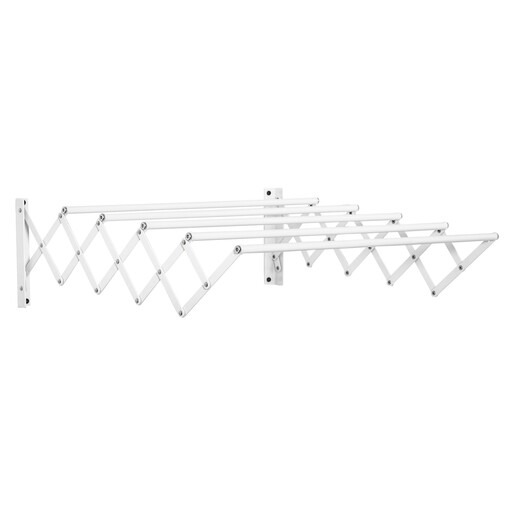
A good choice for air-drying while keeping floor space clear, if wall mounting is possible.
The product description lists 5 bars, dimensions of 63,5 × 60 × 20 cm and a load capacity of 10 kg.
Installation requires pre-drilled holes.
 No image available
A good choice if you want extra heat and an airer that folds away after use. Bear in mind how much space it needs while in use.
The product description lists 230 W, 45–55 °C, a recommended maximum load of 10 kg and open dimensions of 144 × 53 × 91 cm.
The instructions specify a stable, level surface, ventilation, a clearance of at least 31 cm from walls and an earthed socket. Follow the instructions for this model. The NVWA explains when CE marking is mandatory for electrical products; before buying, check the marking and documentation for this version.
 No image available
A good choice if you’re looking for a fixed wall installation and don’t need a portable, folding airer.
The product description lists touch controls, a digital temperature display, a top shelf and dimensions of 58,5 × 55 cm.
Before buying, check the instructions, CE marking and documentation for the exact version. The NVWA explains when CE marking is mandatory for electrical products.
Yes. When drying clothes indoors, make sure there’s airflow in and out. According to Milieu Centraal, ventilation helps remove moisture; using a heated airer doesn’t remove the need for it.
Follow the instructions for the model you choose. The instructions for the electric airer reviewed recommend placing it on a stable, well-ventilated surface, switching it off after use, unplugging it before cleaning and allowing it to cool down. Don’t assume these instructions apply to another model without checking.
CE marking is mandatory for electrical products covered by the applicable rules, according to the Netherlands Food and Consumer Product Safety Authority (NVWA). Check the marking and documentation for the specific model. The general requirement doesn’t, on its own, confirm that an individual product complies.
According to ACM ConsuWijzer, the seller must put things right free of charge under the applicable terms if the product doesn’t meet what you could reasonably expect. Online purchases also generally come with a 14-day cooling-off period after delivery, subject to exceptions. This cooling-off period is separate from your rights if a product doesn’t meet expectations.