
Wearers of delicate summer dresses
If you dry delicate or long dresses, you’ll want to choose a drying method that follows the care label. GINETEX explains symbols for drying on a line, flat and in the shade, among other methods.


First, choose an airer and a place to set it up that let you follow the care instructions for your summer dresses and ventilate your home. Heating may be an option if you need the extra warmth, but also compare the hanging clearance, open dimensions and wattage. Heat is no substitute for a suitable drying method or ventilation.
If you dry delicate or long dresses, you’ll want to choose a drying method that follows the care label. GINETEX explains symbols for drying on a line, flat and in the shade, among other methods.
In an upstairs flat, both the floor space an airer takes up when open and the clearance needed for a dress matter. A tower airer and a winged airer need different layouts.
Drying laundry indoors adds moisture to your home. Milieu Centraal recommends ventilating more when you dry laundry indoors.
| What to consider | What to look for | Who is this most relevant to? |
|---|---|---|
| Drying method for the dress | Read the care label and check for suitable support, hanging clearance and any temperature controls. | I want a delicate dress to dry according to its care label, even if that means laying it flat. Around 31% of consumers put suitable fabric care first. |
| Space and hanging clearance | Measure the space needed when the airer is open, the clear passageway and the space beneath the hanging point. | I want to set up the airer without blocking the way and leave enough room for a long dress. Space is the main concern for around 25% of consumers. |
| Ventilation when drying indoors | Decide where the airer can go and how you can ventilate the room. | I dry clothes indoors and want to remove damp air while keeping the room usable. Around 25% of consumers prioritise ventilation and damp when drying indoors. |
| Power consumption for heating | Compare the wattage of the exact model and the expected running time; kWh is the wattage in kW multiplied by the number of hours. | I want to know whether the extra warmth is worth the electricity for the way I use it. Around 19% of consumers are most concerned about the power consumption of a heated airer. |
An airer with lots of rails or levels won’t necessarily have enough clear length to hang a long dress.
Check the care label and measure both the space needed when the airer is open and the clearance beneath the hanging point.
Even with heated rails, laundry dried indoors adds moisture to your home; the heating element doesn’t remove it.
First, choose a place where you can still ventilate, and leave space between garments. If the area doesn’t allow enough air to circulate, you may need to move the airer.
Moving an airer can mean extra work if the room you’ve chosen is difficult to ventilate.
Power consumption depends on both the wattage and how long the airer is switched on. The stated drying time isn’t a measurement for your dress or home.
Use the wattage of the exact model and a realistic running time to calculate electricity consumption in kWh.
Offers heated winged airers and a heated tower airer, giving you options to compare by shape and floor space.
Offers heated airers with different stated drying lengths; the 21 m model has its own set of specifications.
Also offers unheated tower airers as a point of comparison if you want to save floor space without adding extra heat.
Unheated Pegasus airers are worth comparing if you prefer to dry dresses on clothes hangers.
These Joybuy products offer options for hanging or drying clothes indoors. Their stated features help you compare dimensions, hanging space and any heating by model.
 No image available
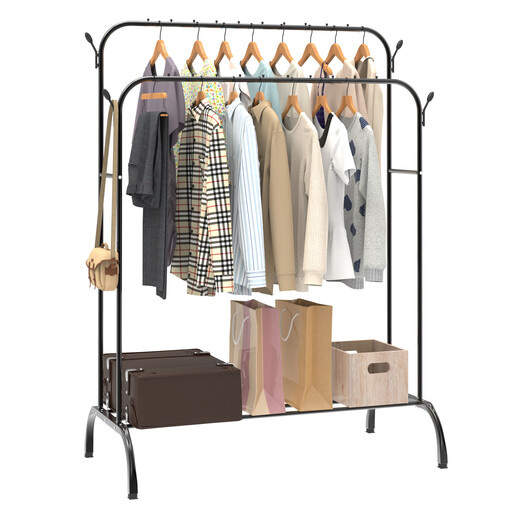
The product description lists two rails for hanging clothes; measure the clearance before hanging a long dress on it.
The description also mentions a storage shelf at the bottom and use in a bedroom or on a balcony.
 No image available
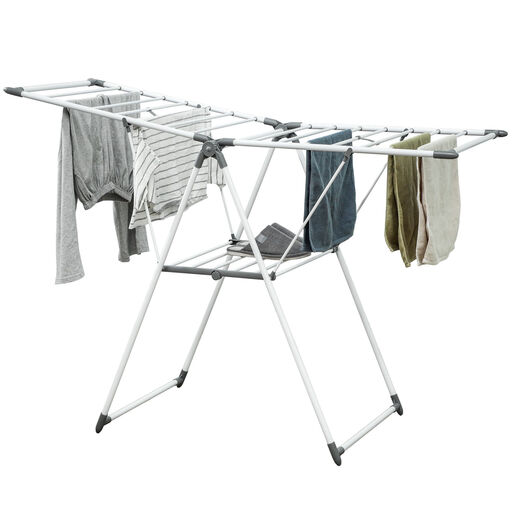
The description lists four height settings for the wings and open dimensions of 156,5 × 61,5 × 97 cm. Measure your intended space.
The drying rails can be adjusted to two levels. According to the product description, the airer should be kept away from heat sources and loaded evenly.
 No image available
According to the product name, this heated model has two side wings and measures 144 × 53 × 91 cm; check that it will fit in your space when open.
The product description calls for adequate ventilation, at least 31 cm of clearance from walls and an earthed socket. Also check the CE marking and rated AC voltage for this model. The NVWA requirement applies to electrical equipment covered by the Warenwetbesluit elektrisch materiaal; the stated voltage range is 50–1000 V rated AC voltage.
 No image available
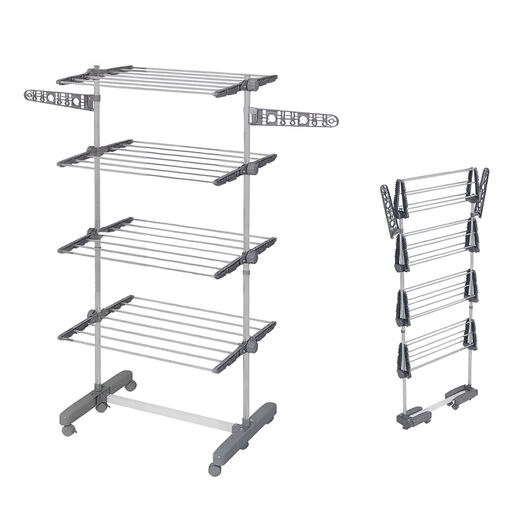
The product description mentions hanging space and options for hanging garments of different lengths; check that a long dress will hang freely.
According to the product name, the airer has wheels and four adjustable levels.
 No image available
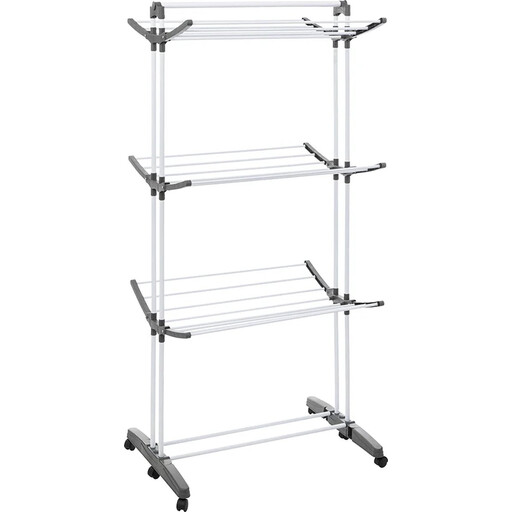
According to the product information, this freestanding airer offers 24 m of drying space and is designed for indoor use.
The stated dimensions are 125 × 62 × 172 cm. Check that the height and layout suit the way your dresses need to dry.
No, not necessarily. Follow the care label for the right drying method and check the airer’s instructions to see whether the dress can be laid or hung on warm rails.
Yes. Drying clothes indoors adds moisture to your home; Milieu Centraal recommends ventilating more when you dry laundry indoors. Heating the airer doesn’t remove the damp air.
For a simple estimate, multiply the wattage of the exact model in kW by the number of hours it’s switched on; this gives you kWh. Then multiply that by your own price per kWh. The result isn’t a measured drying time or a measurement of use for your dress.
If you’ve been using the airer normally, contact the seller if it doesn’t meet what you could reasonably expect. ACM ConsuWijzer states that if a product breaks sooner than expected, the seller must offer an appropriate solution, such as a repair, replacement or refund. This statutory right is separate from any commercial guarantee.
CE marking is required for electrical equipment covered by the Dutch Warenwetbesluit elektrisch materiaal. The NVWA states that, among other things, the applicable rated AC voltage must be between 50 and 1000 V. Check the electrical details and marking on the specific model.