
People with delicate dresses
You want to choose a drying method that follows the care label and avoid hanging a dress incorrectly or exposing it to unsuitable heat.


Start by checking the care label and ventilation in your utility room. If a dress can dry without extra heat and the space is suitable, an unheated airer may be all you need. Choose a heated winged airer or tower only if you value the extra warmth or smaller footprint, and check the available hanging space, energy use and instructions for both the dress and the appliance.
You want to choose a drying method that follows the care label and avoid hanging a dress incorrectly or exposing it to unsuitable heat.
You want to know whether the room can get rid of moist air; a heated airer is no substitute for ventilation.
You’re comparing a wide winged airer with a tower and also want to know whether there’s enough headroom for long dresses.
Milieu Centraal points out that drying laundry indoors adds moisture to the air, so check the ventilation before deciding whether extra heat would be useful.
| What to consider | What should you look for? | Who is this most relevant to? |
|---|---|---|
| Fabric and drying method | Read the care label and check whether the dress should be dried hanging or flat. Follow the appliance instructions too before using heated bars. | If I have a dress with specific drying instructions, I want to know which method is suitable and whether heat is allowed. Around 33% of consumers put fabric care first. |
| Removing moisture | Check how fresh air enters the utility room and how moist air can escape; heating doesn’t remove the need for ventilation. | In a utility room without clear air circulation, I want to stop moist air from lingering. Around 27% of consumers put moisture removal first. |
| Space for the dress and airer | Measure the floor space, height and room to move around. Compare these with the airer’s dimensions when open and the clearance beneath the place where the dress will hang. | With limited floor space, I want to hang my long dress without it touching the floor or a lower part of the airer. Around 20% of consumers put available space first. |
| Energy use | Compare the stated wattage and expected running time with your own electricity tariff. A kWh estimate based on wattage and hours is an approximation, not a measurement of a complete drying cycle. | If I only need extra heat when conditions call for it, I want to weigh the energy use against how I’ll use the airer. Around 20% of consumers put energy use and the value of extra heat first. |
Even when you use a heated airer, moisture from the laundry enters the indoor air. Without enough air circulation, it can linger in the utility room.
Check the supply of fresh air and the way moist air is removed before choosing an airer.
An airer with plenty of drying line doesn’t automatically provide enough room for a long dress to hang freely. A tower tier or the floor could get in the way.
Measure the dress and check the clearance where you plan to hang it.
A price or electricity-cost calculation from another market may not apply to the version you’re buying or your electricity tariff.
Compare the wattage of your chosen model and its expected running time with your own price per kWh.
The range described includes a heated winged airer with a cover and a heated drying tower with a cover.
The DD6003 electric airer is described as a folding winged model.
The brand describes heated airers and a drying pod; the pod is a different option for clothes that dry hanging up.
Minky describes, among other products, a folding heated winged airer with a cover.
A relevant unheated alternative, with airers and towers, including models described as having hanger hooks and space for longer garments.
These product options are designed for drying clothes indoors: a folding airer for clothes hangers and a heated winged airer.
 No image available
An option if the care label allows you to dry your dresses hanging up and you want to fold the airer away after use.
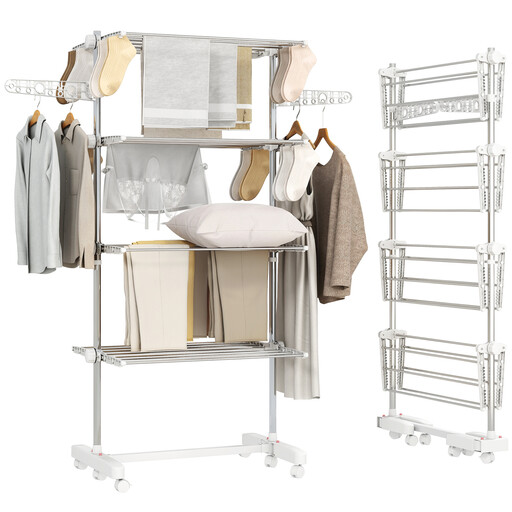
Four main shelves, two swivelling side arms and openings for clothes hangers; measures 172 × 142 × 55 cm when open and 172 × 80 × 13 cm when folded.
 No image available
A heated winged airer to consider if you want extra warmth and have room for it when fully open in your utility room.
Stated power rating: 230 W. Dimensions: 144 × 53 × 91 cm. Follow the care label and instruction manual; the instructions require adequate ventilation and a minimum distance of 31 cm from walls.
No. Don’t assume it’s suitable based on the style of the dress or the airer’s temperature setting. Check the fabric care label for drying instructions and follow the appliance instructions too.
Make sure fresh air can enter and moist air can escape. Milieu Centraal points out that drying laundry indoors adds moisture to the air; heating alone is no substitute for ventilation.
Multiply the stated power in kW by the number of hours of use to get an estimate in kWh. A 230 W airer running continuously at that power for four hours works out mathematically at 0,230 × 4 = 0,92 kWh; this isn’t a measurement of a complete drying cycle and doesn’t account for any thermostat or other controls.
Contact the seller about your statutory rights. ACM ConsuWijzer explains that, depending on the circumstances, the seller must repair or replace a faulty product, or refund you, free of charge; a manufacturer’s guarantee doesn’t limit these statutory rights.
Electrical appliances placed on the market in the Netherlands must meet the relevant European safety requirements. Ondernemersplein, a Dutch government service, refers to CE marking and an EU declaration of conformity; check the information for the specific model rather than assuming a general product listing confirms that documentation.